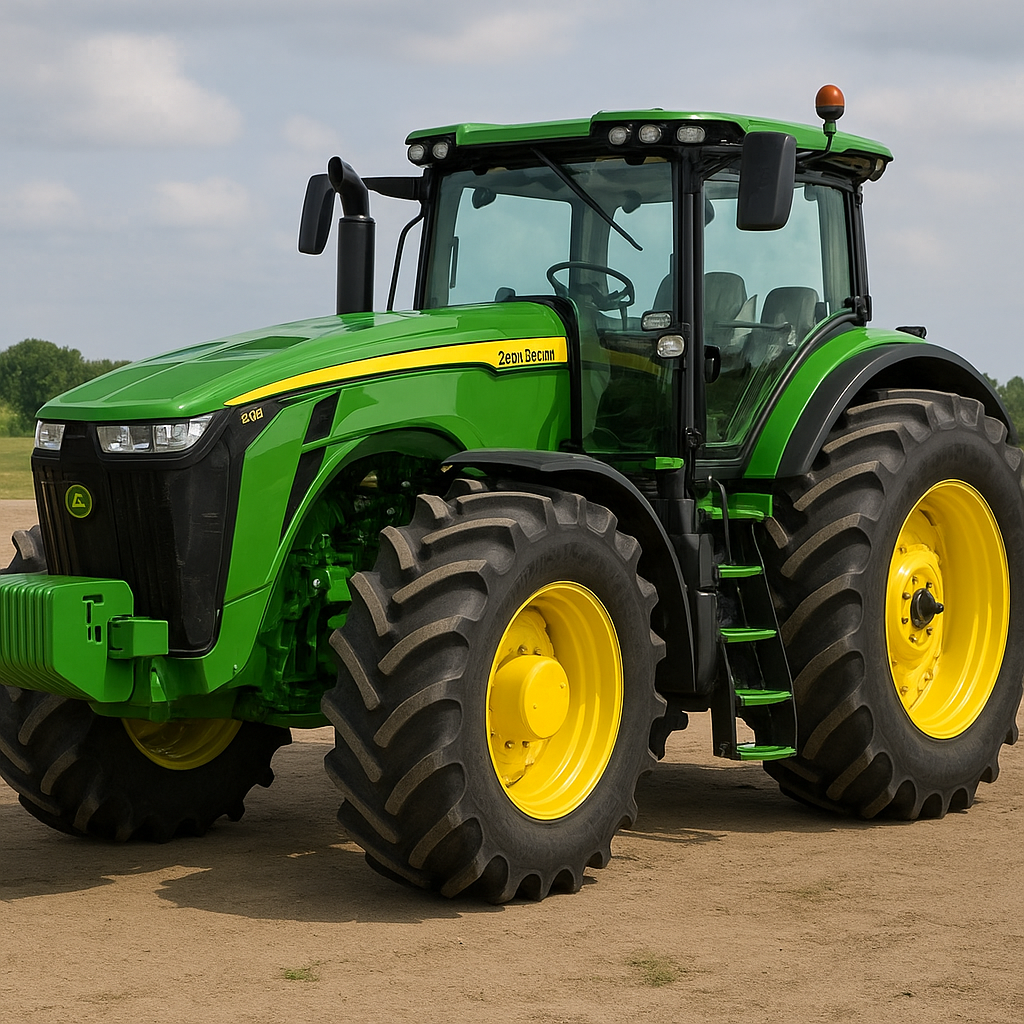
The John Deere 8R 330 is a member of the manufacturer’s high-horsepower row-crop and utility tractor lineup, designed to combine robust performance with advanced electronics and operator comfort. In this article you will find a detailed overview of the 8R 330’s design, typical applications, technological highlights, and practical considerations for owners and operators. Where possible, common performance figures and operational characteristics are provided, and comparisons to related configurations are included to help understand where this tractor best fits in modern agriculture and heavy-field operations.
Overview and general characteristics
The John Deere 8R 330 occupies a position in the brand’s eight-series range that balances strong drawbar and PTO capability with maneuverability and modern control systems. As indicated by its model designation, the tractor is centered around approximately 330 horsepower at the engine crank (rated), placing it in the upper-middle segment of large row-crop tractors used by mixed and large-scale arable farmers, contractors, and livestock operations needing high-capacity field performance.
Key attributes that make the 8R 330 attractive include a powerful, typically six-cylinder diesel engine, multiple transmission options (including John Deere’s variable-speed systems), a high-capacity hydraulic system, and a cab designed for long hours of comfortable operation. The machine is commonly offered in both wheeled and tracked or wider-track configurations (8RT variants in the series), expanding its suitability across different soil types and operational profiles.
Engine, performance and drivetrain
The heart of the 8R 330 is an engine engineered to deliver sustained torque and reliability under heavy loads. John Deere typically fits its 8R models with inline-six diesel engines optimized for agricultural duty cycles—strong low-end torque for draft work and responsive power across a wide rpm range for PTO and transport tasks. The engine is built to meet modern emissions regulations while offering fuel-efficient combustion and long service intervals.
Power delivery and management
- Rated horsepower: approximately 330 hp at the crank (model designation basis).
- Many configurations include integrated power management systems that provide temporary horsepower boosts under heavy load or transport situations.
- PTO options typically include standard 540/1000 rpm (mechanical or optional electronic engagement), enabling the tractor to run a wide variety of implements.
Transmission choices on the 8R platform are flexible to match operational needs. John Deere often provides both stepped and continuously variable transmission options on this size class. The IVT (Infinitely Variable Transmission) delivers smooth, stepless acceleration and precise ground speed control, which is particularly advantageous for tasks like seeding, high-speed tillage, or variable-rate applications. PowerShift or e23-type transmissions offer quick gear changes and predictable performance for heavy draft operations.
Hydraulics, three-point hitch and implement integration
The 8R 330 is designed to handle large implements and to integrate deeply with modern implement electronics. The hydraulic system supplies sufficient flow and pressure to meet demanding tasks like hydraulic folding of wide cultivators, autosteer actuators on seeders, front loaders, and for powering hydraulically actuated planters or sprayers.
- Hydraulic flow: high-flow options are typically available to support multiple remote valves and electronic control units for smart implements.
- Rear three-point hitch: rated for heavy implements with electronic control and position/draft sensing to maximize traction and implement performance.
- Rear PTO: standard speeds and high torque capacity allow the 8R 330 to drive large balers, mowers, and mixers.
These features make the 8R 330 well-suited for paired implement operations (e.g., primary tillage followed by secondary tillage), heavy seeding units, large planters, and high-capacity slurry or manure spreaders. The tractor’s lift capacity and stable hydraulic outputs are important for minimizing downtime and improving field efficiency.
Cab, controls and operator comfort
Modern agriculture demands long operational hours, and the John Deere cab on the 8R series addresses that with a focus on ergonomics, visibility, and noise reduction. The cab usually includes a comfortable air-suspended seat, climate control, and a layout that consolidates frequently used controls near the operator for reduced fatigue.
- Display and controls: integrated touchscreen displays provide access to machine settings, guidance, telematics, and implement controls.
- Visibility: large windows and optimized lighting packages help with night work and precise implement placement.
- Noise-, vibration-, and harshness (NVH) reduction features improve comfort during extended shifts.
Advanced operator aids—such as automated steering controller mounts, implement memory settings, and multi-functional joysticks—help improve repeatability and speed up setup between tasks. This contributes directly to higher daily throughput and reduced operator stress.
Precision agriculture and connectivity
One of the most notable strengths of the 8R 330 as a modern tractor is the depth of precision agriculture integration. John Deere equips the platform with options for satellite guidance, variable-rate control, implement mapping, and wireless data transfer.
- AutoTrac and guidance systems allow sub-meter to centimeter-level repeatability when paired with high-accuracy receivers.
- JDLink telematics enable remote monitoring of machine health, GPS-based field tracking, and fleet-level management.
- ISOBUS compatibility and Deere’s integrated displays reduce compatibility friction between tractors and implements from different vendors.
These technologies are aimed at improving efficiency: reducing overlaps and misses in the field, optimizing input use (seed, fertilizer, pesticides), and producing detailed records for traceability and compliance. For larger farms and contractors, the ability to centrally manage fleets and download operational data can have a measurable effect on fuel and input costs over a season.
Typical applications and operational roles
The 8R 330 is a versatile workhorse that finds use across many agricultural and contract applications. Typical roles include:
- Primary and secondary tillage with large plows, discs and cultivators.
- High-capacity planting and seeding with multi-row planters and air seeders.
- Large-scale spraying and fertilizing when equipped with sprayer trailed or mounted units.
- Baling, forage harvesting and feed preparation when paired with heavy PTO implements.
- Transport of heavy loads and agricultural logistics thanks to strong drawbar power.
- Specialist applications such as sub-soiling, deep ripping and soil reclamation.
For contractors who operate across different jobs, the 8R 330’s adaptability—through hitch settings, hydraulic flows, and transmission choices—helps minimize downtime between jobs and allows a single tractor to handle multiple seasonal tasks efficiently.
Fuel efficiency, operational economics and maintenance
Operational cost is a central consideration when evaluating a tractor in this power class. While absolute fuel consumption varies with implement load, soil type and operator technique, tractors like the 8R 330 are engineered for improved fuel efficiency by combining modern combustion technology, optimized drivetrain options, and power-management systems.
- Fuel consumption is mission-dependent; proper match of implement size to tractor power is essential for good economy.
- Preventive maintenance schedules recommended by the manufacturer typically include oil and filter changes, fuel system checks, and cooling system servicing at set intervals to retain performance and resale value.
- Access to dealer service networks and availability of parts influence total cost of ownership—John Deere’s global parts network is a practical advantage in many markets.
From an economic viewpoint, the primary levers to manage operating cost are: matching horsepower to task (avoid over- or under-powered pairings), maintaining proper tire/track pressures and settings to minimize soil resistance, using guidance systems to reduce passes, and adhering to scheduled maintenance.
Safety and regulatory considerations
Safety systems and regulatory compliance are built into modern tractors. Standard features you can expect include roll-over protection integrated into the cab, lighting packages for road travel, and emission control systems that conform to regional standards. Operators should follow recommended practices for hitching, weight distribution, and implement coupling to maintain stability on slopes and during transport.
Comparisons and configurations
Within the 8R lineup and across competitors, the 8R 330 is positioned as a high-capability, multi-role tractor. Compared to smaller 7-series or low-end 8-series units, it offers more horsepower, higher lift capacity and expanded hydraulic options. Versus larger 8R or 9R models, it offers a compromise of lower purchase cost, easier maneuverability and better fuel economy for many tasks.
Common configuration choices that change the machine’s operation include:
- Wheel vs. track (or wide single vs. duals) for traction and soil compaction management.
- Transmission selection (IVT for variable speed control vs. stepped for simplicity under heavy draft).
- Hydraulic and auxiliary valve packages based on implement needs.
- Guidance and precision packages for different levels of autonomy and data capture.
Real-world performance and operator feedback
Farmers and contractors often praise tractors in this class for their combination of power and technology. Commonly reported benefits include better field finish at higher speeds, reduced operator fatigue due to advanced cabs and steering systems, and measurable input savings when guidance systems are correctly used.
Some operators note that the initial complexity of electronics and software requires an investment in training and dealer support. However, once operators become familiar with the systems, the productivity gains and data-driven decisions typically justify the learning curve.
Resale, ownership lifecycle and market considerations
The resale value of a high-spec tractor like the 8R 330 depends on hours, service history, regional demand and attached technology packages. Tractors with up-to-date telematics, full maintenance records and precision ag fittings commonly retain value better because they are easier to re-deploy in commercial operations.
Ownership strategies often balance the capital cost of new equipment against financing options, tax incentives, and the operational gains from higher productivity and reduced labor. For many operations, a modern 8R 330 can be part of a plan to reduce per-hectare costs by enabling larger implements and fewer field passes.
Notable technological highlights
- Integrated guidance and mapping to reduce overlap and improve application accuracy.
- Telematics for remote monitoring and fleet management.
- Variable transmission options that optimize fuel use and traction control.
- Advanced hydraulics to operate modern, electrically controlled implements.
Environmental and sustainability aspects
Modern tractors, including the 8R 330, are part of a broader trend toward improving on-farm sustainability. Fuel efficiency gains, precision application of inputs, and the ability to use conservation tillage systems all contribute to lower emissions per unit of production. Additionally, soil compaction management through track or wide-axle choices helps preserve soil health and water infiltration rates.
Summary and who should consider the 8R 330
The John Deere 8R 330 is targeted at farmers and contractors who need reliable, high-capacity performance with modern precision farming capability. It is especially well-suited to:
- Large arable farms running wide planters and high-speed cultivators.
- Contractors who need a flexible tractor able to perform diverse tasks across seasons.
- Livestock farms requiring strong PTO and hydraulic performance for feed systems and manure handling.
- Operations that plan to leverage telematics and guidance systems to improve efficiency and traceability.
Considering its feature set, the 8R 330 can be an excellent investment where operational scale and technological integration justify the initial cost. When configured appropriately—matching transmission, tire/track choice, hydraulic options and guidance packages to the intended tasks—it offers a balance of power, efficiency and modern control that fits many modern agricultural businesses.
Final considerations
When evaluating an 8R 330 for purchase or lease, prospective buyers should review the following practical items with their dealer: warranty and service plans, available precision packages and software subscriptions, recommended implement matches, and regional support for parts and telematics. A test operation in relevant field conditions (soil type, typical implements, desired working speeds) is highly recommended to confirm the match between tractor configuration and farm needs.
John Deere’s 8R family, including the 8R 330, marries legacy agricultural engineering with contemporary digital tools and operator comforts—making it a capable choice for demanding fieldwork and precision-driven modern farming.