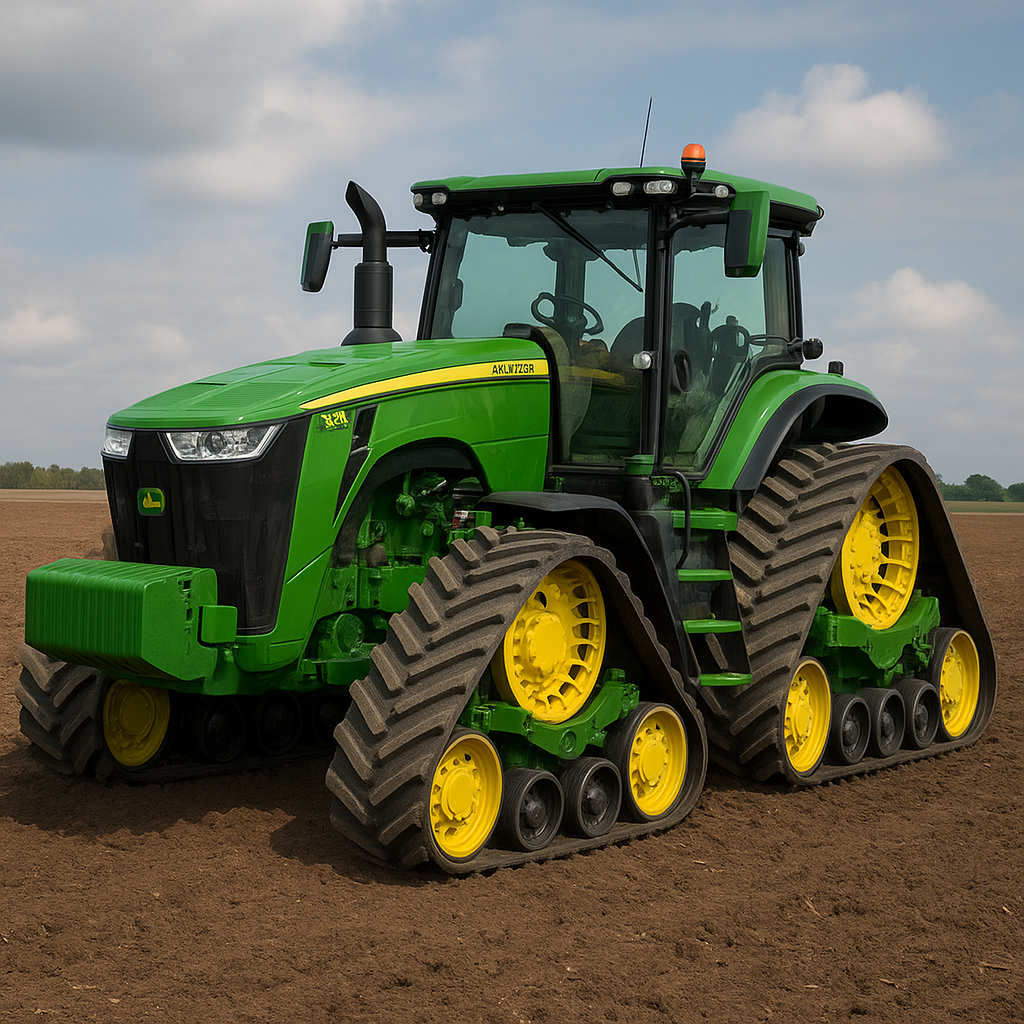
The John Deere 8RX 310 is a high‑performance, four‑track agricultural tractor designed for large-scale farming operations that demand exceptional traction, reduced soil compaction and modern precision features. In this article you will find a detailed description of the machine, its typical applications, technical and operational advantages, maintenance considerations and broader economic and agronomic impacts. The information emphasizes practical uses and real‑world benefits while noting typical specifications and configuration options associated with this model family.
Overview and key design features
The 8RX series from John Deere introduced a new level of flexibility to the company’s 8R platform by replacing the traditional dual large rubber tires with four independent rubber tracks. The model designation 8RX 310 indicates a tractor positioned around the 310‑horsepower class, optimized for heavy drafting, seeding large implements, and pulling high‑capacity planters and tillage equipment.
Core design elements
- Four independent tracks — Each corner of the tractor is fitted with a rubber track assembly designed to spread weight more evenly over a larger contact area compared to dual wheels.
- Power and driveline — The 8RX series pairs John Deere diesel engines with robust transmissions; options commonly include advanced step‑shift or continuously variable transmissions (IVT) depending on the market and customer preference.
- Advanced hydraulics and PTO — Sufficient flow and power to operate large planters, seeders and sprayers, with rear PTO options to suit a wide range of implements.
- Modern cab and electronics — Integrated guidance, telemetry and precision‑farming systems such as AutoTrac, JDLink and ISOBUS compatibility to optimize field operations.
The 8RX concept is focused on improving field productivity through increased traction, reduced slippage, and better flotation compared with wheeled tractors of similar power. This makes it especially suited to regions and operations where soil structure and timing of fieldwork are critical.
Applications and field performance
The John Deere 8RX 310 finds use across a wide variety of large‑scale agricultural tasks. Its combination of power and low ground pressure makes it particularly valuable where heavy implements must be pulled across sensitive soils or when operations are constrained by narrow weather windows.
Typical applications
- Primary tillage and soil cultivation with wide ploughs and cultivators.
- High‑capacity seeding and planting operations, including large air drills and rigid planters.
- Spraying and fertiliser application where stability and traction at higher speeds improve efficiency.
- Hauling heavy trailers and grain carts during peak harvest periods.
- Operations on wet or fragile soils where reduced compaction helps preserve structure and drainage.
Because the tracks distribute the tractor’s weight over a larger surface, the soil compaction per pass is generally lower. Lower compaction helps maintain soil porosity and root development, which can translate into more consistent crop emergence and yield stability under challenging conditions.
Field advantages
- Traction: Tracks significantly reduce slip compared with tires in many field conditions. Reduced slippage means more of the engine’s energy converts to useful draft and less wasted fuel.
- Flotation: The larger footprint improves flotation on wet soils, allowing operations to proceed later into wet spring windows or after rain events.
- Stability on slopes: the wide track base provides enhanced lateral stability when operating on slopes or uneven terrain.
- Smoother ride: independent track modules with suspension options can offer improved operator comfort and implement control at speed.
Technical specifications and typical statistics
Model names like 8RX 310 reflect the tractor’s approximate power class. Below are the types of specifications and typical ranges a buyer can expect; actual figures vary by market, selected options and year of manufacture.
- Rated engine power: around 310 hp (ISO). Peak or “boost” power may be higher under certain operating points depending on the engine calibration.
- Transmission options: advanced step‑shift (e.g., e23 or similar) or infinitely variable transmission (IVT) for smooth power delivery and fuel‑efficient operation.
- Track width options: commonly available from approximately 24 to 36 inches per track (about 610–914 mm) in many markets; wider tracks increase flotation and reduce ground pressure.
- Operating weight: typically in the range of about 12,000 to 16,000 kg depending on configuration, ballast and installed options.
- Fuel capacity: usually sized to support long field days; many tractors in this class carry several hundred litres (typical mid‑range capacities fall between 400 and 600 litres depending on configuration).
- Top road speed: commonly up to 40 km/h (varies with gearing and regional regulations).
- PTO: rear PTO options normally include standard agricultural speeds such as 540/1000 rpm.
- Hydraulic flow: high‑capacity hydraulic systems to support multiple remote valves and high‑flow implements.
These numbers illustrate why the 8RX 310 is considered a medium‑high power machine for large farms. The focus is not only raw horsepower but the integration of powertrain, track system and electronics to deliver consistent field results.
Track systems, undercarriage and soil health considerations
The defining feature of the 8RX line is its track system. Unlike traditional tracked tractors with a single continuous belt, the 8RX uses four independent rubber tracks with modular undercarriage units. This design offers several technical and agronomic benefits as well as some specific maintenance concerns.
Benefits for soil health
- Reduced ground pressure: By increasing the contact area, ground pressure falls, reducing the depth and severity of compaction layers.
- Improved infiltration and root growth: less compaction preserves pore space for water and roots, often leading to better plant establishment in subsequent seasons.
- Timing flexibility: farmers can operate in conditions that would otherwise cause excessive wheel rutting, enabling more timely fieldwork and potentially increasing operational windows.
Maintenance and operational considerations
- Track wear: rubber tracks and undercarriage components wear over time and will require replacement more frequently than steel tracks; operating on abrasive surfaces accelerates wear.
- Track tension and alignment: proper tensioning is essential to avoid premature wear and maintain performance; manufacturers provide recommended service intervals.
- Transportation: tracked machines require attention to road travel speed, potential for track damage on hard surfaces, and legal transport considerations in some regions.
- Replacement cost: rubber tracks and undercarriage assemblies are a significant maintenance expense; total cost of ownership calculations should include projected replacement cycles.
When managed correctly, the net agronomic and operational benefits of lower soil compaction and better traction can outweigh the elevated component costs—especially on large farms where each hour of operation has high economic value.
Operator comfort, electronics and precision farming capabilities
John Deere integrates a range of operator‑focused features and digital services into the 8RX line that enhance productivity and reduce operator fatigue. The cab and electronic systems enable more precise, repeatable field work.
Cab and controls
- Ergonomic controls and air‑suspended seats reduce fatigue during long shifts.
- High visibility and climate control support a comfortable working environment under varied conditions.
- Selectable work modes and transmission mappings allow operators to tune machine behavior for specific tasks.
Precision agriculture and connectivity
- AutoTrac (GPS guidance) and implement guidance reduce overlap and ensure consistent coverage.
- Section Control and variable rate application capabilities improve input efficiency and lower costs.
- JDLink and telematics systems provide remote monitoring, diagnostics and fleet management tools.
- ISOBUS compatibility allows plug‑and‑play control of many modern implements from the tractor’s display.
These technologies collectively contribute to better input management, higher accuracy when planting and spraying, and simplified recordkeeping—important on farms that rely on economies of scale and data‑driven decision making.
Economic considerations and total cost of ownership
Purchasing a tractor like the 8RX 310 is a major capital investment. Buyers must weigh acquisition cost against productivity gains, reduced input waste and longer field windows. Key economic factors include purchase price, fuel and maintenance costs, implement compatibility and resale value.
Factors influencing economics
- Upfront cost: four‑track machines generally command a premium over comparable wheeled tractors due to complex undercarriages and track assemblies.
- Fuel savings: enhanced traction and reduced slippage often produce fuel savings per hectare, especially in draft‑intensive tasks.
- Yield impact: by reducing compaction, tracked tractors can help maintain yields over time—particularly in fields prone to compaction.
- Maintenance schedule and parts: track replacement and undercarriage services must be budgeted; however, proper maintenance extends component life.
- Utilization rate: high annual use lowers the per‑hour capital cost; the 8RX 310 is best suited to operations that run large acreages or require powerful tractors for many hours a season.
In many commercial farms, the decision to invest in tracked tractors hinges on time sensitivity of fieldwork, soil type, and long‑term capital planning. When a machine enables earlier planting, faster seeding or reduced pass frequency, the return on investment can be compelling.
Comparisons, limitations and buying advice
Comparing the 8RX 310 to wheeled 8R counterparts or to other tracked alternatives involves trade‑offs:
- Compared with wheeled tractors of similar horsepower, the 8RX often excels in low‑traction and wet conditions but can be costlier to service and to maintain in terms of undercarriage parts.
- Compared with full steel‑tracked machines, rubber tracks are kinder to fields and roads but may wear faster under abrasive use.
- Implement and hitch compatibility: most modern implements can be matched to the 8RX, but careful attention to hitch heights, drawbar clearances and hydraulic flow is necessary.
Buying advice for prospective owners:
- Match the machine to the operation’s typical soil type and annual utilization—tracks bring the most benefit when soil compaction is a recurring problem or when large implements are used frequently.
- Consider long‑term parts and service plans that include undercarriage components to better forecast lifecycle costs.
- Test drive with the implements you use most: traction and draft behaviour with a loaded planter or cultivator reveal how the tractor will perform in daily use.
- Work with a dealer to spec tractors with the right track width, ballast and transmission for your fields and implements.
Real‑world experience and operational tips
Operators who work with 8RX tractors commonly report advantages in terms of decreased wheel slip, improved comfort at field speeds and the ability to continue operations in marginal conditions. Useful operational tips include:
- Monitor and maintain proper track tension to extend the life of the tracks and reduce fuel‑sapping slippage.
- Avoid prolonged travel on abrasive surfaces like gravel roads when possible; it accelerates track wear.
- Sow and finish fieldwork in ways that minimize turning stress on tracks—tight turns under load increase wear.
- Schedule regular inspections of drive sprockets, idlers and rollers; early detection of wear prevents more expensive damage.
- Use telematics and diagnostic tools to monitor fuel use, engine load and implement drawbar pull for continuous optimization.
Summary
The John Deere 8RX 310 is a purpose‑built, high‑performance agricultural tractor for operations that need the combined benefits of high horsepower, low ground pressure and modern precision farming systems. With its four‑track configuration, it delivers superior traction and flotation in many field conditions, contributing to reduced soil compaction and more reliable field access. Buyers should weigh the higher initial cost and undercarriage maintenance against potential gains in productivity, fuel efficiency and agronomic benefits. For large farms running heavy implements or working in soils where compaction and timing are critical, the 8RX 310 represents a compelling, technologically advanced option within John Deere’s lineup.