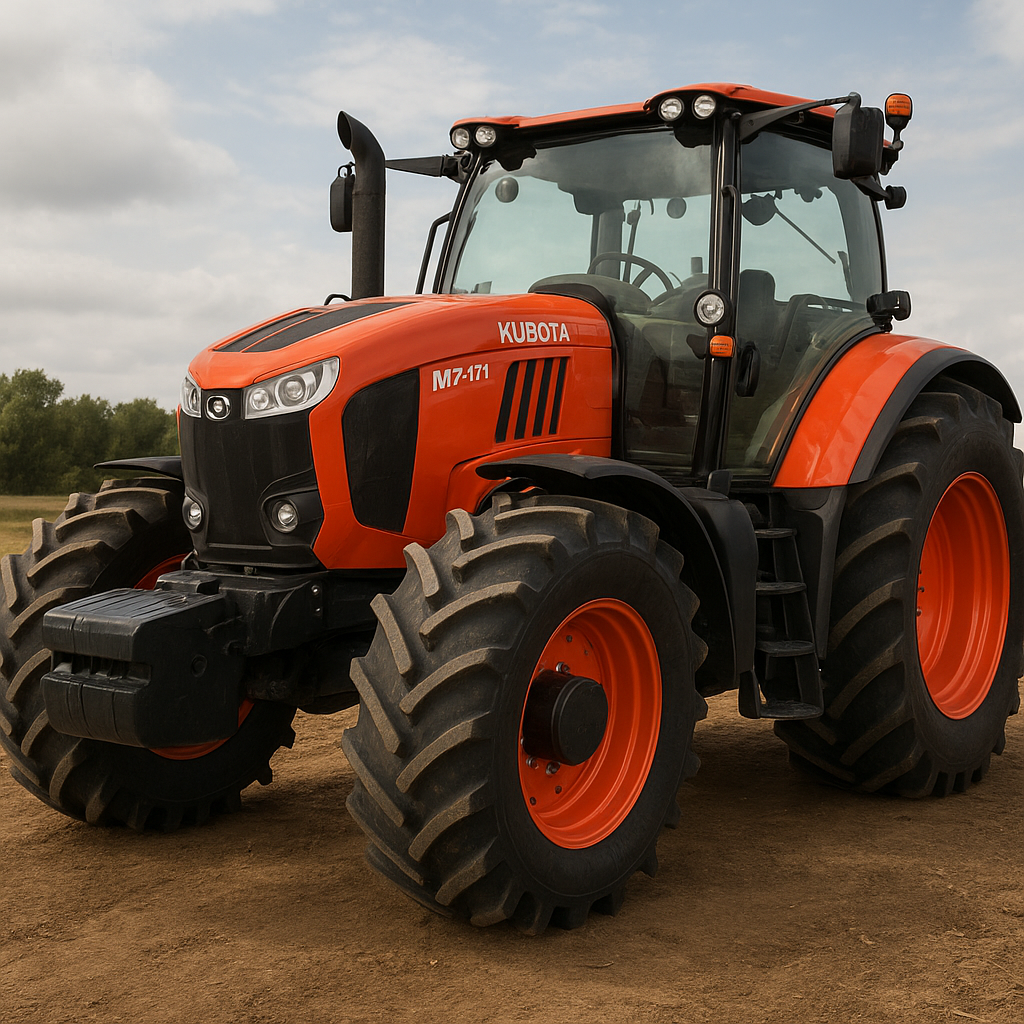
The Kubota M7-171 is a modern, high-capacity agricultural tractor designed to serve a wide range of professional farming and contracting tasks. Combining robust mechanical design and contemporary electronics, the M7-171 aims to deliver consistent performance in fieldwork, transport and front-loader operations. This article explores the machine in depth — from technical characteristics and typical applications to maintenance, operator comfort and market positioning. Along the way you will find practical figures and approximate statistics to help evaluate whether the M7-171 fits specific operational needs. Key concepts such as Kubota, M7-171, engine, horsepower and transmission will be emphasized for quick orientation.
Overview and design philosophy
The Kubota M7 series was developed to bridge the gap between medium- and large-frame tractors, offering power and versatility for mixed farms, contractors and municipal fleets. The M7-171 is positioned near the top of the range in terms of rated power, targeting operations that require sustained drawbar and PTO performance without moving into the largest, most heavy-duty tractor classes. Conceptually, the machine focuses on combining durable mechanical systems with operator-focused ergonomics and modern emissions controls to meet contemporary regulatory standards in major markets.
Technical specifications and key figures
The following figures represent typical specifications for the M7-171; some values may vary by market, option package and model year. Always check the official Kubota specification sheet for the exact configuration you are evaluating.
Core powertrain data
- Engine type: turbocharged, intercooled inline six-cylinder diesel (Kubota-built or OEM-sourced, depending on market).
- Displacement: approximately 6.1 liters (typical for six-cylinder engines in this class).
- Rated horsepower: around 171 hp (model designation reflects approximate rated power).
- Maximum power (engine overboost): typically a few percent above rated power under transient conditions.
- PTO types and speeds: rear PTO with 540/1000 rpm options; ground speed PTO and mid-PTO options may be available depending on configuration.
Transmission and drivetrain
- Transmission options: Kubota often offers both a multi-range powershift and a continuously variable transmission (CVT/KVT) in the M7 range. The KVT (Kubota Variable Transmission) provides seamless acceleration and fine speed control for loader and precision transport tasks.
- Number of gears: depends on transmission choice — powershift units typically offer multiple ranges and several powershift steps, while KVT provides stepless speed variation.
- Four-wheel drive with differential lock options and limited-slip differentials for traction control in challenging conditions.
Hydraulics, lifting and PTO
- Hydraulic system: closed-centre load-sensing systems are often available as an option; pump flow rates on higher-spec M7s typically range from around 110 to 170 L/min depending on installed pumps and options.
- Rear linkage lift capacity: commonly in the range of 7,000–10,000 kg at the lift arms, making the tractor suitable for heavy-mounted implements.
- Hydraulics and control: multiple remote spool valves, electronic controls and optional joystick control for loader operations.
- PTO output: substantial torque for heavy implements; standard PTO speeds and robust driveline design for reliability.
Dimensions, weight and fuel
- Operating weight: typically in the 6,000–7,500 kg range depending on options (cab, ballast, front linkage or loader).
- Fuel tank capacity: usually between 250 and 350 liters, enabling long operating intervals between refueling for long field days.
- Tyre and track options: multiple tyre sizes for different agricultural tasks and soil compaction constraints; front and rear ballast options available.
Note: Specific numeric values are approximate and vary by year and specification. Confirm with an authorized dealer for exact published figures for the model and options you intend to purchase.
Applications and versatility
The M7-171 is built for versatility. Its combination of power, hydraulic capacity and linkage strength makes it appropriate for a wide spectrum of tasks across diversified farming and professional contracting sectors.
Typical applications
- Arable farming: ploughing, seedbed preparation, seeding, cultivation and large-capacity tillage implements.
- Row-crop and mixed farms: power for large mowers, balers, rakes and forage harvest support.
- Loader and material handling: strong front-loader capability for silage, feed, manure handling and pallet operations.
- Transport and logistics: stable PTO and drivetrain for trailed sprayers, spreaders and heavy tipping trailers.
- Contracting and municipal services: snow clearing, road maintenance and tow tasks with appropriate attachments.
Because of its high lift capacity and optional hydraulic flow rates, the M7-171 is particularly suitable where large mounted implements are used or when multiple hydraulic functions are required simultaneously (e.g., front-loader plus rear-mounted implements).
Performance, fuel economy and emissions
Modern tractors are judged not only by raw power but also by how efficiently they convert fuel into useful work and by their environmental footprint. The M7-171 incorporates several design features aimed at optimizing both.
Fuel consumption and operating economy
Actual fuel consumption depends heavily on task, load level and operator technique. Typical ranges for tractors in the 160–180 hp class are:
- Light transport or idle: 8–12 L/h
- Medium field work: 12–18 L/h
- Heavy draft or sustained high-load work: 18–25+ L/h
Fuel-efficient engine tuning, torque curves optimized for fieldwork, and optional transmissions like KVT help minimize excessive fuel use by keeping the engine at ideal RPM for the load.
Emissions control
The M7-171 is configured to meet current emissions regulations in most markets. That generally means compliance with emissions stages such as EU Stage V or EPA Tier 4 Final depending on region. Typical aftertreatment includes selective catalytic reduction (SCR), diesel oxidation catalyst (DOC) and a diesel particulate filter (DPF). Such systems reduce particulate matter and NOx while preserving torque and fuel efficiency through electronic control strategies.
Comfort and operator-focused systems
Long hours in the tractor require attention to operator comfort and convenience. Kubota designs the M7-171 cab and controls with that in mind.
Cab ergonomics and visibility
- Spacious, sound-insulated cab offering 360-degree visibility and large glazed surfaces for safe loader work and field monitoring.
- Ergonomically arranged controls with clear instrument cluster, optional touchscreen displays and programmable shortcuts for common operations.
- Climate control (heating and air conditioning) with good airflow and filtration for operator comfort across seasons.
The cab is often available with suspended seats, adjustable armrest consoles and adjustable steering column to reduce fatigue during long operating days. The cabin and controls are designed to be intuitive so operators can focus on task efficiency rather than searching for switches.
Maintenance, serviceability and reliability
Ease of maintenance and long-term reliability are critical for commercial users. The M7-171 was designed to simplify daily checks and routine maintenance while offering durable components to reduce downtime.
Service features
- Accessible service points: grouped filters and service checks, easy-to-open engine hood and service panels.
- Long service intervals for major items such as engine oil and hydraulic oil on many configurations, subject to operating conditions and manufacturer recommendations.
- Robust driveline components and well-engineered linkages designed for heavy duty cycles often expected of contracting operations.
In addition to mechanical reliability, software-driven diagnostics simplify troubleshooting — many dealers can read fault codes and update control software quickly, minimizing downtime.
Attachments, implements and options
The M7-171 can be equipped with a broad range of implements to maximize utility across the farming season. Below are commonly paired attachments and options:
- Front-loader packages with high-capacity buckets, pallet forks and hydraulic quick couplers.
- Large rotary and drum mowers, disc mowers and conditioner units for forage cutting.
- Large balers and bale handlers, both round and square formats.
- Mounted and trailed seed drills, planters and precision seeding equipment.
- Trailed spreaders, sprayers and slurry units for nutrient management.
- Snowploughs, salt spreaders and municipal front implements for civic contracts.
Market positioning and comparative landscape
The M7-171 competes against mid- to upper-range tractors from European and North American manufacturers. Buyers typically consider machines from John Deere (6/7 series), New Holland (T7), Case IH (Puma), Massey Ferguson and others when evaluating in this horsepower band.
Kubota’s strengths in this segment include strong dealer networks in many regions, known build quality, integrated engine and implement solutions, and a focus on operator ergonomics. Where Kubota differentiates is often price-to-feature balance, optional advanced transmissions like KVT and integrated precision agriculture electronics that are increasingly standard across the field.
Operational statistics and practical numbers
While global production volumes for a specific Kubota model like the M7-171 are not typically published at a model-specific level, several practical operational statistics are useful for budgeting and planning:
- Estimated cost of ownership: depends on fuel costs, maintenance schedules and utilization; many operators measure ownership cost per engine-hour. For tractors in this class, a rough planning figure for fixed costs plus maintenance could range widely — consult local dealer cost calculators.
- Typical daily fuel consumption: 12–20 L/h under normal mixed-duty cycles (see earlier section for ranges).
- Typical useful working window: with a 300 L tank at 15 L/h average, the machine can operate for roughly 18–20 hours before refueling (practical time will be lower due to transport, idle and field conditions).
- Lift capacity and hydraulic flow: mid- to high-range hydraulics make the tractor suitable for implements that require simultaneous multi-valve operations.
These practical numbers help managers size fleets and predict refueling logistics for long harvest or contracting days.
Which operations benefit most from the M7-171?
Operations that will benefit most include mixed arable farms with large implements, contractors who require a single versatile tractor for loader, transport and fieldwork, and farms that need above-average lifting capacity while retaining maneuverability for headlands and transport. The M7-171 is less targeted at very large-scale, continuous heavy deep-plough operations where machines in higher power bands might be more economical; however, it is an excellent fit where versatility, comfort and modern emissions compliance are priorities.
Final remarks
The Kubota M7-171 is a capable and well-rounded tractor for professional farming and contracting. With a focus on balanced power, operator comfort and modern emissions solutions, it offers a compelling package for users who need a reliable workhorse across diverse tasks. When evaluating this model, pay attention to the exact transmission and hydraulic options, as they materially affect productivity and fuel consumption. For definitive technical data and operational figures tailored to your region, consult an authorized Kubota dealer who can provide up-to-date specification sheets and localized service information.