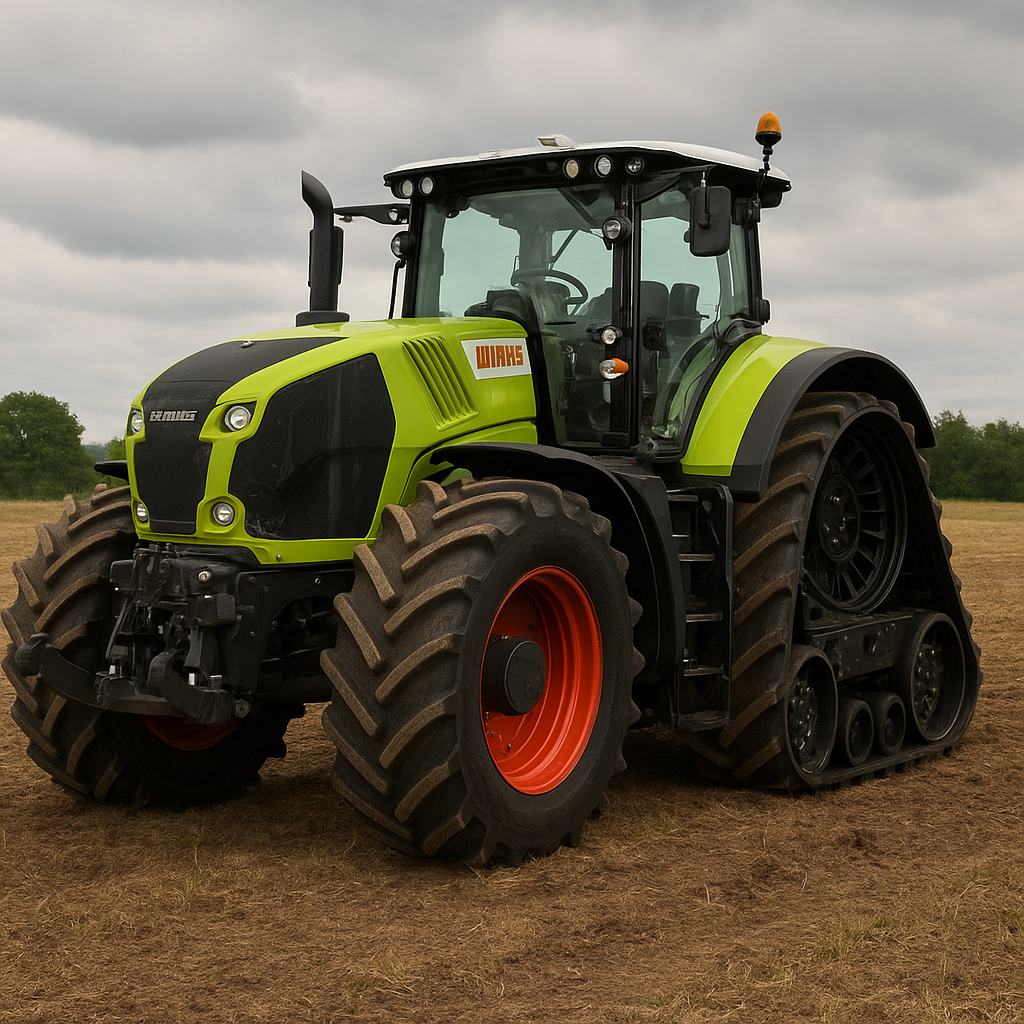
The Claas Axion 930 Terra Trac represents a blend of heavy-duty agricultural capability and modern engineering aimed at maximizing field efficiency while minimizing soil compaction. Designed for large-scale arable farming, contractors and demanding livestock operations, this tractor combines a high-output powertrain with Claas’s Terra Trac undercarriage option to deliver improved traction, flotation and operator comfort on a wide range of soils and conditions. Below are a detailed look at its design, technical features, practical applications and relevant operational data.
Overview and key features
The Claas Axion 930 is positioned near the top of the Axion family and is intended for tasks that require sustained power and robust drawbar performance. With the Terra Trac option, the usual rear wheels are replaced by continuous rubber track units, dramatically changing how the machine interacts with the ground. This variant aims to provide better performance in wet or soft soils, reduced soil damage and increased pull-through for large implements.
- Terra Trac undercarriage: continuous rubber tracks with articulated suspension and drive units.
- High-output diesel engine with modern emissions control to meet current standards (SCR, EGR and particulate filtration on applicable engines).
- Advanced transmission options (including CVT-style solutions) that offer smooth, efficient power delivery across a wide speed range.
- ISOBUS-compatible electronics for implement control and precision farming integration.
- Comfort-focused cab design with ergonomic controls and good visibility for long working days.
The Axion 930 Terra Trac is intended to be a versatile workhorse; it bridges the gap between wheeled tractors that excel on firm ground and full tracked machines designed solely for extreme flotation. It is especially valued where operators need both high drawbar performance and the ability to work in less-than-ideal conditions without excessive soil disturbance.
Terra Trac system: design and benefits
The core selling point of the Terra Trac variant is its undercarriage. Instead of conventional dual or single rear wheels, each side uses a rubber track module that spreads the machine’s mass over a much larger surface area. This has several direct implications for field performance and agronomy:
- Reduced ground pressure — Tracks increase contact area and lower soil pressure, lowering compaction risks and preserving soil structure.
- Improved traction — The continuous contact and higher traction coefficient reduce wheel slip under heavy load, increasing effective drawbar pull.
- Better flotation and passability — The tractor is less likely to bog on wet or soft ground, allowing operations to continue where wheeled tractors might be forced to stop.
- Smoother ride and stability — The track modules often incorporate suspension elements that improve ride quality and reduce peak loads on both the machine and the soil.
- Lower rolling resistance in many conditions — Despite intuitive thinking, the spread of load can reduce the energy lost to sinkage and rolling, improving field efficiency.
The Terra Trac system is not a universal replacement for wheels; it has trade-offs. On hard surfaces and long road transfers, tracks can be noisier and wear faster than tires, and fuel consumption patterns can differ. However, in the contexts where soil protection and traction are priorities—such as seedbed preparation, heavy tillage, and large-scale sowing—the Terra Trac system has clear agronomic advantages.
Engine, transmission and drivetrain
Claas equips the Axion 930 with a high-displacement, turbocharged diesel engine designed for continuous high-load operation, meeting emissions regulations through selective catalytic reduction and particulate filtration where required. The engine is tuned to deliver a broad torque curve, which helps maintain implements at working speed even during demanding field tasks.
- Engine layout: inline six-cylinder unit, turbocharged and intercooled.
- Horsepower class: typically in the region of the 300–350 hp (ISO) class depending on tune and option packages; marketed as a high-power model within the Axion line.
- PTO options: standard rear PTO (540/1000 rpm) and optional speed variants for different implement types; power take-off ratings provide sufficient power for large rotary tillage, mowers and balers.
- Transmission: available with advanced CVT-style or stepless transmissions (Claas CMATIC on applicable models) providing seamless acceleration and efficient power transfer, with road speeds up to approximately 40–50 km/h depending on configuration.
- Hydraulics: high-capacity hydraulic pumps and multiple spool valves support modern seeders, sprayers and front/rear implements; flow rates and control electronics are tuned for precise implement operation.
The overall drivetrain is engineered to translate engine torque into ground-moving force efficiently. In Terra Trac configuration, the track drive units include final drives and tensioning systems designed for long service life under heavy loads, and the tractor’s chassis is reinforced to handle the different load patterns of tracked operation.
Cab, ergonomics and electronics
Operator comfort and control are central to the Axion 930’s design philosophy. Long shifts and repetitive tasks demand a quiet, well-appointed cab and intuitive controls.
- Cab environment: sound insulation, adjustable seating with air suspension, climate control and panoramic visibility.
- Control layout: ergonomic control arm with multifunction joystick, clear displays for engine, transmission and implement parameters.
- Precision farming integration: ISOBUS compatibility, GPS guidance-ready hardware, automatic section control and telematics options for fleet management and remote diagnostics.
- Driver assistance: options for auto-guidance, headland management routines and implement presets reduce operator workload and improve repeatability.
These features contribute both to productivity and to reduced operator fatigue, a critical factor when covering large fields or managing time-sensitive operations like planting windows.
Applications and typical use cases
The Claas Axion 930 Terra Trac is suited to a broad set of agricultural tasks where high power and traction are required together with an emphasis on minimizing soil damage. Key applications include:
- Primary tillage — ploughing and heavy cultivating where deep draft forces demand sustained drawbar performance.
- Seeding and drilling — pulling large seed drills and air seeders with minimal soil structure damage, especially in wet spring conditions.
- Trailed tank and slurry operations — stable pulling for large liquid manure spreaders and slurry injectors.
- Large mower and baling operations — when mowing or harvesting large areas quickly, the tractor’s PTO and hydraulic capacity help drive high-capacity implements.
- Contracting and rental fleets — Terra Trac variants are popular among contractors who must maintain schedules regardless of field moisture conditions.
- Specialized tasks — sugar beet, potato and root-crop cultivation where careful soil handling is essential.
Operators who run mixed systems—combining arable and livestock enterprises—or who work fields with varying soil types often choose a Terra Trac variant to add capability without fully committing to a tracked-only fleet.
Performance, fuel economy and statistics
Exact performance and consumption figures can vary by engine tune, transmission, implemented load and operating conditions. The following points provide a realistic picture of what owners and operators can expect based on factory data for similar machines and aggregated field reports.
- Effective horsepower: marketed around the high-200s to low-300s hp (ISO) for the Axion 930 base engine; peak torque delivery is optimized for low-to-mid engine speeds to support draft-intensive work.
- Tractive efficiency: Terra Trac setups commonly reduce wheel slip to single-digit percentages under load, improving effective pull and reducing wasted fuel when compared to wheeled counterparts in soft ground conditions.
- Ground pressure reduction: depending on track width and ballast, Terra Trac can reduce ground pressure by approximately 20–40% versus equivalent wheel configurations, significantly lowering compaction risk.
- Hydraulic flow rates: available flow is typically sufficient for most high-demand implements; auxiliary pumps and load-sensing hydraulics supply consistent operation.
- Road speed and transport: configured for legal road speeds up to about 40–50 km/h, allowing timely transfers between fields.
Field fuel consumption depends heavily on task. In high-draft tillage, fuel use will naturally rise, while during transport or lighter fieldwork the efficient transmission and engine management can lower hourly fuel burn. Owners commonly report that, on heavy soil tasks where wheeled tractors struggle, Terra Trac variants complete the work faster and with comparable or slightly better fuel consumption per hectare because of reduced slip and fewer passes.
Maintenance, lifecycle and operating costs
Operating a Terra Trac machine introduces specific maintenance regimes that differ from wheeled tractors. Track systems have components that demand inspection and occasional replacement on a different schedule than tires and axles.
- Track wear and replacement: rubber tracks, drive sprockets and rollers wear over time; replacement intervals depend on road use, soil abrasives and operator habits.
- Tensioning and alignment: correct track tension and alignment are critical for even wear and long service life; manufacturers specify routine checks and adjustments.
- Service access: Claas designs service points for accessibility, but tracked units may require additional checks on the drive units and sealing areas.
- Resale and lifecycle value: Terra Trac-equipped tractors often maintain strong resale values in regions where soft-soil performance is valued; conversely, markets that prioritize road hours and mixed use may value wheeled variants more highly.
From an ownership-cost perspective, operators balance the higher initial investment of the Terra Trac option against productivity gains and potential reductions in soil remediation costs. Farms concerned with long-term soil health may find the investment pays back via improved yields and lower compaction remediation needs.
Comparisons and alternatives
When choosing a power unit for large-scale farming, operators compare the Axion 930 Terra Trac to both wheeled equivalents and full-track tractors from other manufacturers. Important comparison points include:
- Flotation vs. mobility — tracks offer flotation; wheeled tractor options can be fitted with wide tires or duals for partial mitigation of compaction.
- Cost vs. capability — Terra Trac adds cost but expands the window of workable conditions in which large implements can be used.
- Maintenance profile — tracked systems require different upkeep but can reduce implement wear by providing steadier pull and less shock loading.
- Implement compatibility and hydromechanical support — the Axion 930 is built to work with large modern implements and integrates with precision farming tools for maximum efficiency.
In many cases the right choice depends on farm structure: specialized contractors and large arable farms with heavy soil or frequent wet seasons will often prioritize a Terra Trac option, while farms with mostly dry, firm soils may prefer the flexibility and marginally lower purchase cost of wheeled tractors.
Notable operational observations and owner feedback
Feedback from operators and contractors using Axion 930 Terra Trac machines highlights several recurring themes:
- Enhanced field access during marginal weather, reducing downtime and preserving planting or harvest windows.
- Improved implement control due to reduced slip and consistent forward speed under load.
- Cab comfort and operator ergonomics receive positive marks, particularly for long working days and transport runs.
- Maintenance of track units requires user education and a pro-active service approach, but no more challenging than other modern powertrain components when managed properly.
- Good integration with guidance and telematics systems is appreciated by farms using precision agronomy to maximize input efficiency.
Practical buying considerations
Prospective buyers should evaluate a few key factors when considering an Axion 930 Terra Trac:
- Assess field conditions across seasons: if soft soils or spring workability are frequent challenges, the Terra Trac option offers clear advantages.
- Consider transport needs: if long daily road transfers are typical, discuss track wear and potential road-friendly arrangements with dealers.
- Evaluate implement match: ensure that PTO, hydraulic and linkage capacities align with the implements you plan to use.
- Check for precision-farming and telematics packages that will support your farm’s data-driven workflows.
- Plan a maintenance schedule that includes track inspections, tensioning, and drive-unit checks to maximize lifecycle value.
Summary
The Claas Axion 930 Terra Trac is a high-capacity agricultural tractor designed to deliver reliable power, superior traction and reduced soil compaction. It is particularly well-suited to large-scale arable operations, contractors and farms operating on challenging or variable soils. Key strengths include the Terra Trac undercarriage’s flotation and traction benefits, robust engine and transmission packages for demanding work, and modern cab and electronic systems that support precision farming and operator comfort. While the Terra Trac option requires attention to a slightly different maintenance regime and represents a higher initial investment, many operators find the productivity and agronomic benefits justify the choice—especially where preserving soil structure and working windows is critical.