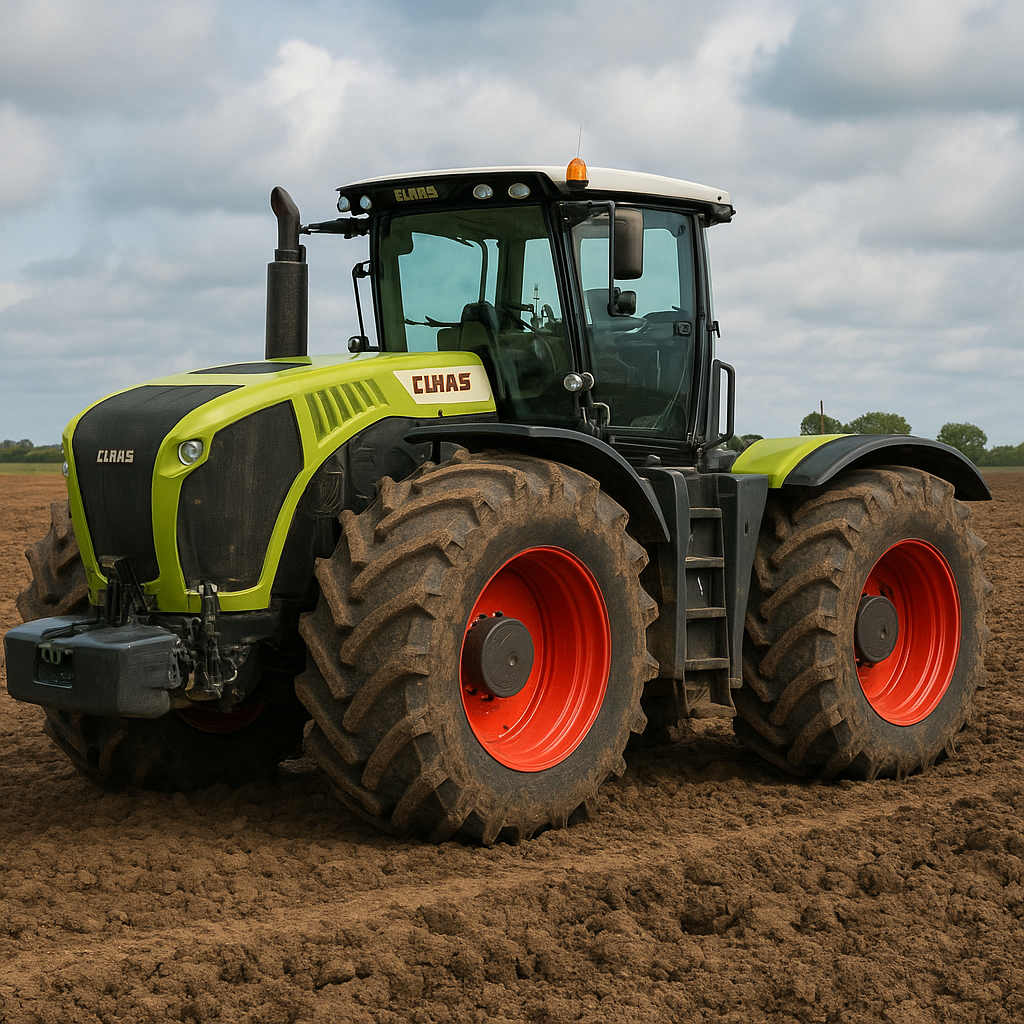
The Claas Xerion 5000 is a high-capacity agricultural tractor designed to meet the demands of large-scale farming, contracting and specialised field operations. Combining robust mechanical architecture with modern electronics and operator-focused ergonomics, the Xerion 5000 aims to deliver exceptional levels of productivity, flexibility and durability. In the sections that follow, this article outlines the vehicle’s main characteristics, typical applications, technical highlights, operator environment and economic considerations. Throughout the text, approximate technical figures and general industry statistics are provided where available to give a realistic picture of the machine’s capabilities.
Design philosophy and core features
Claas developed the Xerion family with an emphasis on versatility, high tractive effort and the ability to handle heavy-mounted implements across a wide range of tasks. The Xerion 5000 sits near the top of the Xerion range and is built around a number of defining characteristics: a powerful diesel engine, a heavy-duty driveline and a spacious, highly visible cab. The machine’s architecture is intended to provide balanced weight distribution and low soil compaction potential relative to the power it provides, which is essential for preserving field structure in high-output operations.
Key mechanical attributes
- Powertrain: The Xerion 5000 is equipped with a high-output diesel engine delivering approximately 500–530 horsepower (roughly 370–390 kW), depending on exact specification and market variant. The engine conforms to modern emissions standards and is tuned for high torque at low engine speeds to support heavy draft work.
- Transmission and driveline: A heavy-duty, continuously variable or stepped powertrain architecture (depending on model year and configuration) provides smooth speed control and efficient power delivery under load. Full-time four-wheel drive and advanced differential management enhance traction in challenging ground conditions.
- Chassis and axles: The Xerion’s frame is designed to support large implements and high drawbar loads. Ballasted configurations and optional dual- or triple-wheel setups increase traction and lower ground pressure for wet or soft soils.
- Hydraulics and PTO: High-flow hydraulic systems and robust PTO options are available to run large mounted implements, seeders, sprayers and tillage equipment. Hydraulic flow rates and PTO speed choices are tailored to heavy implement requirements.
Operator environment
Claas placed substantial emphasis on operator comfort and control ergonomics when designing the Xerion 5000. A roomy cab with excellent all-round visibility and logically arranged controls reduces operator fatigue during long working days. Modern Xerion cabs include advanced climate control, adjustable seating, multi-function joysticks and integrated displays for machine status and implement control.
The cab architecture and control systems aim to improve both safety and productivity. Operators can monitor fuel use, implement performance and guidance systems from in-cab terminals, while optional camera systems and lighting packages extend visibility for night operations.
Primary applications and typical use cases
The Claas Xerion 5000 is intended for large farms, contracting businesses and specialised operations where both horsepower and traction are required. Its design makes it especially suitable for tasks that require continuous heavy drawbar or hydraulic power rather than high-speed transport. Typical applications include:
- Tillage: Pulling large ploughs, cultivators and discs across wide working widths. The Xerion’s power and ballast options allow it to cope with deep tillage and heavy soil conditions.
- Sowing and seeding: Running large seed drills and air seeders; precision farming systems integrated with the tractor improve seeding accuracy over large areas.
- Fertiliser and lime spreading: Operating high-capacity spreaders at field-ready widths while maintaining consistent ground speed and distribution.
- Spraying: When fitted with rear- or front-mounted sprayers, the Xerion can support very large booms and tank capacities used in broadacre cropping.
- Transport and heavy haulage: Although not primarily a high-speed road tractor, the Xerion is used for moving heavy trailers and equipment around large operations, typically up to about 40 km/h depending on local configuration and regulations.
- Specialised operations: Tasks such as logging, snow clearing, and site preparation—especially when heavy hydraulic power and sturdy frame are advantageous.
Advantages in large-scale farming and contracting
In operations where time-window constraints are tight—such as planting and harvest windows—a single high-horsepower unit like the Xerion 5000 can reduce the number of passes or the number of machines required to complete work quickly. This can translate into cost savings via lower labour needs and improved timeliness, which has direct effects on yield and operational efficiency.
Technology, automation and precision agriculture
Modern Claas Xerion tractors integrate advanced electronics to enable precision agriculture workflows. These features have become essential for large-scale stakeholders seeking to maximise input efficiency and reduce environmental impact.
- Guidance systems: Compatibility with GNSS-based auto-steer solutions allows repeatable pass-to-pass accuracy, reducing overlaps and gaps. Typical accuracy levels with RTK corrections can be within a few centimetres—important for high-precision seeding and spraying.
- ISOBUS compatibility: Standard interfaces allow the tractor to communicate with a wide range of implements, enabling implement-specific control directly from the tractor’s displays.
- Telematics and fleet management: Remote machine monitoring and data logging enable farm managers and contractors to oversee multiple machines, track fuel use, maintenance intervals and operational metrics.
- Automated implement control: Hydraulic and electronic control loops can regulate boom sections, seeding rates and other implement functions to respond dynamically to field conditions.
The combination of high hydraulic capacity, strong electrical systems and ISOBUS ensures the Xerion 5000 can operate the largest, most sophisticated implements currently used in broadacre cropping and land management.
Performance statistics and operational metrics
Below are common performance figures and operational metrics associated with large, high-power tractors of the Xerion class. Exact figures for any particular Xerion 5000 will vary with model year, specification and optional equipment; the ranges below are representative and should be used as guidance rather than exact guarantees.
- Engine power: approximately 500–530 hp (approx. 370–390 kW).
- Maximum road speed: often around 40 km/h in regional configurations; some market variants limit road speed to meet regulations.
- Operating weight: typically in the range of 12–16 tonnes depending on ballast, tyres and fitted equipment.
- Hydraulic flow: many high-end variants provide high-flow hydraulics (e.g., in the region of 180–210 L/min or more) to run multiple hydraulic consumers simultaneously.
- PTO options: multiple PTO speed settings (e.g., 540/1000 rpm equivalents or electronic PTO control) to accommodate diverse implements.
- Fuel tank capacity: large tanks are common to allow long working days without refuelling; capacities often exceed several hundred litres depending on configuration.
- Turning radius and manoeuvrability: good for its size thanks to articulated steering and four-wheel steering options, allowing more precise implement placement and reduced headland time.
Performance in the field will depend heavily on ground conditions, operator skill, implement match and ballast setup. For example, fuel consumption under heavy draft duties may vary significantly—operators typically monitor litres per hectare or litres per hour depending on the task to quantify efficiency.
Operator comfort, safety and ergonomics
Ergonomics and operator wellbeing are critical for high-hour machines. Claas equips the Xerion cab with amenities designed to reduce fatigue and improve focus: adjustable high-comfort seats, low-noise cabins, large windows for visibility and easy access to controls. The cab layout supports day-long operation, which is common in both large farms and contracting work.
- Visibility: Elevated seating and large glass areas provide a broad view of implements and headland operations.
- Controls: Multi-function joysticks and touchscreen displays centralise implement and drive controls to minimise operator movement and cognitive load.
- Climate and filtration: Advanced climate control and filtration systems maintain operator comfort and can reduce dust ingress during dry fieldwork.
- Safety features: Integrated lighting packages, rollover protection and camera systems enhance safety for both field and road travel.
Maintenance, serviceability and total cost of ownership
Large tractors like the Xerion 5000 are significant capital investments. Claas has engineered the Xerion for reasonable service intervals and accessibility of key components to reduce downtime. However, given the complexity and size of such machines, maintenance planning and skilled servicing are essential.
Maintenance considerations
- Scheduled servicing: Regular oil, filter and fluid service intervals are critical for engine and transmission longevity. Modern engines and aftertreatment systems require specific procedures to ensure emission compliance.
- Telematic diagnostics: Remote diagnostics reduce the time to identify problems and can be used to pre-emptively address issues before they cause lengthy outages.
- Parts and support: Availability of compatible parts and trained technicians in a given region strongly influences downtime and effective life of the machine.
When evaluating total cost of ownership, buyers should consider not just purchase price but typical fuel consumption, maintenance costs, expected service life, resale value and potential productivity gains due to reduced working hours or fewer machines required on a site.
Environmental factors and regulatory compliance
Claas designs engines to meet contemporary emissions regulations (e.g., EU Stage V or equivalent in other regions). Aftertreatment systems, diesel particulate filters and selective catalytic reduction (SCR) are commonly used technologies in modern high-power tractors to reduce NOx and particulate emissions.
- Emission control: Compliant engines reduce environmental impact and ensure machines can be operated in regulated markets.
- Soil protection: Large tractors allow broader implements to complete tasks in fewer passes; with careful tyre and ballast selection they can also be configured to limit soil compaction.
- Fuel efficiency strategies: Precision farming techniques—such as variable-rate application and section control—help optimise input use and reduce the environmental footprint per hectare.
Market position, competition and economic considerations
In the high-horsepower segment, the Xerion 5000 competes with tractors from major manufacturers that offer similar levels of power, hydraulic capacity and implement compatibility. Buyers choose based on factors like implement ecosystem, dealer network, operator comfort, fuel efficiency and total cost of ownership.
Comparative advantages
- Versatility: Its ability to accept a wide variety of large implements and to operate both as a traction and hydraulic power unit makes it attractive for multi-role use.
- Integration with Claas systems: When used alongside Claas harvesting and tillage implements, the Xerion benefits from integrated support and system-level optimisation.
- Resale and fleet value: Large, well-maintained machines from reputable brands tend to retain value in the used market when supported by strong dealer networks.
For many large-scale farm enterprises, the decision to purchase a tractor like the Xerion 5000 is driven by the need to reduce field operation time windows and to enable the use of large, efficient implements. For contractors, the machine’s robustness and flexibility make it a reliable platform for varied client work across seasons.
Practical tips for potential owners
- Match implements carefully: Ensure that implements are rated for the tractor’s drawbar and hydraulic capacity to avoid wasted performance or premature wear.
- Plan ballast and tyre strategy: Optimise tyre choice and ballast to balance traction and soil compaction depending on seasonal conditions.
- Invest in training: Operators who understand field settings, telematics and precision systems will extract more value and achieve better fuel economy.
- Monitor telemetry: Use telematics and fuel tracking to detect anomalies early and to benchmark productivity across seasons and fields.
Conclusion
The Claas Xerion 5000 is a purpose-built machine for demanding agricultural environments where high levels of power, traction and hydraulic capacity are required. Its blend of robust mechanical design, a comfortable operator environment and modern control systems make it an effective tool for large-scale tillage, seeding, spraying and other heavy-duty tasks. While exact performance figures vary by configuration and model year, prospective buyers and operators should expect approximately 500 horsepower-class performance, substantial hydraulic flow, large fuel capacity and high carrying and drawbar capability. When matched with the right implements and supported by good maintenance and operator training, the Xerion 5000 can be a central asset in modern, high-output farming operations.