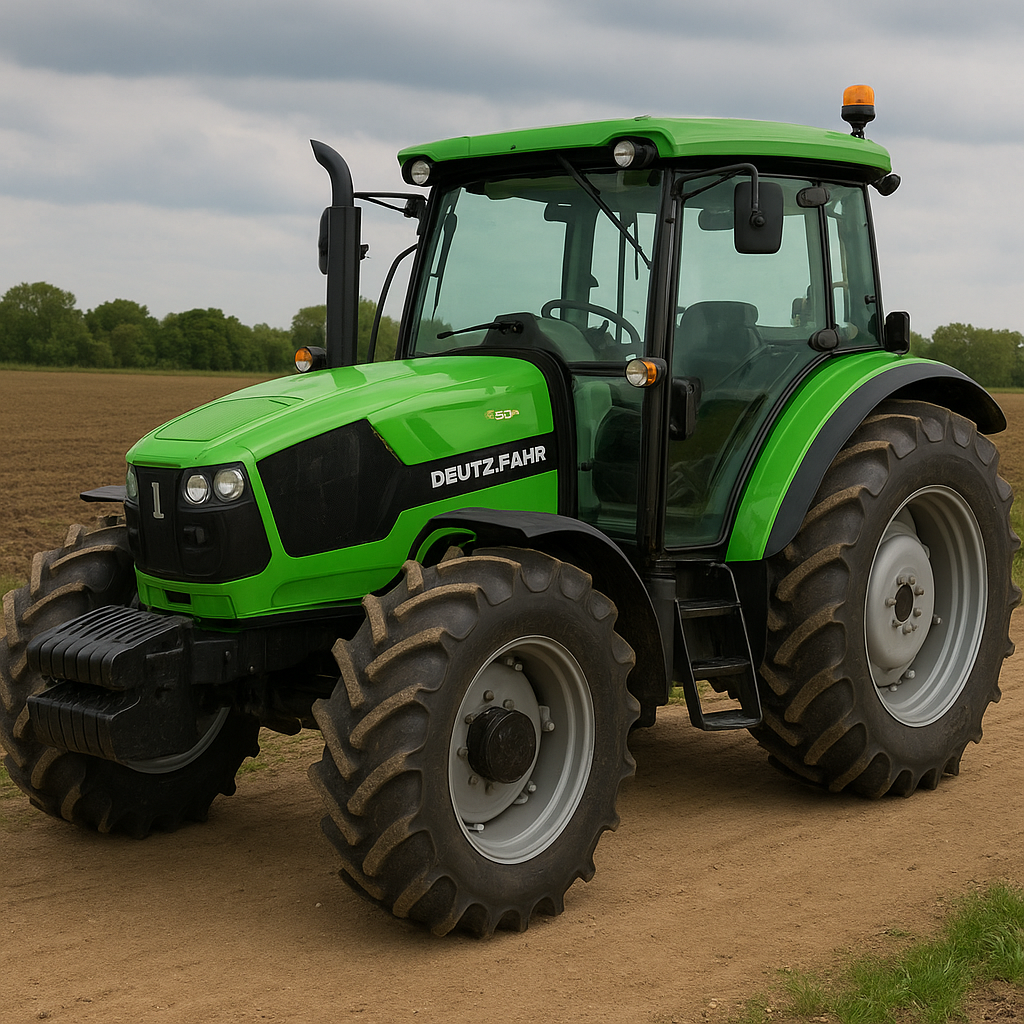
The Deutz-Fahr 5090.4 is a compact, work-oriented tractor designed to balance everyday agricultural utility with comfort and reliability. Positioned in the lower-mid range of Deutz‑Fahr’s lineup, the 5090.4 is commonly chosen by mixed farms, contractors, and municipal services that require a dependable machine for a wide variety of tasks. This article explores the history, technical characteristics, practical applications, economic considerations and buying tips for the model, drawing on available manufacturer data and common field experience.
Overview and heritage
Deutz‑Fahr has a long history in agricultural machinery, combining German engineering with practical design for modern farming needs. The 5090.4 continues that tradition as part of the 5‑series family that targets operators who need a compact but capable tractor for daily chores. It represents a blend of straightforward mechanical systems and ergonomic features, intended to deliver dependable performance without excessive complexity.
The model name indicates its market positioning: the “50” class or roughly the 80–100 horsepower band, and the “.4” typically denotes four‑wheeled drive configuration in Deutz‑Fahr nomenclature. Over production years the 5090.4 has been offered with a choice of equipment packages tailored to field work, loader duties and general farm transport. Its design emphasizes ease of service, good visibility from the cab, and compatibility with common implements.
Technical specifications and performance
Exact specifications can vary with year, market and optional packages. Below are representative technical characteristics and performance figures typically associated with the Deutz‑Fahr 5090.4. Where values vary between versions, ranges are given.
- Engine: modern diesel engine from Deutz or partner manufacturers; 3‑ or 4‑cylinder options depending on configuration, turbocharged and intercooled in many units.
- Horsepower: rated power commonly around 85–95 hp (category nominally marketed as a 90 hp class).
- Torque: torque peaks designed to provide strong low‑end pull for implements; peak torque figures depend on engine option but are tuned for field loads.
- Transmission: mechanical synchromesh transmissions are common, often with options such as 12×12 or 24×12 ranges and shuttle/reverser options for loader work and transport.
- Hydraulics: open‑center or closed‑center hydraulic systems offered; typical pump flow rates in the range of 40–60 L/min depending on specification, enough to operate mid‑ and rear hitch implements and front loaders efficiently.
- PTO: standard rear PTO with 540 rpm and sometimes 540E or 1000 rpm options; electro‑hydraulic engagement is common for operator convenience.
- Lift capacity: rear three‑point linkage lifting capacity typically between 2,200 and 3,200 kg (depending on configuration and options), enabling operation of heavy mounted equipment and large trailers.
- Top speed: road speeds up to around 30–40 km/h depending on gearing and local homologation.
- Fuel capacity and consumption: fuel tank sizes commonly in the 80–120 L range; typical fuel consumption under moderate load commonly ranges from about 6–12 L/h, varying with duty cycle and implement load.
- Weight and dimensions: curb weight often in the 3,000–3,800 kg range; compact footprint suited for narrow gates and smaller yards.
- Emissions compliance: engines meet the applicable emissions standard for the production year and market (e.g., EU stage / US Tier classifications where required).
These numbers are representative; buyers should consult specific technical sheets for the production year and option package of the particular tractor they plan to purchase. The 5090.4 is built to deliver a balance of torque, lifting capability and agility appropriate to small‑to medium‑sized farm operations.
Applications and typical uses
The Deutz‑Fahr 5090.4 is a multi‑purpose tractor well suited to a broad set of agricultural and non‑agricultural tasks. Key application areas include:
- Field crop work — ploughing, harrowing, seeding and precision cultivation when paired with appropriate implements.
- Hay and forage operations — mowing, raking, baling and transporting bales; PTO and hydraulic capability make it useful for balers and forage wagons.
- Loader and yard work — lifting, moving feed, bedding and building materials with a front loader; visibility and hydraulic flow support fast loader cycles.
- Transport and shuttle work — hauling trailers, slurry tankers and sprayers on farms and local roads; optional shuttle transmissions improve efficiency during frequent directional changes.
- Livestock farm tasks — bedding, feed distribution and manure handling, where nimbleness and moderate lift capacity are valued.
- Municipal and contractor duties — mowing roadside verges, light snow clearing and sweeping, where a compact profile and maneuverability matter.
Beyond pure power, the 5090.4’s strengths lie in its adaptability. It performs well as a primary tractor on smaller farms, or as a complementary machine on larger holdings where multiple tractors are needed. Its compatibility with front loaders, compact implements and a variety of PTO‑driven equipment makes it a flexible choice for mixed operations.
Cab, ergonomics and operator experience
Deutz‑Fahr places emphasis on operator comfort and layout even in its smaller tractors. The 5090.4 typically features:
- Comfortable cab or platform options, with climate control and visibility optimized for loader and hitch work.
- Logical control layout — hydrostatic or mechanical levers, easy access to hydraulic flow controls and PTO engagement, and a clearly arranged instrument cluster.
- Seat suspension and adjustable steering column on many models, reducing fatigue during long shifts.
- Sound and vibration insulation designed to keep noise at acceptable levels for extended operation.
For operators who spend many hours in the tractor every week, these ergonomic details translate into productivity gains and reduced physical strain. The 5090.4’s cab choices and control ergonomics make it a practical tool for both short daily chores and longer transport sections.
Maintenance, reliability and running costs
One of the selling points of the 5090.4 is straightforward maintenance and good access to service points. Regular maintenance items to monitor include engine oil and filters, hydraulic fluid and filters, PTO and gearbox servicing, and cooling system checks. Some practical highlights:
- Durability: rugged mechanical architectures and widely available parts help keep downtime low. Common‑rail systems and modern engine management require quality fuel and periodic servicing.
- Maintenance: service intervals follow manufacturer recommendations; many owners find daily pre‑start checks and scheduled filter/oil changes sufficient to sustain reliable operation.
- Operating economy: balanced fuel consumption relative to output, especially when using the tractor near its rated working range, contributes to favorable cost per hour metrics on typical tasks.
- Resale and parts support: Deutz‑Fahr enjoys broad dealer networks in many regions, which aids parts availability and resale values compared with lesser‑known brands.
Actual running costs depend heavily on duty cycle, maintenance discipline and local fuel and labor prices. For many owners, predictable maintenance and the relative simplicity of mechanical systems translate into a favorable lifetime cost of ownership.
Practical tips for buyers
When evaluating a Deutz‑Fahr 5090.4 (new or used), consider these practical points:
- Match capacity to work — assess average implements and loads to ensure horsepower and lift capacity are appropriate; an undersized tractor will wear faster and burn more fuel under constant overload.
- Check hydraulic flow and PTO options — loader work and certain implements require higher flow rates or specific PTO speeds (540 vs 1000 rpm).
- Inspect service history — on used machines, ensure regular servicing, evidence of oil changes, and records of any major repairs.
- Look at tires and brakes — these are costly to replace; tire condition can indicate overall care of the machine.
- Consider comfort package and cab features — if multiple operators use the tractor, ergonomic features will significantly affect satisfaction.
- Verify emissions and local compliance — ensure the tractor meets local regulatory standards for noise and emissions if required for operation or resale.
Comparisons and positioning against competitors
In its class the 5090.4 competes with models from brands such as New Holland, Massey Ferguson, John Deere (lower‑end models), Kubota, and Claas. Its competitive advantages typically include:
- Reputation for robust construction and serviceability in European markets.
- Good balance of power and agility for mixed farms and service contractors.
- Dealer support in regions where Deutz‑Fahr is established, which affects long‑term ownership costs.
Potential buyers should compare real world productivity, dealer support, and total cost of ownership across similar tractors, rather than focusing solely on headline horsepower. For many operations, the right match depends on implement compatibility and hydraulic performance as much as engine output.
Statistical outlook and market relevance
While specific global sales figures for the 5090.4 are not universally published, the tractor belongs to a segment that remains highly relevant: compact and lower‑mid power tractors are in steady demand among small‑to‑medium sized farms, contractors and municipalities. Trends affecting the 5090.4’s market presence include:
- Demand for versatile machines that can perform both field and yard tasks.
- Growing emphasis on fuel efficiency and emissions compliance, pushing manufacturers to refine engines and after‑treatment systems.
- Preference for tractors that offer modern comfort and connectivity features while retaining straightforward mechanical serviceability.
Secondary market activity for models like the 5090.4 tends to be robust in regions where Deutz‑Fahr has a strong dealer network. Typical depreciation patterns follow those of similar tractors in the 80–100 hp class: steady loss in the first years, then a more gradual depreciation as the tractor proves reliability and accumulates working hours.
Final considerations
The Deutz‑Fahr 5090.4 is a versatile, pragmatic choice for operators needing a reliable, mid‑range tractor that can handle a diverse workload without the complexity and cost of larger machines. Its strengths are its adaptability, comfortable operator environment, and the balance of hydraulic and PTO features suitable for many implements. Buyers should verify specific model year specifications, consider their implement requirements carefully, and assess the local dealer and service network. With the right match of equipment and maintenance, the 5090.4 can serve as a dependable backbone for small farms, contractor fleets and municipal fleets.