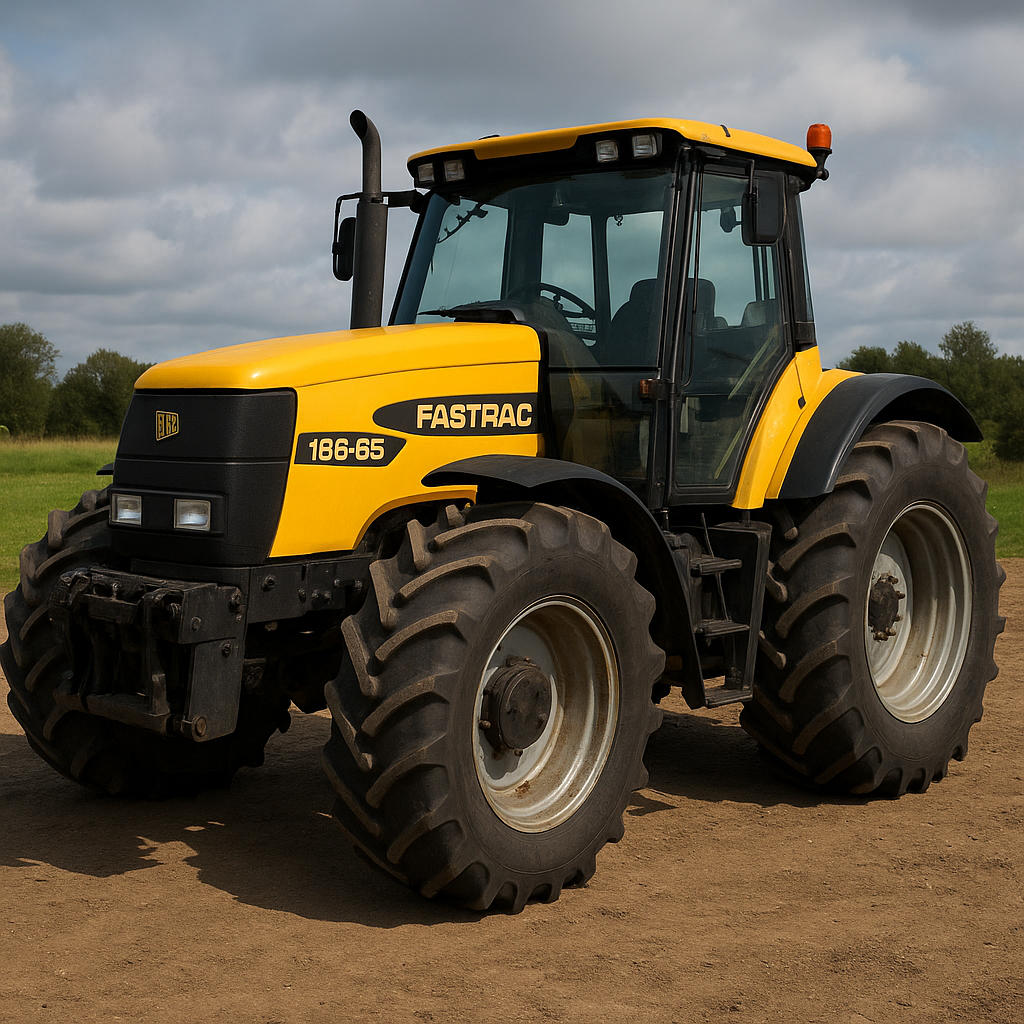
The JCB Fastrac 185-65 is a member of the well-known Fastrac family of high-speed agricultural tractors designed and produced by JCB. Combining road-going performance with field-capable power and comfort, this model is aimed at operators who need a machine capable of fast transport between jobs as well as productive work in the field. Below are detailed descriptions of its design rationale, typical specifications, areas of application, operational characteristics, and other interesting information that makes the Fastrac 185-65 distinctive.
Design and key technical characteristics
The JCB Fastrac line has always been built around a concept that emphasizes a combination of mobility, ride comfort, and productive agricultural capability. The model designation 185-65 commonly indicates the combination of nominal engine output and road speed: roughly 185 horsepower and a top speed of around 65 km/h. This balance between power and transport speed defines the machine’s role as both a field tractor and a fast road transporter.
Chassis and suspension
- The Fastrac family is noted for its purpose-designed ladder-frame chassis with integrated suspension. Both front axle and cab suspension systems are designed to reduce vibration and improve stability at higher road speeds, which increases day-long operator comfort and reduces fatigue.
- Suspension advantages: better traction on uneven ground, improved implement control when transporting equipment, and reduced soil compaction risk from uncontrolled bouncing.
Engine and transmission
While exact engine families differ across production years, typical configurations for a machine in this category include a turbocharged diesel engine tuned to deliver reliable torque across a broad rpm range. The Fastrac 185-65 is commonly fitted with engines in the ~170–190 hp bracket with robust torque curves optimized for PTO and draft work.
- Transmission options historically offered across Fastrac models include power-shift gearboxes and continuously variable or stepped transmissions tailored for smooth acceleration on-road and precise speed control in the field.
- High road speed capability is paired with low-speed gear ranges to allow high tractive effort at slow speeds for intensive field operations.
Hydraulics, PTO and hitch
- Hydraulic systems on Fastrac tractors provide high flow rates to operate modern implements, often with multiple remote spool valves and electronic control options for precision agricultural equipment.
- PTO configurations are typically multi-speed (e.g., 540/1000 rpm or equivalent), enabling the tractor to drive a wide range of implements.
- The three-point hitch is robust and designed to handle heavy implements used in tilling, seeding, spraying and baling work.
Applications and typical uses
The Fastrac 185-65 is a versatile machine that fits a range of agricultural and non-agricultural roles. Its combination of usable power, high top speed, and comfortable suspension make it especially attractive for operations where machines must move frequently between fields or over long distances on public roads.
Primary agricultural uses
- Arable farming: pulling large ploughs, discs and cultivators where steady power and durable hitching are required.
- Forage and grassland operations: mowing, tedding, raking and baling where speed between fields reduces operational downtime.
- Spraying and fertiliser application: stable platforms and precise hydraulic controls enable even application over large areas.
- Seed and planting operations: ability to transport planters and seed drills quickly and place them accurately into work.
Contracting, haulage and municipal use
- Contractors value the Fastrac’s ability to act as a tractor and fast transporter, allowing same-day movement of implements across a wide geographic area.
- In municipal roles, the machine can be used with road maintenance equipment, flail mowers, sweepers and snow-clearing tools, where travel speed and comfort are important.
- Transporting equipment between job sites is quicker and usually requires less additional haulage support, reducing overall logistic costs.
Specialist and mixed-farm applications
Mixed farms and specialist producers (e.g., those with multiple separated fields) find the Fastrac concept valuable because the tractor reduces transit time, increases productive hours on attachment work, and can be a single-machine solution for several tasks.
Operational performance, economy and real-world statistics
When assessing a tractor like the Fastrac 185-65, operators focus on metrics such as fuel consumption, uptime, field speed, tractive effort, PTO output, and total cost of ownership. Below are typical performance characteristics and considerations that can be expected from a tractor in this class. Where precise specification varies, figures are described as approximate or typical for machines in this range.
Power and PTO performance
- Nominal engine output: commonly around 185 hp (approximate for this model designation), with usable torque supporting sustained PTO-driven work.
- PTO power at the shaft is somewhat lower than engine output once drivetrain losses are accounted for; operators should expect a percentage drop from engine-rated hp to delivered PTO hp (typical for farm tractors).
Speed and productivity
- Top road speed is often a key selling point; a figure near 65 km/h explains the “65” in the model name for some variants, allowing rapid transit between sites compared with conventional tractors limited to 40 km/h.
- Higher average speed between jobs translates directly into higher productive hours on implements and reduces the number of machines required on large farms.
Fuel consumption and economy
Fuel use is dependent on the task: heavy draft work uses significantly more fuel than road transit. Modern diesel engines combined with intelligent transmissions and efficient hydraulics typically yield competitive fuel consumption for the power delivered. For a tractor in this category, typical fuel consumption might range from roughly 12–25 liters/hour depending on load and operating conditions, but this varies widely based on implement, soil and operator technique.
Reliability and uptime
- JCB’s Fastrac series has a reputation for robust build and long service intervals when maintained correctly.
- Key service considerations include regular oil and filter changes, monitoring of suspension bushings and components, and ensuring cooling, fuel, and electrical systems remain clean and functional.
Comfort, ergonomics and operator features
One of the distinguishing features of the Fastrac family is operator comfort — an important factor when tractors are used for long haul and long-hour operations.
- Cab design: spacious with good visibility, adjustable seating, and ergonomically-arranged controls to reduce fatigue during long shifts.
- Suspension: both front axle and cab suspension contribute to a smoother ride compared with conventional tractors, important for safety and operator wellbeing at higher road speeds.
- Controls and electronics: modern Fastrac models often include electronic control units (ECUs) that manage engine, transmission and hydraulic functions, providing more precise performance and diagnostic capabilities.
Maintenance, servicing and lifecycle considerations
Proper maintenance is essential to guarantee the expected long-term performance. The Fastrac is engineered for relatively straightforward access to service points, but complexity increases with more advanced transmissions and electronic systems.
Service intervals and consumables
- Regular checks: engine oil and filter, hydraulic oil and filters, fuel filters, air filters and cooling system.
- Suspension components and brake systems require inspection, especially for machines that spend significant time on tarmac at high speeds.
- Warranty and dealer networks: JCB’s global dealer network typically provides parts and service support, which is a practical advantage for operators in many regions.
Total cost of ownership
Total cost of ownership should factor in purchase price, fuel consumption, maintenance, downtime, resale value and the value of time saved by higher transit speeds. For many operators, the ability of a Fastrac-type tractor to reduce transport time and consolidate tasks into fewer machines offers a measurable return on investment.
Innovations, variants and competitive position
The Fastrac series has introduced several innovations in the agricultural tractor market, and the 185-65 variant is part of that lineage. Key innovations that impact users include improved mobile comfort through suspension, high-speed capability for modern logistics, and flexible implement compatibility.
Technology trends and optional equipment
- GPS guidance and precision farming interfaces: modern Fastracs can be fitted with guidance systems and ISOBUS-compatible implements to increase efficiency and reduce operator workload.
- Telematics and remote diagnostics: many modern tractors support remote monitoring to help fleets manage maintenance and track performance.
- Optional front loaders, ballast packages, and tyre choices: these allow customization for different tasks and ground conditions.
Market competitors
Competitors in the high-speed tractor segment include models from other major manufacturers who target similar combined transport-and-field roles. Buyers typically compare ride comfort, top speed, hydraulic capacity, PTO performance and dealer support when choosing between manufacturers.
Practical tips for buyers and operators
For prospective buyers and operators considering a Fastrac 185-65, a few practical recommendations can help ensure the machine meets operational needs:
- Assess the balance between road work and field work: if your operation requires frequent road transit, a high-speed tractor like the Fastrac can reduce time and improve productivity.
- Check hydraulic flow and hitch capacity to ensure compatibility with the largest implements you intend to use.
- Inspect suspension components and tyre condition carefully on used machines, as these are critical for safe high-speed operation.
- Consider telematics and guidance packages if you plan to use precision agriculture techniques — they improve efficiency and can reduce input costs.
Summary and concluding remarks
The JCB Fastrac 185-65 presents a compelling package for users who need a combination of substantial engine power and high road speed alongside robust agricultural capability. Its mix of JCB engineering, emphasis on comfort through advanced suspension, and versatile hydraulic and hitch systems make it suitable for a wide range of work—from heavy tillage to fast inter-field transport and municipal applications. While exact technical numbers vary with production year and specification, the model is generally characterized by around 185 horsepower and a capability for approximately 65 km/h transport, powerful PTO options and strong hydraulic performance to drive modern implements. Buyers should evaluate total cost of ownership, service history, and available options to match the machine to their operational profile.
Key strengths: mobility, versatility and operator comfort.