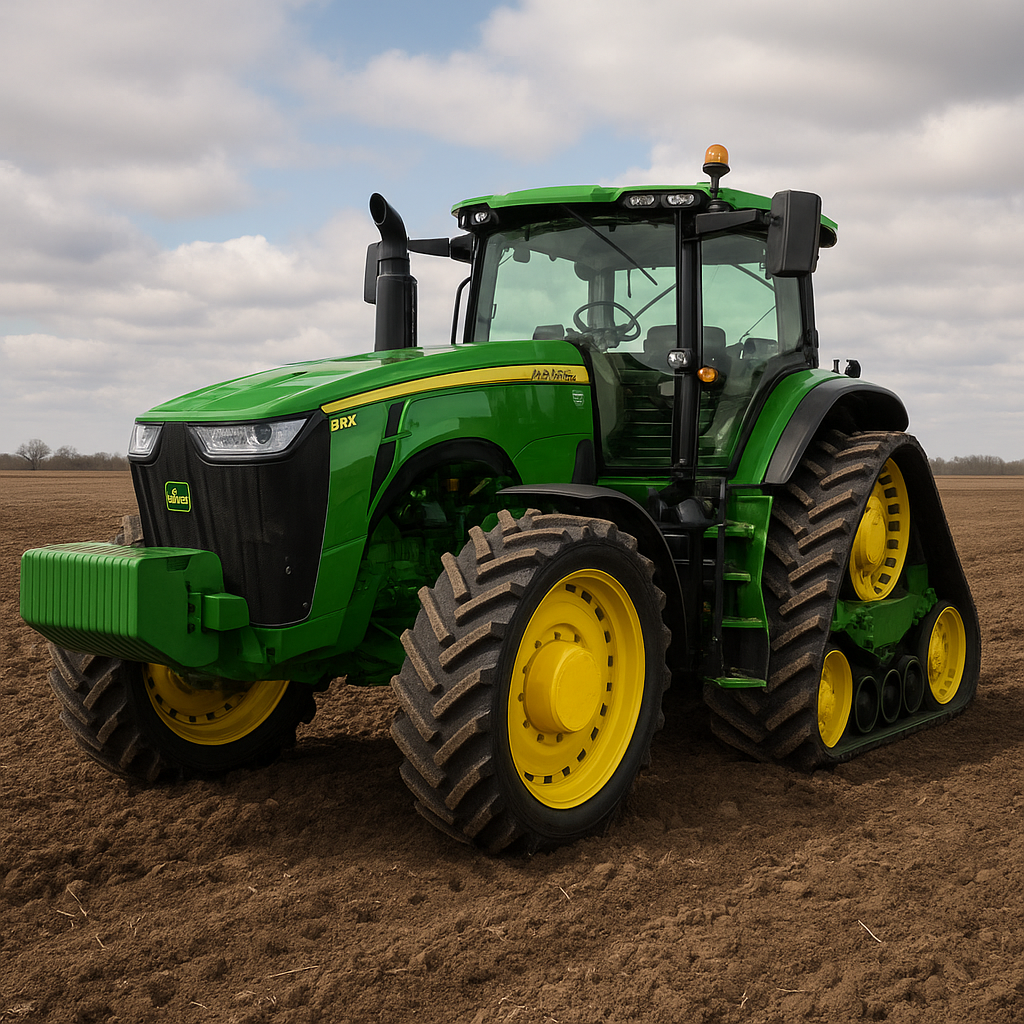
The John Deere 8RX 370 is a high-performance, track-equipped agricultural machine designed for large-scale farming operations where traction, flotation and consistent field performance are critical. Combining modern engine technology, advanced hydraulics and an operator-focused cab, the 8RX 370 aims to deliver reliable power across a wide range of tasks — from primary tillage and heavy seeding to transport and high-speed field work. In the following sections I describe its design, typical applications, operational advantages, maintenance considerations and economic and environmental aspects, as well as practical guidance for farmers and contractors considering this model.
Design and technical overview
The 8RX 370 belongs to John Deere’s 8R/8RX family, which expanded the company’s lineup of large tractors by offering a dedicated multi-track platform rather than traditional wheels. The model designation “370” refers to its nominal engine output, which places this machine in the upper mid-range of large row-crop tractors. Key design priorities for the 8RX series include improved ground contact, lower soil compaction, higher continuous tractive effort and better stability on uneven ground.
Engine and powertrain
- The 8RX 370 is typically powered by a robust, inline 6-cylinder John Deere diesel engine tuned to deliver approximately 370 horsepower at rated engine speed (ISO rated power). In many operating conditions, available power at the drawbar or PTO will be slightly lower, but torque and boost functions offer short-term power for demanding tasks.
- Transmission options historically available in the 8R/8RX family include John Deere’s e23 PowerShift and continuously variable alternatives (IVT/AutoPowr) depending on specification and regional market. These transmissions are engineered to provide smooth shifts, precise speed control and efficiency across varying loads.
- Hydraulic systems on the 8RX 370 support multiple remotes with high flow rates suitable for large implements such as air seeders, cultivators and heavy plows. Lift capacities and three-point hitch ratings are comparable to wheeled counterparts in the 8R range, enabling use of demanding implements.
Undercarriage and track system
Unlike traditional two-track or wheeled tractors, the 8RX 370 uses a four-track layout with independent bogies. The multi-track arrangement offers several mechanical and agronomic benefits:
- Broader contact patch per track — increased flotation and lower ground pressure than single tires or two-track systems;
- Four-track configuration enhances lateral stability and towing efficiency, translating engine torque more directly to the soil with reduced slippage;
- Undercarriage components (rollers, idlers and track belts) are designed for heavy-duty duty cycles; however, they require different maintenance and inspection routines than tires.
Cab, controls and electronics
The 8RX 370’s cab is designed for long hours in the field. John Deere emphasizes operator comfort and integrates guidance and telematics systems into the control architecture:
- Advanced cab ergonomics with climate control, noise insulation and seating designed for fatigue reduction;
- Factory-ready or dealer-installed guidance systems (e.g., GPS-based auto-steer) that improve overlap control and field efficiency;
- John Deere precision agriculture technologies — including telematics, machine data logging and compatibility with farm management software — for optimized field planning and maintenance scheduling.
Applications and field performance
The 8RX 370 is tailored to the needs of large grain, row-crop and mixed farms as well as agricultural contractors who operate in varied soil and weather conditions. Its performance profile makes it particularly valuable where heavy implements and consistent traction are required.
Main use cases
- Tillage and primary cultivation: The 8RX 370 excels pulling large plows, disc harrows and field cultivators across extensive acreages. The extra contact provided by the four tracks reduces wheel slip and improves fuel efficiency during heavy draft work.
- Seeding and planting: When running large planters or air seeders, maintaining constant ground speed and avoiding soil compaction are priorities. The 8RX helps maintain consistent depth and seed placement by reducing sink-in and minimizing track slip.
- Spraying and nutrient application: For wide-boom sprayers and manure spreaders, the lower ground pressure helps preserve crop residues and reduce rutting, which is essential in wetter seasons.
- Transport and haulage: With adequate road mode settings and transmission options, the 8RX 370 can tow heavy trailers and handle transport tasks between fields or to storage areas, with good ride stability at speed.
Performance characteristics
Farmers and operators note several consistent performance advantages in field trials and operational use:
- Reduced soil compaction relative to equivalent wheeled tractors, especially in marginally moist conditions;
- Improved traction and lower slippage translate into higher effective drawbar pull for long periods, which can lower fuel use per hectare under heavy-duty tasks;
- Enhanced stability on slopes and soft ground, making it safer to operate large implements in less-than-ideal field conditions;
- Smoother ride for the operator when compared with smaller or heavily-laden wheeled tractors, due to distributed load and track damping characteristics.
Operator experience and technology features
Comfort and ease of use are important for minimizing operator fatigue and maximizing productivity. The 8RX 370 incorporates several features aimed at improving the day-to-day experience.
Cab environment and ergonomics
- Spacious, climate-controlled cab with suspension seat and low noise levels;
- Intuitive control layout with multifunction joystick options for transmission and implement control;
- Large windows and camera integration for improved visibility around implements and when maneuvering in confined areas.
Precision agriculture and connectivity
Modern 8RX tractors are typically configured to work with John Deere’s precision farming ecosystem:
- GPS-guided auto-steer systems that reduce overlap, cut input costs and raise productivity;
- Telematics and remote-monitoring platforms that enable fleet managers to track location, operating hours, fuel use and service alarms in real time;
- Compatibility with variable-rate application, section control and documentation tools that support smarter nutrient and seeding management strategies.
Maintenance, lifecycle and practical ownership considerations
Track tractors like the 8RX 370 bring different maintenance demands compared with wheel tractors. Prospective owners should plan for both the benefits and the long-term responsibilities.
Undercarriage and track lifecycle
- Track and undercarriage wear depends heavily on field conditions and transport vs field hours. Frequent transport on abrasive surfaces accelerates wear compared to predominantly field use;
- Routine inspections of track tension, roller bearings, and idler components are essential to prevent downtime. Manufacturers provide recommended service intervals, but operators often adapt schedules based on observed wear;
- While tracks can be more expensive to replace than tires, some operations find the trade-off acceptable because of improved productivity, reduced soil damage and lower downtime from wheel flats or rim issues.
Fuel and operating costs
Fuel consumption varies with load, field conditions and operator technique. In heavy draft work with large implements, the 8RX 370’s improved traction can yield better fuel efficiency per hectare than an equivalent wheeled tractor experiencing significant slip. However, on light transport or low-draft tasks, a wheeled machine may be more efficient. Owners should track actual fuel burn with telematics to evaluate return on investment.
Resale, service network and parts availability
- John Deere’s global dealer network supports parts, warranty and service for the 8RX family. Availability of local technicians trained on track systems is an important factor when purchasing;
- Resale values for large tractors often reflect hours, service history and condition of the undercarriage; meticulous maintenance and documentation help preserve value;
- Optional support packages — extended warranties, maintenance plans and telematics-based service reminders — can reduce total cost of ownership variability over the machine’s life.
Economic and environmental considerations
Investing in a high-horsepower, track-equipped tractor like the 8RX 370 carries both economic and environmental implications that should align with farm strategy.
Cost-benefit analysis
- Purchase price for new 8RX-class machines is significant. Depending on specification, options and regional market, a new machine’s price can be in the high hundreds of thousands of dollars. Exact pricing varies with configuration and dealer incentives;
- Operators evaluate the machine by calculating cost per hectare: fuel, maintenance, depreciation, and increased productivity due to faster field operations or better first-pass results;
- Contractors often justify purchase through the ability to serve multiple large-acreage customers and by minimizing downtime across a busy seasonal window.
Environmental benefits
- Lower ground pressure helps preserve soil structure and reduce compaction layers that can limit root growth and reduce yields over time. This effect can have long-term ecological and productivity benefits for a farm’s soils;
- Better traction and reduced slip can translate into fuel savings per unit of work, reducing the carbon footprint for certain high-draft operations;
- When combined with precision application systems, the 8RX 370 enables more accurate input placement, which can reduce over-application of chemicals and fertilizers.
Comparisons, alternatives and who should consider the 8RX 370
Choosing between a multi-track tractor like the 8RX 370 and alternatives (wheeled 8R models, two-track 8RT models, or competing brands) depends on operation size, crop types, soil conditions and budget.
- Compared with wheeled tractors of similar engine rating, the 8RX typically offers better flotation and traction, at the cost of higher undercarriage maintenance and potentially higher initial purchase price;
- Compared with two-track designs, the four-track 8RX provides improved lateral stability and often smoother transport behaviour, which can be decisive for very heavy implements or high-speed fieldwork;
- Owners with very high proportions of transport on paved roads may prefer wheeled tractors for lower rolling resistance and reduced track wear; conversely, those who operate primarily on soft, wet or uneven ground will likely benefit most from the 8RX platform.
Practical tips for potential buyers and operators
- Assess your typical workload: quantify hours in heavy draft vs transport — this influences whether track benefits outweigh cost;
- Discuss undercarriage warranty and estimated service intervals with your dealer; differences in local terrain can substantially change wear expectations;
- Consider factory-equipped precision agriculture and telematics options to maximize fuel efficiency and maintain detailed service records that aid resale;
- Train operators on track-specific best practices: proper transport speed limits, turning techniques to reduce track stress, and daily visual inspections.
Conclusion
The John Deere 8RX 370 is a purpose-built machine for large-scale, high-demand agricultural operations that require consistent traction, reduced soil compaction and reliable power for heavy implements. While its initial cost and undercarriage maintenance needs are higher than many wheeled alternatives, the operational advantages — especially in soft or uneven ground and during heavy tillage or seeding operations — can make it a compelling investment. Those considering the 8RX 370 should closely evaluate their field conditions, duty cycles and long-term soil management goals, and work with dealers to configure the tractor for the most efficient and productive use.