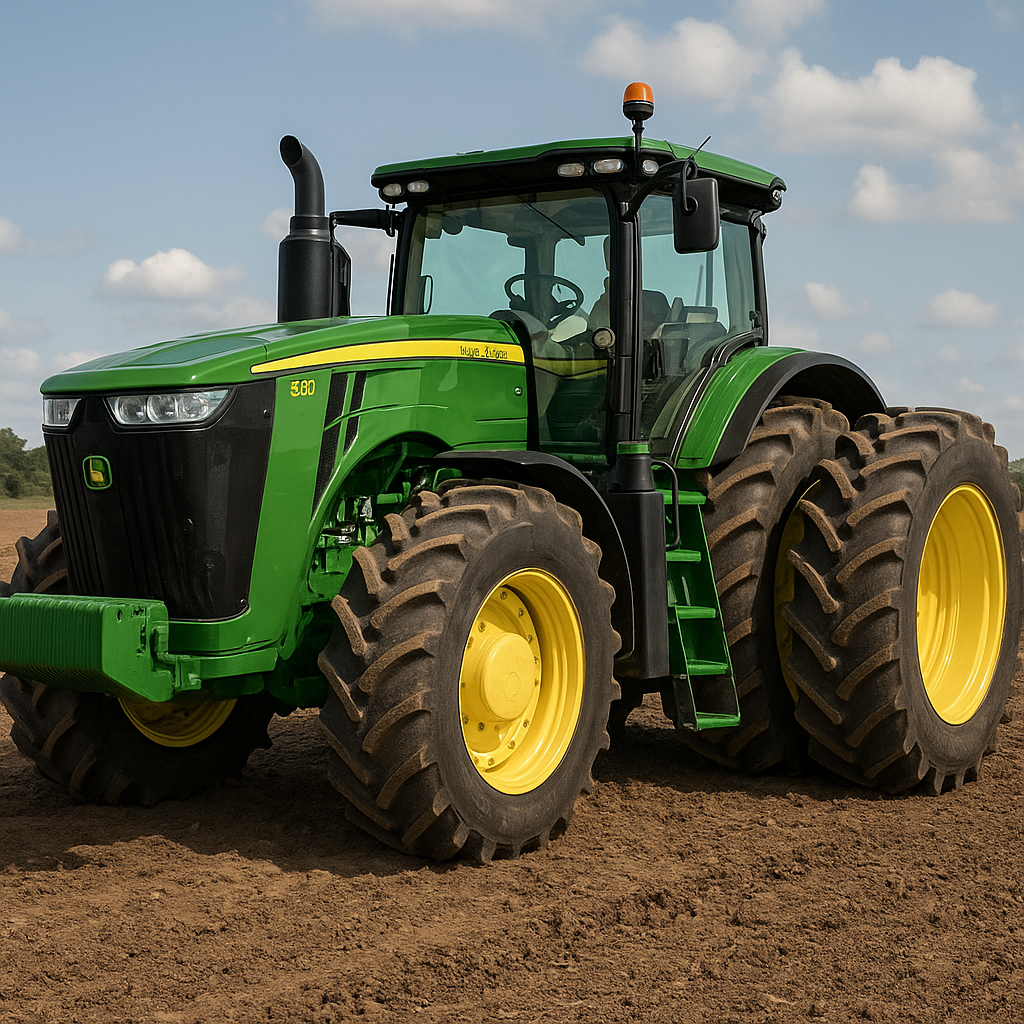
The John Deere 9R 590 is a heavy-duty agricultural tractor designed for the largest field operations and contractors. Combining substantial engine output with advanced electronics, robust hydraulics and operator-oriented features, this model targets farms that require high-capacity soil tillage, seeding, fertilizer application and transport work. In the sections that follow, you will find an overview of the machine’s design and philosophy, its typical technical specifications, common applications, as well as notes on technology, economics and maintenance. Wherever precise numbers are provided they should be treated as representative values that can vary by year, configuration and market.
Overview and design philosophy
The John Deere 9R 590 belongs to the 9R family — a line created for large-scale row-crop and tillage operations where maximum on-field productivity is essential. The model number reflects its position in the series: the 590 is built to deliver very high continuous power and torque. Key design goals for the 9R line include maximizing field working speed, minimizing downtime through durable components, and increasing operator comfort to allow long shifts in the cab without excessive fatigue.
Core attributes
- Power: High engine output for demanding implements and large working widths.
- Torque: Generous torque reserve for low-speed pulling and deep tillage.
- Reliability: Heavy-duty drivetrain and reinforced subframe suitable for repeated high-load cycles.
- Comfort: Spacious cab, ergonomic controls and advanced climate and suspension systems.
- Technology: Onboard precision agriculture systems for guidance, telematics and implement control.
Typical technical specifications
Exact specifications vary by production year and optional equipment. Below are representative values commonly associated with the 9R 590 platform. These should be used for general comparison rather than purchase-level specification without confirming the build sheet of a specific machine.
Engine and powertrain
- Engine type: inline-six turbocharged diesel (John Deere PowerTech family).
- Displacement: approximately 13.6 liters (varies slightly by generation).
- Rated power: nominally around 590 horsepower (model designation reflects the power class; PTO and drawbar power are lower).
- Emissions: Tier 4 Final / Stage V compliant on recent models (selective catalytic reduction and diesel particulate solutions).
- Transmission: available with high-capacity, continuously variable transmissions (IVT/AutoPowr on later builds) or e23 PowerShift-like options; multiple speed and torque-management strategies improve fuel economy and responsiveness.
- Top road speed: configurable up to typical legal limits for agricultural transport (often around 40 km/h or 25 mph).
Hydraulics, hitch and PTO
- Hydraulic flow: high-flow, variable-rate systems delivering several hundred liters per minute to feed implements and auto-steer actuators.
- Electronic hitch control: integrated load-sensing three-point hitch and drawbar management for precise depth and traction control.
- PTO: heavy-duty PTO options (often 1000 rpm variants) configured for large balers, seeders, and other high-demand implements.
Dimensions and weight (typical)
- Operating weight: substantial — designed for traction and stability with large tires or dual/triple wheel setups; depends on ballast and tyre configuration.
- Ground clearance and wheelbase: tuned for high clearance and a stable platform when towing wide implements.
Performance indicators
- Fuel consumption: highly dependent on load and field conditions; typical working consumption ranges from moderate to high for heavy tillage (estimates often 15–35 L/h depending on task and engine load).
- Drawbar pull and tractive effort: among the top in the class, enabling it to pull multi-disc cultivators, large ploughs and deep subsoilers effectively.
Applications and typical uses
The 9R 590 is targeted at large-acreage operations. Its primary value is in tasks that require continuous high power and torque combined with reliable electronics and hydraulic control. Common applications include:
Tillage and primary cultivation
Large chisel plows, heavy disc harrows and cultivators require sustained power to maintain operating speed and depth. The 9R 590 supports wide implements that enable operators to increase hectares covered per hour, reducing time-to-finish for spring or fall operations.
Seeding and nutrient application
When pulling very wide planters and air seeders, the machine provides the power to maintain consistent forward speed and hydraulic supply for fan-driven systems and metering. For high-capacity fertilizer application, both tow-behind and integrated systems benefit from the stable tractor platform and hydraulic control.
Transport and haulage
Large harvest transports, grain cart pulling and heavy tank movements are routine uses. The 9R 590’s road speed options and torque allow it to haul across large fields and between operations without being outpaced by the load.
Support roles and specialty tasks
Contractors and large farms also use machines like the 9R 590 for manure injection, subsoiling, and heavy implement transport. Its comprehensive electronics make it suitable as a platform for precision-guided operations, including autosteering and section-control tasks.
Technology, automation and operator environment
One of the strong selling points of high-end John Deere tractors is integration of advanced electronics and service platforms. The 9R 590 is typically configurable with the latest precision tools available at the time of manufacture.
Precision agriculture systems
- GPS guidance and auto-steer: differential GNSS with centimeter-level repeatability in RTK-equipped setups; reduces overlap and improves input efficiency.
- Implement control: ISOBUS compatibility and John Deere proprietary interfaces for controlling application rates, section control and seeding depths.
- Telematics: JDLink or similar platforms enable remote monitoring of fuel use, machine health, fault codes and location for fleet management.
Cab and operator comfort
The cab of the 9R 590 is built for long hours: air suspension seat, climate control, low-noise environment and intuitive multi-function armrest. Displays consolidate machine and implement data, while joystick and pedal configurations are tailored for precise control. Ergonomics aim to reduce operator fatigue and improve decision-making on the move.
Autonomy and advanced assistance
While not a fully autonomous tractor, the 9R 590 often supports advanced driver assistance: automatic section control, return-to-headland routines, and automated lift/lower sequences. These features reduce operator workload and allow for more consistent field passes.
Economics, ownership costs and productivity
Purchasing and operating a 9R 590 is a capital investment typically justified on very large farms or contracting businesses where hourly productivity and reduced labor constraints return value. Key economic considerations include:
Acquisition and lifecycle costs
- Upfront price: high relative to medium-size tractors; pricing depends on options, transmission choice and factory-installed technology packages.
- Depreciation: large tractors can hold value well in markets with high demand for heavy machinery; resale dynamics are tied to commodity cycles and farm consolidation trends.
Operating costs
- Fuel: a major variable cost — optimizing field speed and matching engine load to the task is critical to controlling spending.
- Maintenance: scheduled service intervals for oil, filters, SCR elements and hydraulics; access to dealer service networks influences downtime risk.
- Tyres and ballast: heavy implements require robust tyre setups; costs increase with duals or tracks and with ballast choices to maximize traction.
Productivity gains
When compared to multiple smaller tractors, a single 9R 590 can reduce the number of passes required, shorten the fieldwork window and allow operations to better leverage favorable weather windows. For contractors who bill hourly, the productivity potential can justify the investment quickly during peak seasons.
Maintenance, uptime and reliability
Design features aim to support high uptime. Nevertheless, owners should plan for robust maintenance programs and operator training to protect the investment.
Common service items
- Engine fluids and filters, including diesel particulate filter and SCR dosing fluids.
- Transmission and hydraulic oil changes at recommended intervals.
- Tyre inspection and inflation management.
- Software updates for control modules and telematics to maintain functionality and add features.
Dealer support and warranty
John Deere’s dealer network typically offers extensive support — from on-site diagnostics to parts supply. Extended warranty and service contracts are frequently available and worth considering for machinery that works year-round in demanding conditions.
Comparisons and market position
In the heavy-tractor segment, the 9R 590 competes against other high-horsepower tractors from global manufacturers. Buyers weigh multiple factors when choosing between brands and models:
What differentiates the 9R 590
- Integration of John Deere’s precision agriculture ecosystem (machines, implements and software designed to work together).
- Strong dealer network in many major agricultural markets.
- Available combination of high power and advanced transmission options to match field tasks efficiently.
When another option might be preferred
Some operators choose alternative brands for lower acquisition cost, different dealer relationships, or specific implement compatibility. The decision is highly dependent on local support, spare-parts pricing and the existing fleet makeup.
Real-world examples and use cases
From large grain farms to professional contractors, the 9R 590 is typically used in scenarios such as:
- Covering thousands of hectares during spring fieldwork windows where speed and implement width are crucial.
- Contractors performing deep tillage and requiring a tractor with significant drawbar pull and hydraulic capacity.
- Seeders and air drills with wide booms where consistent ground speed and autosteering cut overlaps and save seed and fertilizer.
- Heavy haulage between fields during harvest season where reliable road speed and braking systems are necessary.
Environmental considerations
Modern tractors like the 9R 590 incorporate emissions control systems to meet regulatory standards. Operators should consider best practices to minimize environmental impact:
- Use precision application and variable-rate technologies to reduce over-application of fertilizers and pesticides.
- Employ controlled traffic farming where possible to limit soil compaction by confining wheel traffic to permanent lanes.
- Maintain engines and aftertreatment systems to ensure efficient combustion and reduced particulate emissions.
Summary
The John Deere 9R 590 is a heavy, high-capacity agricultural tractor designed to serve the largest farms and contracting operations. It emphasizes power, efficiency, technology and operator comfort, and is commonly used for deep tillage, wide seeding operations, high-capacity nutrient application and heavy haulage. While specific numbers vary across model years and configurations — including engine displacement, exact horsepower figures, hydraulic flows and weights — the platform is consistently positioned as a top-tier choice for operations that prioritize hourly productivity and integrated precision agriculture capabilities.