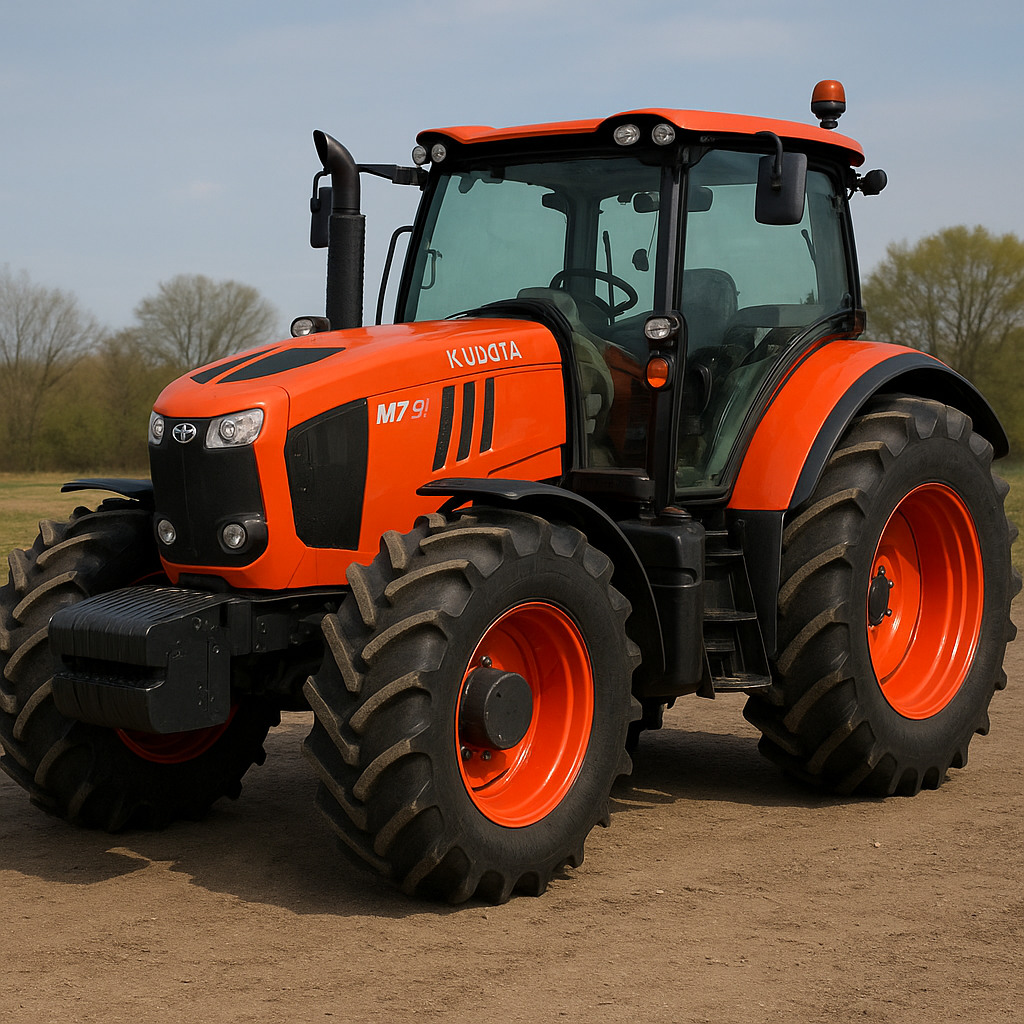
The Kubota M7-151 is a member of Kubota’s M7 series, designed to deliver strong performance for medium-to-large agricultural operations, municipal work, and contractor tasks. Combining robust construction with modern electronics and comfort features, this tractor aims to balance power, efficiency, and operator ergonomics. In the following sections we will explore its technical characteristics, practical applications, maintenance considerations, and market position, as well as highlight features that make it an interesting choice for a wide range of users.
Technical characteristics and key features
The Kubota M7-151 is positioned as a high-capacity, versatile tractor that bridges the gap between utility and heavy-duty fieldwork. At the core of its design are a durable powertrain and a thoughtfully engineered hydraulic and electrical system that allow for seamless operation with a broad variety of implements.
Powertrain and engine
The heart of the machine is its Kubota M7-151 rated engine. The model designation indicates the approximate nominal output, with the tractor delivering around 151 metric horsepower at the flywheel in typical configurations. The engine is a modern, turbocharged diesel, built to meet contemporary emissions standards and to provide smooth torque delivery across a broad rpm range. This translates to strong pulling capability and good responsiveness for PTO-driven implements.
Important aspects of the engine and drivetrain architecture include:
- 6-cylinder configuration in many variants, providing smoother operation and better balance under load.
- Common-rail fuel injection and turbocharging to improve combustion efficiency and fuel economy.
- Multiple PTO speed options (commonly 540 and 1,000 rpm) for compatibility with a wide range of implements.
- A robust cooling system designed for sustained heavy use during hot operating days.
Transmission and driveline
The transmission choices for the M7-151 typically include powershift or IVT/continuously variable-style systems on certain trims. These transmissions are engineered to provide smooth range changes and the ability to keep the engine in an optimal power band, which enhances fuel efficiency and operator comfort.
Key transmission features:
- Multiple forward and reverse ranges suitable for both transport and field speeds.
- Optional creeper gears or a low-range setup for specialized tasks like vegetable cultivation or heavy seeding where very low ground speeds are required.
- Durable final drives and axles capable of handling heavy loads when using front loaders or heavy rear implements.
Hydraulics and three-point hitch
Hydraulic capacity is a central selling point for this class of tractor. The M7-151 is equipped with powerful hydraulic pumps and multiple remote valve options, allowing simultaneous operation of several hydraulic circuits. The rear three-point hitch is designed to lift heavy implements and to perform precision depth control for modern tillage and seeding equipment.
Typical hydraulic highlights:
- High-flow pumps for loader use and hydraulic fan options.
- Multiple SCV (selective control valve) options, often up to four or more, enabling complex implement functions.
- Rear three-point hitch with high lift capacity and electronic control for accurate implement positioning.
Applications and real-world uses
The M7-151 is targeted at operators who need a tractor that can handle a broad spectrum of tasks without sacrificing comfort or efficiency. Its combination of power and hydraulics makes it suitable for heavy fieldwork, transport, and specialized tasks.
Field operations
For arable farmers, the M7-151 is well-suited to operations such as ploughing, power harrowing, strip-tilling, and seedbed preparation. The robust torque curve and high hydraulic capacity allow it to handle large cultivators, heavy discs, and multi-section planters. Its PTO options and steady power delivery also make it a good match for balers, mowers, and forage equipment.
Loader and material handling
Equipped with a front loader, the M7-151 becomes a capable material handler on farms and estates. The strong chassis and hydraulic specs enable it to lift heavy pallets, feed bales, and loads of aggregate. This makes the tractor valuable not only for fieldwork but also for yard duties, manure handling, and construction-like tasks around the farm.
Specialized and municipal roles
Municipalities and contractors often use tractors of this class for tasks such as mowing public verges, sweeping, snow removal, and operating mid-to-large sized implements for landscaping and road maintenance. The combination of comfort and reliability makes the M7-151 an attractive tool for operators who spend long days in the cab.
Livestock and mixed farms
On livestock farms, the tractor’s strength in loader operations, transport, and feed distribution is particularly valuable. The ability to match PTO-driven mixers, straw blowers, and bale processors makes it an efficient central machine in mixed enterprises.
Operator comfort, ergonomics, and safety
Kubota pays attention to the operator experience, and the M7-151 reflects that with a cabin designed for long hours of work. The cab combines noise reduction, ergonomically placed controls, and visibility to boost productivity and reduce fatigue.
Cab features and layout
The cab typically offers:
- Comfortable, adjustable seating with suspension to reduce vibration exposure.
- Low noise levels and climate control (heating and air conditioning) for year-round use.
- Well-organized controls with options for joystick operation for loader and implement control.
- Good all-round visibility and optional camera systems for easier rear implement monitoring.
Comfort and operator convenience are prioritized because they translate directly into productivity: fewer breaks, more precise work, and less wear on the operator.
Safety systems
Modern tractors are equipped with multiple safety systems, and the M7-151 typically includes features such as:
- Rollover protective structure integrated into the cab design.
- Service brakes with reliable stopping power, sometimes with wet disc brakes for durability.
- Lighting packages for safe operation at dawn, dusk, and night, including high-intensity work lights.
- Optional electronic aids like hill-hold functions and cruise control for transport tasks.
Maintenance, operating costs and durability
Operational economics are an important aspect for buyers. While the initial purchase price is significant, long-term value is determined by fuel consumption, service intervals, parts availability, and resale value. Kubota’s reputation in many markets is built on durable machines with relatively low lifetime ownership costs.
Routine maintenance
Routine tasks include oil and filter changes, fuel system checks, cooling system maintenance, and hydraulic fluid and filter servicing. Kubota aims to make service points accessible and to provide long service intervals where possible to minimize downtime.
Practical maintenance notes:
- Easy-to-access service panels and grouped maintenance points speed up routine checks.
- Long-life components in key areas like the cooling system and fuel filtration help maintain uptime.
- Authorized dealer networks provide warranty support and regular service plans in many regions.
Fuel economy and lifecycle costs
Fuel costs are often the largest single operational expense for high-horsepower tractors. The M7-151’s modern engine management and efficient transmission options are designed to keep fuel consumption reasonable for its power class. Matching tractor size and configuration to the workload—rather than over- or under-sizing—also helps control lifecycle costs.
Attachments, compatibility, and versatility
One of the M7-151’s strengths is its compatibility with a wide range of implements and attachments. This modularity increases the tractor’s utility, allowing owners to perform many jobs with a single base machine.
Common attachments
- Front loaders and quick-attach systems for material handling.
- Rotary cutters, flail mowers, and finishing mowers for land management.
- Seeders, planters, and cultivators for arable operations.
- Bale handlers, silage equipment, and feed mixers for livestock farms.
- Snow blowers, ploughs, and road maintenance attachments for municipal use.
Versatility in the M7-151 comes from both mechanical capacities (hydraulics, PTO, hitch) and from optional electronic interfaces that allow modern precision agriculture implements to be used seamlessly.
Market reception and statistical perspective
Tractors in the M7 class, including the M7-151, are popular with medium to large farms seeking a balance between power and versatility. Sales data vary by region, but overall trends show a steady demand for reliable, fuel-efficient tractors equipped for precision agriculture.
- Model naming convention: Kubota’s M7-151 designation typically corresponds to a machine in the ~150-hp class, a popular segment for diversified farms.
- Resale value: tractors from reputable manufacturers with strong dealer networks tend to retain value better; proper maintenance significantly improves resale prospects.
- Adoption trends: demand is bolstered by the need for machines compatible with modern implements and guidance systems (GPS/AutoTrac), sectors where Kubota has been expanding its offerings.
Concrete sales figures for a specific model like the M7-151 fluctuate year by year and between markets, influenced by currency exchange rates, local subsidies, and crop prices. Buyers usually consult local dealers for up-to-date availability, configuration options, and financing offers.
Comparisons, advantages and potential limitations
When evaluating the Kubota M7-151 against competitors, consider the following aspects:
Advantages
- Reliability: Kubota’s engineering and global support network are frequently cited as strong points.
- Operator comfort and modern features that reduce fatigue on long working days.
- Strong hydraulic performance and hitch capacity for handling large implements.
- Good balance between power and fuel economy compared with older designs.
Potential limitations
- Initial cost: tractors in this power class are significant investments; configuration options can raise the price further.
- Complexity: advanced electronics and transmissions may require dealer-level servicing for some issues.
- Weight and size: on smaller farms or in constrained environments, a large tractor may be impractical.
Buying considerations and configuration tips
Choosing the right configuration of an M7-151 depends on the intended primary tasks. Below are tips to help match the tractor to the job.
- For heavy fieldwork: prioritize transmission options that provide efficient power transfer and a high-capacity hydraulic system.
- For mixed-use with loader work: consider front axle and loader packages with high lift capacity and quick-attach systems.
- For precision farming: specify factory-ready electrical harnesses and GPS-compatible interfaces to simplify retrofitting guidance systems.
- For transport and roadwork: invest in high-quality tires and braking systems to increase safety and reduce tire wear.
Note on warranties and dealer support: verify the local dealer’s service capabilities, parts availability, and warranty terms before purchase, since after-sales support strongly affects long-term ownership satisfaction.
Summary
The Kubota M7-151 is a solid choice for operators who need a versatile, comfortable, and capable tractor in the ~150-horsepower class. Its strong hydraulic systems, modern engine technology, and comfortable cabin make it suitable for a wide array of tasks, from heavy tillage to loader work and municipal duties. While initial investment and the complexity of advanced systems are considerations, the combination of performance and operator-focused design make the M7-151 an appealing option for many medium-to-large agricultural operations and contractors seeking a multi-role machine.