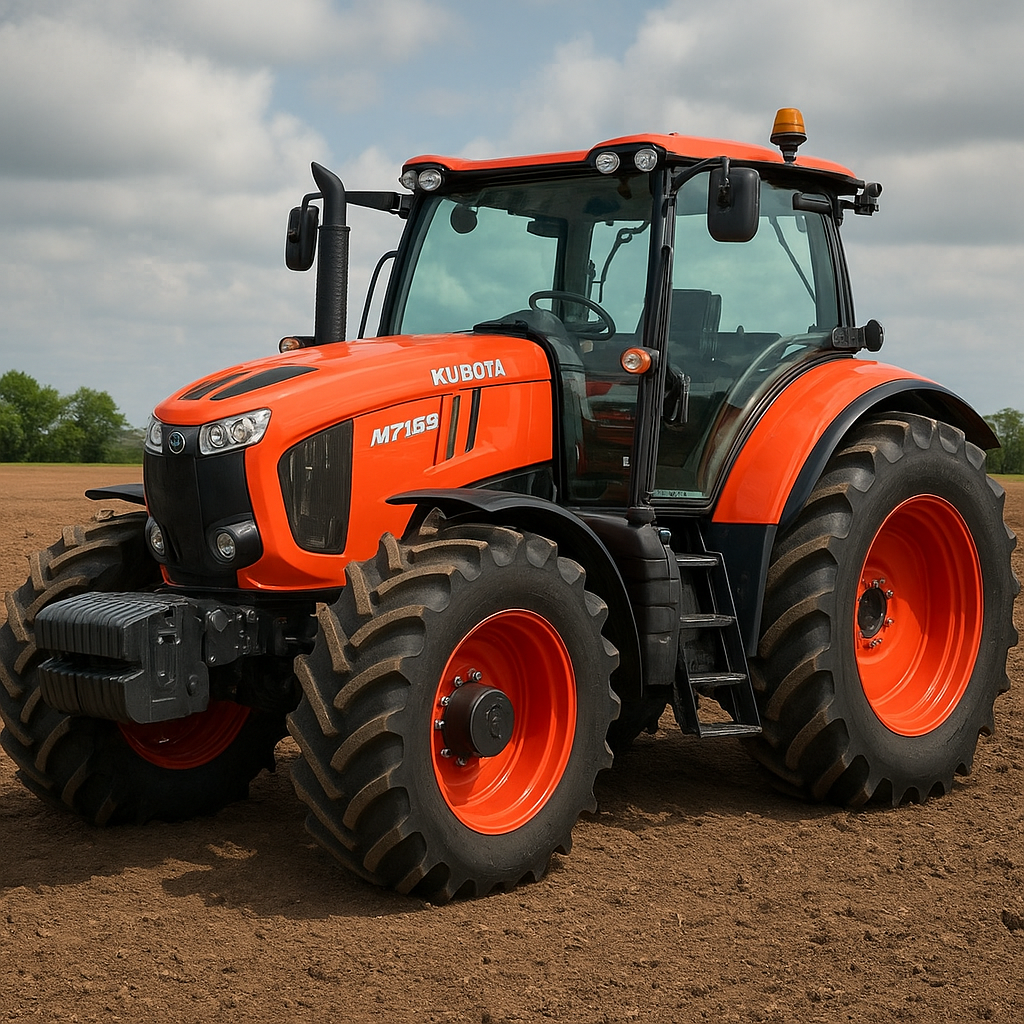
The Kubota M7-153 is a member of Kubota’s M7 series of heavy-duty tractors designed for demanding agricultural, industrial, and municipal tasks. Combining robust mechanical components, modern emissions controls, and operator-focused features, this model aims to deliver a balance of power, efficiency, and reliability for medium-to-large farms, contractors, and mixed-use operations. The following article explores the tractor’s design and technical characteristics, typical applications, operator comforts, maintenance considerations, and market context to give a full picture of where the M7-153 fits in today’s machinery landscape.
Design and technical characteristics
The Kubota M7-153 is engineered as a versatile, high-performance agricultural tractor. While exact specifications can vary slightly by year and market, key characteristics that define the model include a high-displacement diesel engine tuned for sustained torque, heavy-duty transmission options, strong rear linkage and hydraulic capacity, and modular attachments designed to expand the tractor’s usefulness.
Engine and powertrain
The core of the M7-153 is its diesel engine, rated at approximately 153 horsepower in the power class that Kubota designates with the model name. The engine is built to provide ample low-end torque for fieldwork such as ploughing, deep cultivation, and heavy loader tasks. Modern M7 series tractors typically use multi-cylinder Kubota diesel engines with turbocharging and intercooling and include aftertreatment systems that meet more stringent emissions standards (for example, Stage IV / Tier 4 Final in many markets). These systems ensure compliance without sacrificing the performance expected by professional users.
Transmission layouts for the M7-153 are provided to suit different operator preferences and applications. Customers commonly find options including multi-range power-shift transmissions and advanced continuously variable transmissions (CVT) or variable transmissions in later or higher-spec variants. These transmissions allow smooth speed changes under load, precise ground-speed control for planting and spraying operations, and robust functionality for loader and PTO-driven equipment.
Hydraulics, PTO, and linkage
Hydraulic capacity is a major selling point for tractors in this class. The M7-153 typically offers a hydraulic system designed for high flow and multiple spool valves, enabling the tractor to run complex implements such as hydraulic seeders, balers, front and rear loaders, and specialized implements. Rear linkage lift capacity on machines of this class is usually substantial, often in the several-thousand-kilogram range, enabling the use of large ploughs, cultivators, and rear-mounted seeders. The PTO system commonly supports both 540 and 1000 rpm settings to match a wide variety of implements.
Chassis, axles and weight
Built on a heavy-duty chassis, the M7-153 is designed for stability and traction in the field, with rigid axles and available four-wheel drive. Operating weight tends to be in the mid-tonnage range expected of 140–170 hp class tractors, balancing ballastability for traction and transport practicality. Front-end loader compatibility is standard on many builds, and front three-point linkage options extend the tractor’s implement compatibility.
Applications and field usage
The Kubota M7-153 is targeted at professionals who require a tractor versatile enough to perform a wide spectrum of tasks. Its combination of power and hydraulic capability makes it appropriate for cropping, livestock support, hay and forage work, loader operations, transport, and some specialty uses. Below are common application categories where the M7-153 is frequently employed.
- Arable farming — Primary tillage tasks (ploughing and subsoiling), secondary tillage (cultivating, harrow work), seeding, and slurry/injector operations where steady torque and control are necessary.
- Hay and forage — Mowing, raking, baling, and forage transport for medium-to-large operations that need reliable PTO and hydraulic performance.
- Livestock farm work — Handling feed, bedding materials, and slurry spreading as well as transport and general yard work.
- Loader operations — Material handling, pallet work, and loading trailers; the M7-153’s frame and hydraulics support a variety of loader arms and attachments.
- Contracting and municipal — Roadside mowing, snow clearing with front-mounted snowploughs or blowers, and other civic maintenance tasks where endurance and multi-function capability matter.
Because of its middle-upper power bracket, the M7-153 is a good fit for farms transitioning from smaller tractors who require more sustained power and heavier implement compatibility, as well as for contractors who need a single tractor that can adapt to multiple tasks across seasons.
Operator environment and ergonomics
Kubota places emphasis on operator comfort and control in the M7 series. An ergonomic cab layout, good visibility, and user-friendly controls contribute to better productivity during long shifts. The cab usually features climate control, comfortable seating, and an organized instrument cluster with digital displays for monitoring engine performance, hydraulic flow, and implement settings. A multifunction armrest and conveniently grouped levers reduce operator fatigue and speed up repetitive tasks.
- Cab insulation and pressurization for dust control
- Adjustable operator seat with suspension
- Intuitive joystick options for loader and hydraulic control
- Integrated monitor systems for implement and vehicle data
These features improve operator satisfaction and can translate into lower labor costs through higher effective working hours and fewer errors, particularly when the tractor is used for precision tasks such as seeding and spraying.
Performance, fuel economy and emissions
Tractors like the M7-153 are designed to deliver a balance between brute strength and fuel efficiency. The presence of modern electronic fuel management, turbocharging, and aftertreatment systems help optimize combustion and reduce fuel consumption while meeting emissions regulations. Field fuel consumption will vary widely with task, implement load, terrain, and operator technique, but operators report that tractors in this power class, when well-matched to implements, can show reasonable liters-per-hour figures for heavy draft work and much lower rates during light transport or PTO-light tasks.
Regulations in many markets require Tier 4 Final / Stage IV-compliant engines, which incorporate selective catalytic reduction (SCR), diesel particulate filters (DPF), or combinations of exhaust aftertreatment technologies. These systems maintain environmental compliance while allowing the engine to deliver rated power. For many operators, the benefit of reduced emissions and potential access to certain subsidies or incentives makes these systems a valuable part of ownership.
Maintenance, serviceability and reliability
Longevity and uptime are critical for professional users. Kubota’s design philosophy for the M7 series emphasizes ease of service and long maintenance intervals where possible. Key maintenance items include routine oil and filter changes, monitoring and servicing the aftertreatment system (where applicable), checking hydraulic fluids and hoses, and attention to drivetrain components such as transmissions and axles. A good preventive maintenance schedule helps reduce costly downtime during peak seasons.
- Accessible service points for regular daily checks
- Long-life components and sealed systems in many areas to reduce contamination
- Dealer networks for parts availability and warranty support in most markets
- Aftermarket options for extended warranties and service agreements
Reliability is the product of solid design, proper operator training, and a disciplined maintenance routine. Owners who follow manufacturer-recommended schedules and use high-quality consumables typically find that tractors like the M7-153 return strong lifecycle value.
Attachments, versatility and implement compatibility
One of the strengths of the M7-153 is its capacity to adapt via a broad range of attachments. This versatility is central to the value proposition for many buyers who need a single prime mover for multiple seasonal tasks. Typical attachments and systems compatible with this class of tractor include:
- Front and rear loaders with quick-attach systems
- Rear-mounted ploughs, cultivators, and cultivator-seeders
- Mowers, tedders, rakes, and balers for forage operations
- Spreaders, sprayers, and slurry tanks for nutrient application
- Snowblowers, snowploughs, and road maintenance tools for municipal use
- Front linkage and PTO for specialized front-mounted implements
Hydraulic flow rates, implement control circuits (proportional spools, flow sharing), and electronic linkages make the tractor usable with precision implements and ISOBUS-compatible tools, improving machine-to-implement communication and automation potential.
Market positioning, resale and economic considerations
When considering the purchase of an M7-153, buyers should weigh initial cost, operating costs, expected resale value, and return on investment (ROI). Tractors from established global brands such as Kubota usually hold their resale value reasonably well due to broad dealer networks, parts availability, and brand recognition. Financial considerations often include:
- Initial purchase price vs. productivity gains (time saved, tasks consolidated)
- Fuel and consumables costs relative to daily utilization
- Depreciation and resale expectations in the used market
- Financing, leasing, and rental options for seasonal demand management
For many operators, a tractor such as the M7-153 makes financial sense when it replaces multiple smaller machines or increases the capacity to complete critical seasonal tasks more quickly, thereby reducing crop loss risk and contractor labor costs.
Safety and regulatory aspects
Modern tractors prioritize operator safety with roll-over protective structures (ROPS), well-positioned lights and beacons for road travel, and increasingly sophisticated electronic aids such as cruise control and hill-hold features. Emissions equipment and safety systems must be correctly maintained to ensure compliance with local environmental and safety regulations. Proper training and adherence to safety procedures reduce the likelihood of accidents when using heavy implements or performing loader work.
Real-world examples and user feedback
Operators who choose tractors in the 140–160 hp bracket typically cite a set of practical benefits: the tractor’s ability to pull large implements without constant downshifting, sufficient hydraulic capacity for multi-function implements, and the comfort required for extended work periods. Many users appreciate a tractor that can be configured with multiple transmission and hydraulic packages to suit precision farming tasks or straightforward heavy draft work.
Common praise includes dependable starting and low-vibration running, good cab ergonomics for long days, and the ability to multitask (loader work in the morning, fieldwork in the afternoon) without swapping machines. Criticisms from some buyers in this class may focus on the complexity of aftertreatment systems (which can require periodic regeneration cycles), or on initial purchase price compared with lower-feature alternatives.
Buying tips and decision checklist
Potential buyers should match the tractor’s abilities to their specific operational needs. A short checklist of considerations includes:
- Define the primary and secondary tasks the tractor must perform (tillage, loader, mowing, etc.).
- Consider hydraulic demand: number of spools, flow rate, and control options required by your implements.
- Decide on transmission preference: whether smooth variable speed (CVT/KVT) or a powershift suits your work style.
- Check dealer support, warranty terms, and parts availability in your region.
- Compare fuel tank capacity and expected refuelling intervals for continuous operations.
- Look at resale values for comparable used tractors to gauge lifetime cost.
Additionally, arranging a demonstration day with representative implements attached helps validate real-world performance and operator comfort before committing to purchase.
Summary and outlook
The Kubota M7-153 represents a class of tractor aimed at professionals who need a dependable, adaptable machine with enough power for heavy draft and loader tasks, yet refined enough for precision operations. Its combination of modern engine controls (including emissions aftertreatment where required), versatile hydraulic systems, and operator-friendly cab features make it a compelling choice for medium-to-large farms and contractors. With proper maintenance and an informed purchasing decision, the M7-153 can be a central asset in a modern agricultural or municipal fleet, delivering long-term productivity and consistent service.
Reliability, comfort, versatility, hydraulics, PTO, transmission, maintenance, efficiency, power, and productivity are the principal qualities that prospective buyers should evaluate when considering this tractor for their operation.