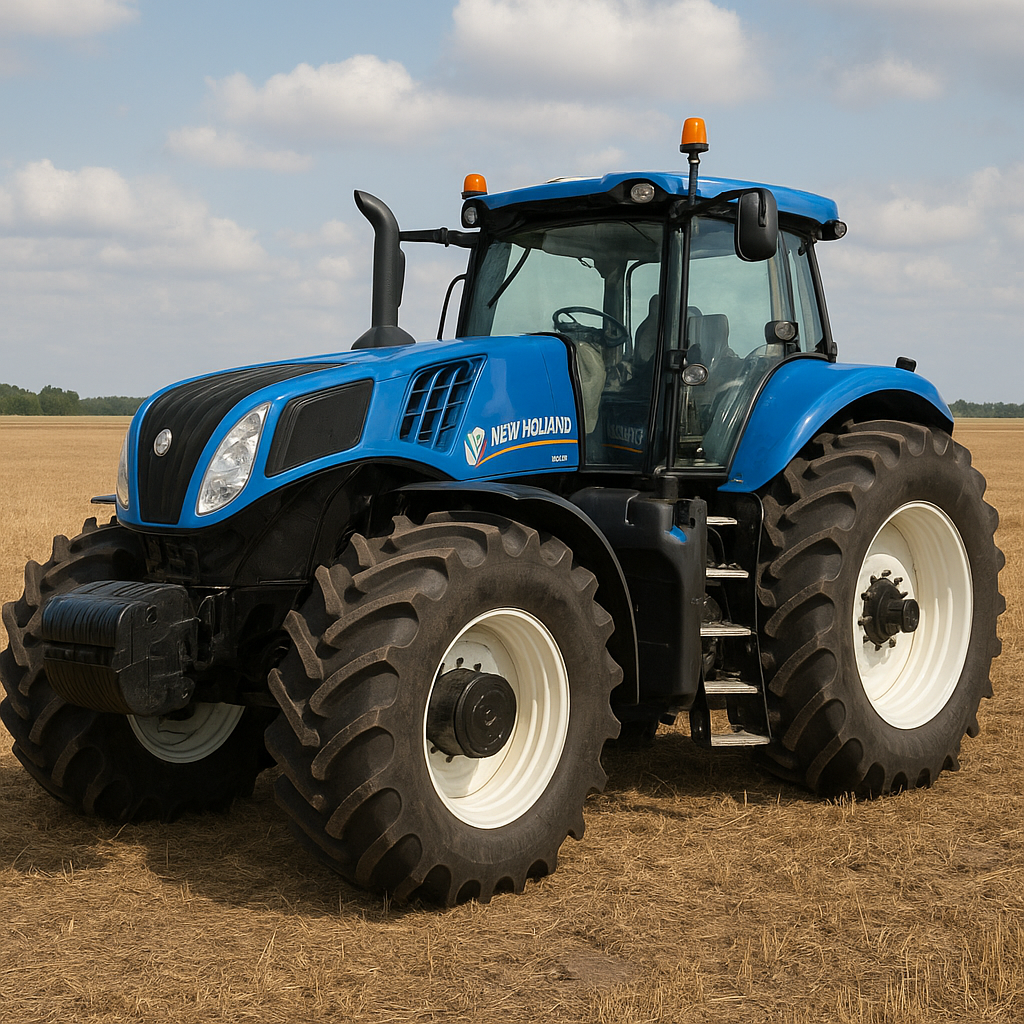
The New Holland T8.350 is a heavyweight contender in the modern agricultural tractor market, designed for large-scale farming, heavy tillage and demanding fieldwork. Combining robust mechanical design with advanced electronics and operator comfort features, the T8.350 aims to deliver high productivity, fuel efficiency and versatility for contractors and large farms. Below you will find an in-depth overview of the machine’s design, typical specifications, applications and operational considerations.
Design and Powertrain
The heart of the T8.350 is a high-output, six-cylinder diesel engine tuned to deliver roughly the performance expected from a 350-class tractor. New Holland equips the T8 series with engines that meet current emissions standards (Stage V in many markets) by using aftertreatment systems that commonly include selective catalytic reduction (SCR) and particulate filtration. The overall result is an engine package focused on combining high torque at low revs with compliance to modern environmental rules.
Key mechanical and drivetrain attributes that define the platform include:
- Engine: robust six-cylinder diesel, designed for strong low-end torque and extended service intervals. Depending on configuration and market, rated power is in the 330–380 hp class, with the model designation T8.350 indicating the approximate nominal output in horsepower.
- Transmission: New Holland’s acclaimed Auto Command continuously variable transmission (CVT) is available for smooth, stepless speed control and optimized fuel economy under load. The CVT is especially useful for precision tasks and when matching tractor speed to implement needs without constant gear shifts.
- Drivetrain options: configurations include two- and four-wheel drive setups, as well as factory-fitted tracks or duals. The SmartTrax (tracked) option provides improved flotation, lower soil compaction and better traction in soft conditions.
- Hydraulics and PTO: heavy-duty hydraulic systems support large implements, with high flow rates (typical delivery in this class can be in the 150–250 L/min range depending on the pump setup) and multiple remote valves. PTO outputs match the engine capability and are designed for mounted and trailed equipment typical of large farms.
Typical Specifications and Performance Indicators
Exact specifications vary by market, optional equipment and year of manufacture, but the T8.350 typically sits within the following ranges and characteristics. Where precise figures can differ by configuration, note ranges rather than single fixed numbers:
- Rated engine power: approximately 330–380 hp (model name indicates the 350 hp class).
- Maximum torque: substantial torque output at low rpm to ensure pulling power for deep tillage and heavy loads; torque rise characteristics prioritize traction and hitch capacity.
- Transmission: Auto Command CVT with infinite ratios within the working range; top road speed usually 40 km/h (many markets offer 50 km/h gearing options).
- Hydraulic flow: high-flow variable displacement pump options are common; typical factory choices often range from about 150 to 250 L/min depending on specification.
- Rear linkage capacity: capable of lifting large implements; typical lift capacities for this class can be in the 8,000–12,000 kg range at the hitch, depending on specification and country calibration.
- Fuel tank: large tank capacities to minimize downtime on big farms—typical capacities in this class range from roughly 500 to 800 liters depending on fitment and market options.
- Weight: gross vehicle weight and operating weight vary; ballpark operating mass for a fully equipped T8.350 is often in the 10–14 tonne range depending on tyres/tracks and ballast.
- Axles and tyres/tracks: heavy-duty axles to handle high drawbar loads, with multiple tyre options including narrow, wide, flotation and dual wheels; track options for reduced compaction.
These figures place the T8.350 firmly in the large-tractor category, catering to operators who need both high field productivity and road transport capability for long distances between sites.
Applications: Where the T8.350 Excels
The T8.350 is engineered for large-scale, intensive agricultural operations and contractors who require a single machine capable of performing a wide variety of demanding tasks. Notable application areas include:
- Deep tillage and primary cultivation—moldboard ploughing, subsoiling and heavy discing where high drawbar pull and sustained torque are essential.
- Sowing and seeding at high speed with large multi-row planters and drills that demand consistent forward speed control and hydraulic supply.
- Coupling to large sprayers and manure spreaders for high-output application tasks where PTO and hydraulic power are critical.
- Transport and haulage—moving large trailers or tankers between fields and on-road where higher top speeds and comfortable cab environments reduce driver fatigue.
- Silage and forage systems—driving large mowers, tedders, rakes and forage wagons that require quick response and robust PTO power.
- Contracting—where machine uptime, quick adaptation between jobs and resale value are important operational considerations.
In short, the machine is designed to be a multi-role workhorse for the most demanding farm and contracting tasks.
Operator Comfort and On-Board Technology
New Holland has placed emphasis on cab ergonomics and the integration of electronic systems to simplify complex tasks and enhance operator productivity. Typical cabin and control features include:
- Ergonomic cab with climate control, low-noise environment, panoramic visibility and multiple comfort options for long shifts in the field.
- High-resolution touchscreen displays (often the IntelliView family) for machine management, guidance and implement control. Display sizes and software packages vary by market and option level.
- Advanced guidance and autopilot systems compatible with GNSS for precision farming, enabling headland management, section control and variable-rate application when integrated with implement electronics.
- Telematics solutions such as PLM Connect (or similar) which allow remote monitoring of machine status, fuel consumption, location and basic diagnostics—helpful for fleet management and preventative maintenance planning.
- Automated functions such as programmable work modes, economy settings and sweet-spot engine mapping to balance fuel economy and performance automatically.
These systems reduce operator workload and improve consistency of work, which in turn increases effective daily outputs.
Fuel Efficiency, Emissions and Economics
Large tractors like the T8.350 are designed with fuel economy and emissions regulation compliance in mind. New Holland’s approach typically combines engine calibration for low-RPM torque, aftertreatment systems and transmission logic that helps keep the engine in the most efficient operating window.
- Fuel economy: actual fuel consumption depends strongly on the task, loading, soil conditions and operator choices. In general, CVT transmissions and engine “sweet-spot” tuning can reduce fuel burn compared with older multi-range transmissions by matching engine speed more closely to load.
- Emissions: equipment for many markets meets Stage V/ Tier 4 Final emissions standards using SCR, DPF and related technologies to minimize NOx and particulate emissions while preserving fuel efficiency and power delivery.
- Total cost of ownership: factors include purchase price, fuel consumption, maintenance intervals, resale values and uptime. New Holland aims to provide competitive service intervals and dealer support to lower operating costs across the machine’s lifecycle.
Maintenance, Reliability and Serviceability
Maintenance considerations are critical for machines working long hours in difficult conditions. The T8.350 platform emphasizes accessibility for routine servicing and long component life. Typical maintenance and reliability features include:
- Easy access to service points—filters, drains, battery and fluid checks are arranged to reduce downtime during routine servicing.
- Extended service intervals for major units where possible and widely available global dealer networks for replacement parts and warranty support.
- On-board diagnostics via the cab display and remote telematics to quickly identify faults and schedule preventive maintenance, helping to avoid major failures in the field.
- Heavy-duty components—axles, hitch, hydraulics and bearings are designed to handle the high loads associated with the tractor’s size class.
Practical Considerations for Buyers
Choosing a large tractor like the T8.350 involves matching machine capability to farm needs, balancing purchase cost against productivity gains and considering long-term fleet management. Practical points to assess include:
- Work profile: Determine the percentage of heavy draft work (ploughing, subsoiling) vs transport or lighter tasks. If primary work is heavy draft, a heavier, higher-traction configuration (duals or tracks) is sensible.
- Implements: Ensure hydraulic flow, PTO speed and rear linkage capacity match the implements you intend to use. Upgrading pumps and valves might be necessary for particularly demanding hydraulic tools.
- Cab and technology: If precision farming, variable-rate applications and telematics are important, select an options package with compatibility for guidance systems and data transfer.
- Resale and fleet balance: Large tractors are capital-intensive. Consider how this tractor fits within a fleet, rotation cycles and resale value in your region.
- Operator training: Sophisticated transmissions and electronic systems pay dividends only if the operator understands how to use them for fuel saving and productivity.
Comparisons and Market Position
The T8.350 competes with other high-horsepower tractors from global manufacturers. Its major strengths are a balance of raw power, modern transmission technology (Auto Command CVT), advanced cab features and options for tracks and precision farming electronics. Buyers often compare it to rival tractors in the same horsepower bracket, weighing factors such as dealer support, parts availability, operator preference and total cost of ownership.
New Holland tends to position the model as a versatile large-farm tractor that blends comfortable operator environment with tools for precision agriculture, while also offering configurations tailored to either heavy fieldwork or more road-oriented tasks.
Real-World Use Cases and Performance Observations
Farmers and contractors using tractors in this class commonly report the following operational observations:
- Excellent pulling power for deep primary tillage tasks when correctly ballasted and fitted with appropriate tyres or tracks.
- Auto Command transmissions significantly improve average field speed and reduce fuel consumption when managed properly, especially on long, continuous passes.
- Tracked configurations (when fitted) reduce soil compaction and improve traction in wet seasons, leading to more consistent field performance across variable conditions.
- Operator fatigue is reduced by comfortable seats, low noise levels and automated functions—important for long days and multiple successive jobs.
- Telematics and remote monitoring enhance fleet utilization and allow maintenance to be scheduled proactively, reducing unexpected downtime.
Summary: Strengths, Limitations and Final Notes
New Holland built the T8.350 to be a high-output, versatile tractor for demanding agricultural environments. Its main strengths are the combination of high horsepower, the smooth and efficient Auto Command (CVT) transmission, modern emission control (Stage V compliance in many territories), and a feature-rich cab with integrated precision-farming tools like the IntelliView displays and telematics connectivity. The availability of tracks (SmartTrax) and multiple hydraulic/PTO configurations further enhance its applicability across a wide range of farm tasks.
Limitations are typical for machines of this class: higher initial purchase cost, the need for skilled maintenance and operator training to realize full efficiencies, and the requirement for suitable implements that match the tractor’s capability. Nonetheless, for large operations and contractors seeking a single machine to handle high-output work, the T8.350 is designed to offer a compelling balance of power, comfort and modern technology.
Note: Specific numeric values for capacities and performance depend on year, market and optional equipment. When evaluating a particular unit, consult the manufacturer’s specification sheet or local dealer to confirm exact figures for horsepower, hydraulic flow, linkage capacity, fuel tank volume and recommended service intervals.