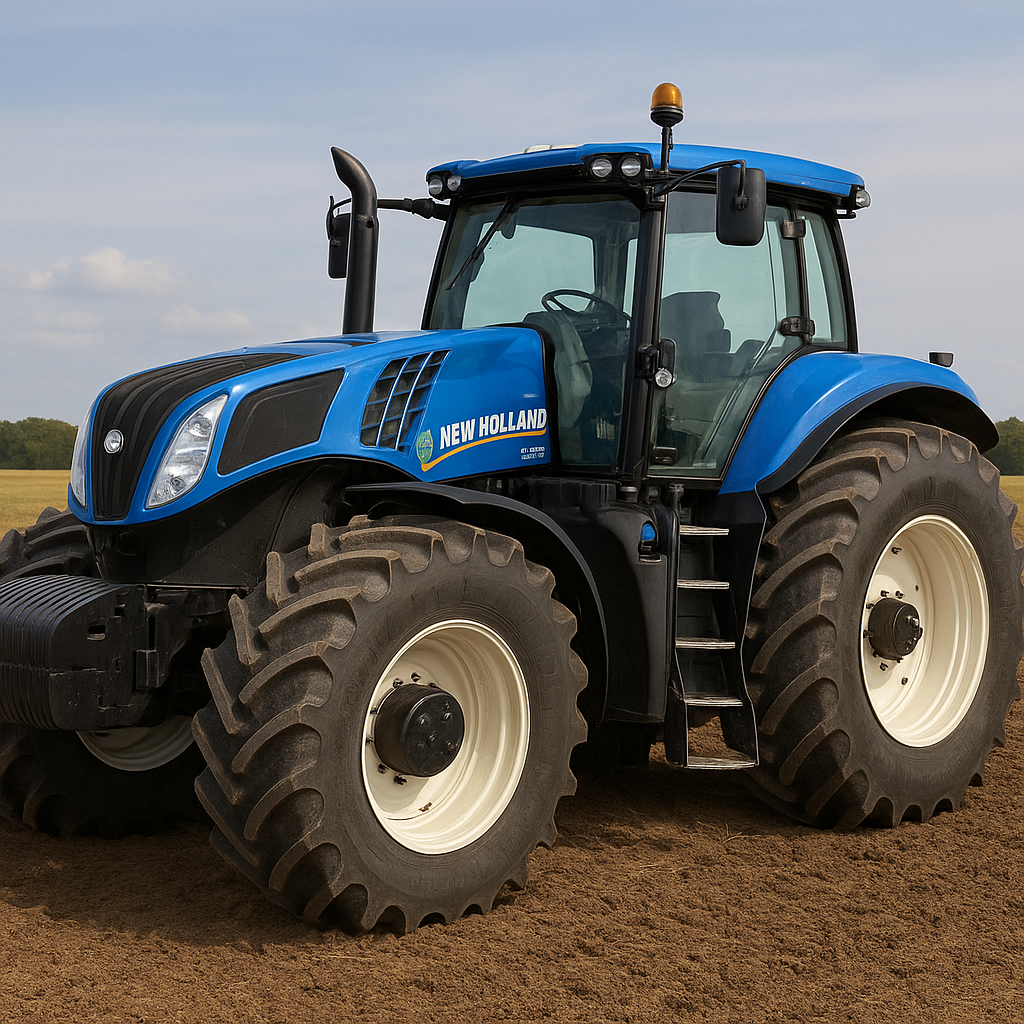
The New Holland T8.435 is a member of the high‑horsepower T8 family designed to address the needs of large-scale arable farms, contractors, and mixed operations that require a combination of sustained pulling power, advanced hydraulics and intelligent transmission options. This article explores the T8.435’s design philosophy, typical applications, technical characteristics, operator amenities and economic considerations. Where exact figures vary by market or configuration, approximate or typical values are given and flagged as such. Throughout the text you will find discussion of the machine’s most important attributes, including power, efficiency, comfort and reliability.
Overview and positioning
The T8.435 sits at the upper end of New Holland’s row‑crop and chassis‑based tractor range. It is engineered to deliver sustained outputs for heavy tillage, large planters and seeders, high‑capacity slurry and fertilizer applications, heavy transport and large baling or forage operations. New Holland markets the T8 series as a modern, versatile platform combining advanced diesel engines with intelligent transmissions and precision farming electronics. For many operators the T8.435 represents a balance of raw horsepower and refined electronic control systems designed to improve daily productivity while reducing operator fatigue and operating costs.
Design features and key technologies
Core to the T8.435 concept are several design pillars: a high‑torque diesel engine, flexible transmission choices, a capable hydraulic system and a comfortable, technology‑rich operator environment.
Engine and powertrain
The T8.435 is named for its nominal engine output, i.e., approximately 435 hp (around 320 kW). New Holland fits its high‑power T8 tractors with emissions‑compliant FPT (Fiat Powertrain Technologies) engines or equivalent units tuned for torque delivery across a wide rev range. Typical attributes of the powertrain include heavy flywheel mass for draft control, turbocharged and intercooled aspiration, and after‑treatment designed to meet regional emission standards (e.g., Tier 4 Final / Stage V where applicable).
One of the most appreciated elements is the transmission: New Holland’s AutoCommand continuously variable transmission (CVT) or equivalent powershift options allow smooth, stepless acceleration and fine speed control. AutoCommand enables precise speed matching during seeding and on‑headland maneuvers, while delivering fuel efficiency benefits in both field and road transport. Many units also include integrated features such as engine‑transmission management to optimize fuel use and responsiveness.
Hydraulics, linkage and PTO
The T8.435 typically offers a robust hydraulic system to support demanding implements. This means high flow rates from the load‑sensing pump and multiple remote spool valves with electronic control for fingertip adjustment. Typical maximum flow rates (depending on specification) can reach around 160–190 liters per minute for combined standard and optional pumps. Rear lift capacities are often in the range of approximately 10,000–12,000 kg, making the tractor suitable for large seed drills, heavy subsoilers and large slurry applicators.
PTO options commonly include 540/1000 rpm with electro‑hydraulic engagement and management through the implement control systems to protect driveline components and improve coupling ease. Front PTOs and front linkage options are available on many configurations, increasing implement versatility.
Chassis, axles and suspension
T8 tractors are built on a heavy‑duty chassis with wide track options and multi‑purpose axles. Front axle suspension and cab suspension are often included to improve ride comfort and stability at speed. The available front suspension systems (e.g., Terraglide+ or equivalent) work together with the AutoCommand transmission and active front hitch to keep large implements stable at transport speeds and in the field. Tyre and track options allow the machine to be optimized for traction, flotation or road speed depending on the operator’s priorities.
Applications and typical use cases
The T8.435’s combination of high power, hydraulic capacity and advanced electronics makes it suitable for a wide array of heavy agricultural tasks:
- Primary tillage: large moldboard ploughs, heavy disc harrows and deep ripping implements that require sustained drawbar pull.
- Seeding and planting: pulling wide planters and air seeders at consistent forward speeds to preserve seed placement accuracy and minimize overlap.
- Fertilizer and slurry application: high‑capacity tankers and trailing‑arm applicators that require steady PTO and hydraulic reliability.
- Forage and baling: tandem balers, large mowers and forage harvesters where PTO and hydraulic power are critical.
- Road transport and haulage: heavy trailers and transport frames, taking advantage of higher road speeds and CVT efficiency for long transfer runs.
- Contracting work: contractors benefit from the T8.435’s capability to run a diversity of implements across different farms and jobs, improving return on capital.
Additionally, specialty uses such as forestry mulching, heavy earthmoving with an appropriate attachment, and winter maintenance (snow blowers and large blades) are feasible when machines are properly specified and fitted.
Operator comfort and technology
New Holland places strong emphasis on operator experience in the T8 series, and the T8.435 typically includes a spacious cab, climate control, ergonomic seat and armrest controls, and comprehensive digital displays. Key operator features often include:
- Large touchscreen displays with implement and tractor telematics integration for precision farming (GPS guidance, auto‑steer, section control).
- Joystick and multifunction armrest design for controlling forward/reverse, three‑point hitch, spool valves, and optional front loader functions.
- Advanced cab suspension and noise insulation to reduce fatigue during long operating days.
- Visibility enhancements such as LED lighting packages and optionally heated mirrors and cameras for rear/side implement monitoring.
Precision agriculture packages are commonly integrated or available as factory options, enabling variable rate application, field mapping and remote fleet management—tools that can substantially increase efficiency on large farms or contracting fleets.
Performance figures and operational statistics (typical values)
Exact specifications vary by market and equipment pack, but the following are representative numbers often associated with tractors in this category and model family:
- Engine output: approximately 435 hp (roughly 320 kW) at rated RPM. Peak or boost outputs may be higher in brief operating windows.
- Maximum torque: typically in the range of 1,600–2,000 Nm depending on engine tuning and boost.
- Fuel capacity: tanks commonly hold several hundred liters; typical configurations have around 500–600 liters for extended field operation.
- Hydraulic flow: combined standard and optional pumps can offer around 160–190 L/min to service multiple implements simultaneously.
- Rear lift capacity: commonly up to roughly 10,000–12,000 kg, allowing for the heaviest mounted equipment.
- Road speed: factory limits commonly 40 km/h in many regions, with optional higher‑speed transmission settings in some markets.
- Operating weight: depending on tyres, ballast and attachments, typical ballpark weights range from about 10,000 kg to 14,000 kg.
- Fuel consumption: varies with load, but in heavy work average consumption could be on the order of 15–35 liters/hour depending on task intensity; transport work tends to be lower per hour but higher per distance unit.
These figures should be treated as indicative. For precise values, specifications from a local dealer or the official factory data sheet should be consulted because payload, optional equipment and emissions packages all materially affect numbers.
Maintenance, serviceability and operating costs
High‑power tractors like the T8.435 are engineered for long service intervals and relatively easy maintenance, but lifecycle costs remain significant. Notable aspects for operators include:
- Service intervals for oil and filters coordinated to maximize uptime; many modern engines use longer intervals thanks to advanced filtration and synthetic lubricants.
- Access to the engine bay, filters and major wear points designed to be service‑friendly to reduce downtime during peak seasons.
- Telematics and remote diagnostics options that help dealers and fleet managers monitor fuel use, uptime and service reminders—reducing unexpected failures.
- Parts availability and dealer network coverage play a major role in total cost of ownership, particularly in regions with intense seasonal peaks.
Operators considering a T8.435 should model total ownership costs including fuel, tires, service, insurance and financing. The capital cost will be higher than medium‑power tractors, but productivity gains—especially on large acreages or contracting jobs—can justify the investment through fewer passes, higher daily output and improved implement compatibility.
Safety and environmental considerations
Modern New Holland tractors incorporate both passive and active safety features: rollover protection within the cab structure, hydraulic interlocks for PTO and lift control, and lighting packages to improve visibility. Emissions control systems on the T8.435 use after‑treatment technologies (e.g., SCR, DPF, DOC where required) to comply with local regulations. These systems add complexity to maintenance but are necessary to reduce NOx and particulate emissions.
Operators should be aware that heavy tractors can compact soil, particularly when used repeatedly on wet soils with wide implements. Mitigation strategies include using wide flotation tyres or tracks, controlled traffic farming practices and careful timing of field operations. The efficiency gains from electronic controls, precision application and matched implement selection can, however, reduce total input use and emissions per hectare compared with less optimized alternatives.
Market context and resale considerations
High‑power tractors like the T8.435 are purchase decisions often driven by acreage, implement width and the need for single‑tractor capability. In markets with large farms or where contractors prevail, demand for tractors in the 300–500 hp class has been sustained because the machines reduce the number of passes and match the capacity of modern implements.
Resale values depend on hours, maintenance history and regional demand. Properly maintained machines with telematics logs of service and usage typically fetch stronger resale prices. Options such as GPS/auto‑steer, front linkage, premium lighting and larger hydraulic packages also increase resale desirability.
Practical tips for operators
- Match tyres or tracks to field conditions: flotation tyres or tracks reduce compaction and improve traction for heavy draft work.
- Use integrated precision farming tools to cut overlaps, manage inputs and track machine productivity; the labor and input savings often pay back the technology cost quickly on large farms.
- Plan for seasonal service: pre‑season checks and scheduled maintenance reduce the probability of breakdowns during critical windows.
- Invest in operator training for CVT and engine management features to maximize fuel economy and reduce operator stress on heavy tasks.
Conclusion
The New Holland T8.435 is designed as a high‑capacity, technologically advanced tractor for modern large‑scale agriculture and contracting. It offers a mixture of raw power, intelligent transmission and robust hydraulic capability meant to handle the widest and heaviest implements with efficiency. Combined with modern telematics, comfort amenities and safety features, the T8.435 can increase productivity on farms that require large daily outputs. Exact performance and cost figures depend on configuration and local market options; operators should consult dealers for full technical data sheets and configure the tractor to match their implements and agronomic practices. The tractor’s strengths—high torque, adaptable hydraulics, and precision farming integration—make it a compelling option for businesses focused on scale, consistency and long‑term return on investment.