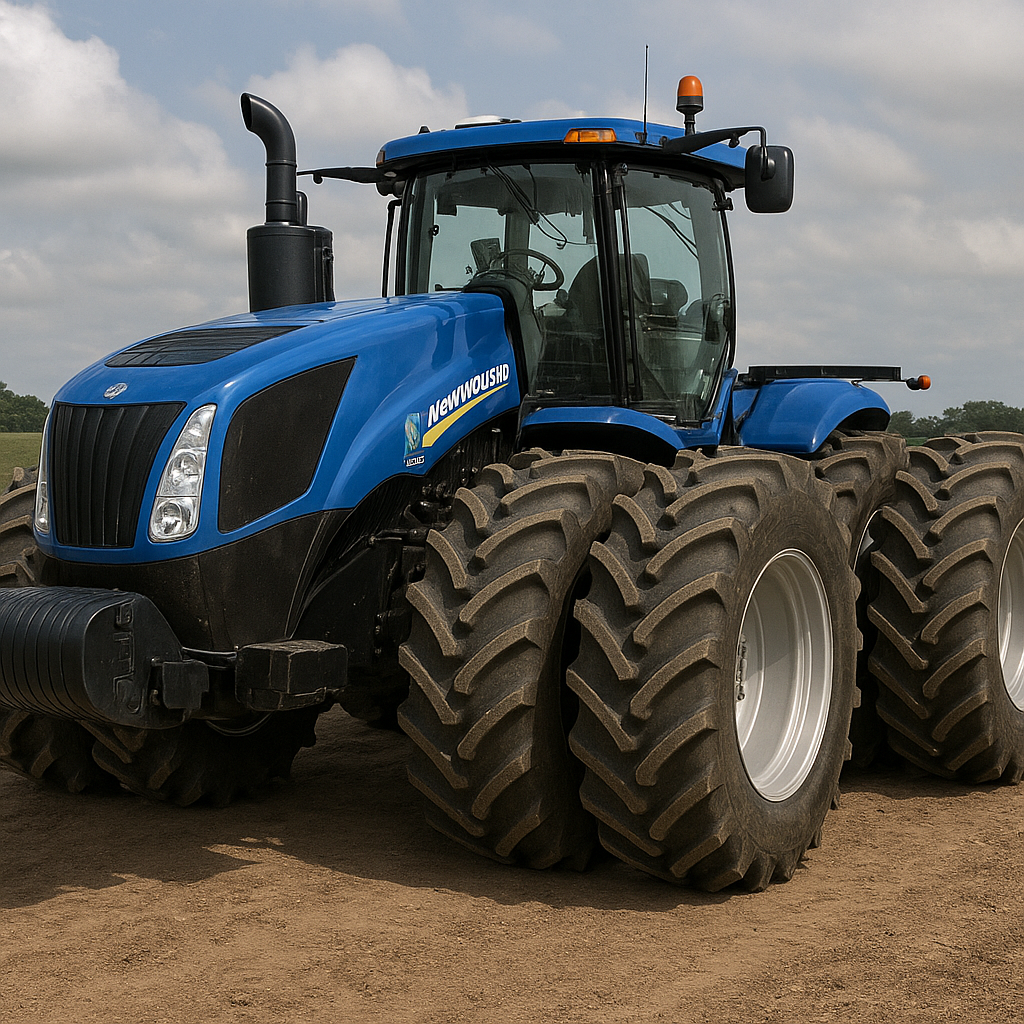
The New Holland T9.600 represents the pinnacle of the T9 series of high-horsepower tractors designed for large-scale arable farming, heavy tillage and demanding traction work. Built to move large implements, handle high draft loads and maintain high productivity across long working days, this machine blends heavy-duty mechanics with modern electronics and operator comforts. Below you will find an in-depth look at its characteristics, practical applications, technical highlights, operational tips and the economic and environmental context that makes the T9.600 a compelling choice for contractors and large farms.
Overview and design philosophy
The T9 series was developed to meet the needs of farms and contractors requiring very high tractive effort with minimal soil compaction and maximum field productivity. The T9.600, as the flagship designation in the range, is aimed at users who need sustained, high-power performance in the field. New Holland’s design priorities for the T9 include robust mechanical foundations, advanced traction systems, operator comfort for long shifts, and integration with precision-agriculture technologies.
Key design elements
- Tracks and traction: The T9 platform is commonly configured with wide tracks (four-track or two large 24–30-inch tracks depending on market), which increase ground contact area, reduce soil compaction and improve traction in variable soil conditions.
- High-capacity driveline: The driveline and final drives are engineered for continuous high power and torque transfer to the ground under very high draft loads, with heavy-duty components to withstand repeated heavy use.
- Operator environment: A roomy, ergonomically designed cab with advanced controls and visibility reduces operator fatigue and increases productivity over long hours.
- Electronics and connectivity: Integration with auto-guidance, ISOBUS-compatible implements and telematics supports precise, efficient operations and enables data-driven farm management.
These design choices make the T9.600 a machine targeted at high-acreage operations, large implement towing (plows, cultivators, subsoilers), heavy seeding operations, tillage and, in some configurations, even high-power transport and specialty tasks.
Technical highlights and specifications
The T9.600 carries the expectations associated with its model name: high engine output and a heavy-duty specification. While specific figures can vary with year, emission stage and optional packages, the following general technical highlights characterize the model family and typical T9.600 builds.
Powertrain and engine
- Engine output: The T9.600 is identified by its approximately 600 indicated engine horsepower rating (manufacturer model designation). This places it among the highest-power tractors commonly used in agriculture.
- Engine family: New Holland typically equips the T9 with a large-displacement, turbocharged diesel engine from its supplier family designed to meet the latest emissions standards through aftertreatment systems (SCR, particulate filtration where required).
- Torque and responsiveness: High torque at working RPMs ensures effective draft performance with large tillage implements and helps maintain forward momentum in challenging soils.
- Transmission/drive system: The T9 normally uses a heavy-duty transmission optimized for traction and drawbar tasks, paired with large-range gearing suitable for both fieldwork and transport. Drive-to-ground can be via large dual wheels or, more commonly for T9, via track systems which optimize flotation and traction.
Hydraulics, PTO and hitch
- Hydraulic capacity: High-flow hydraulic systems support large planters, seeders and active tillage implements; multiple hydraulic circuits and valves are available for complex implement control.
- PTO options: The T9 family supports heavy-duty PTO configurations for powered implements, though many applications for the T9 rely mainly on draft rather than PTO-driven tools.
- Hitch and draft link: Reinforced three-point hitch and drawbar systems designed to handle substantial draft loads and heavy mounted or trailed equipment safely and reliably.
Cab, controls and technology
- Cab comfort: Large, climate-controlled cab with air suspension seating, low noise levels and panoramic visibility to reduce fatigue over long shifts.
- Displays and controls: Multi-function displays, often with touchscreen IntelliView-style interfaces, consolidate machine controls, implement settings and precision guidance information in a single location.
- Precision agriculture features: Factory-enabled compatibility with GPS auto-guidance, section control, variable-rate application and ISOBUS provides integration with modern farm-management workflows.
Approximate metrics and weights
Exact weights and dimensions depend on configuration (tracks vs. wheels, ballast, fuel capacity and optional equipment). As a general guide:
- Rated power: around 600 engine horsepower (model-based designation).
- Operating weight: heavy, typically in a high-tonnage range when equipped with tracks and ballast; operators should expect a machine weight that supports optimal traction without excessively increasing soil compaction through wide track footprint.
- Fuel capacity: large tanks suited to long field days between refueling; actual liters vary by specification and market.
Primary applications and field roles
The New Holland T9.600 is not a general-purpose small farm tractor — it is an industrial-strength machine intended for specific high-demand uses. Below are the main areas where the T9.600 shines.
Tillage and soil cultivation
- Deep ripping, heavy ploughing and large cultivator operations that require continuous high draft force are core roles for the T9.600. Its traction and weight distribution allow large working widths and deep penetration without excessive wheel slip.
- Track configurations lower ground pressure and maintain traction even in softer soils, enabling earlier or later season operations when conditions are otherwise marginal.
Seeding and planting with large implements
- When paired with very large planters and seeders, the T9.600 provides both the drawbar power and hydraulic flow to operate long working widths while maintaining consistent forward speed for high-quality seed placement.
- Precision agriculture systems (auto-guidance, section control) allow these operations to be carried out with high accuracy across many hectares.
Large-scale cultivation and nutrient application
- High-capacity sprayers or applicators that are trailed behind the tractor can be handled with minimal performance loss, especially on firm soils and with track options limiting compaction.
- Fertilizer banding and deep-placement tools also benefit from the sustained power and hydraulic capacity of the T9 platform.
Contracting and specialized heavy tasks
- Many operators deploy a T9.600 in contracting fleets for tasks where a high-horsepower machine increases hourly productivity enough to justify the investment — e.g., large-scale primary tillage across tens of thousands of hectares.
- Specialized attachments and conversions allow the machine to serve in non-farm heavy-traction roles such as land reclamation and road/ditch maintenance in agricultural environments.
Operational advantages and challenges
Owning and operating a T9.600 brings distinct advantages but also requires deliberate management to maximize return on investment. Below are the most important considerations.
Advantages
- High productivity: Large working widths paired with sustained power output reduce the hours needed per hectare for heavy field operations.
- Reduced draft-induced slippage: Track options improve traction efficiency, decreasing fuel wastage due to slippage and lowering soil compaction per unit of work.
- Comfort and control: Advanced cab and electronic systems support long working days while providing precise control of implements and field operations.
- Integration with precision farming: ISOBUS and telematics support data collection and automation that improve accuracy and input-use efficiency.
Challenges and requirements
- High acquisition cost: The T9.600 is a significant capital investment; purchase decisions usually rest on farm scale, contracting income potential and long-term replacement planning.
- Transport logistics: Large machines require planning for road transport, gates, bridges and turnaround space on-farm; in some regions, permits or escorts may be necessary for transport.
- Maintenance: Heavy-duty driveline components, track systems and aftertreatment hardware require scheduled maintenance and specialized service knowledge.
- Soil and traffic management: While tracks reduce point compaction, operators must follow traffic lanes and controlled-traffic cropping strategies where possible to minimize overall soil structure impacts.
Maintenance, serviceability and lifecycle costs
Maintaining a T9.600 to factory-recommended schedules is essential for reliability and long service life. Given the tractor’s role as a high-utilization workhorse, planned maintenance and proactive parts management are crucial.
Key maintenance areas
- Engine and aftertreatment: Regular oil and filter changes, and careful monitoring of SCR/DPF systems (if equipped) to ensure emissions compliance and performance.
- Tracks and undercarriage: Track tension, wear patterns and roller/bogie condition should be checked frequently; replacement costs can be material and should be anticipated in lifecycle budgets.
- Hydraulics and PTO: Fluid cleanliness and filter replacement are critical for multi-valve hydraulic systems handling high flow and pressure.
- Electrical and electronics: Precision guidance and telematics systems require both hardware reliability and up-to-date software; subscription services or updates may be part of ongoing costs.
Ownership economics
Total cost of ownership depends on utilization. Large-acreage farms and contractors that can keep the machine productive across the season are best positioned to amortize purchase costs. Considerations include:
- Fuel consumption — optimized through efficient matches of gear selection and ground speed and by leveraging auto-guidance to minimize overlaps and slippage.
- Depreciation and residual value — strong maintenance records and brand reputation can preserve resale value.
- Parts and service availability — dealer support networks and availability of OEM parts influence downtime risk and operating costs.
Precision farming, connectivity and software
Modern T9.600 tractors are designed to be integral parts of a digitally connected farm, providing both machine control and data streams for agronomic decision-making.
Auto-guidance and steering
- Factory or dealer-installed guidance systems allow sub-meter to centimeter-level repeatability, reducing overlap and missed areas, increasing field efficiency and reducing input waste.
- Steering assists and headland management can automate complex sequences, further reducing operator workload and improving consistency across long working days.
ISOBUS and implement integration
- ISOBUS compatibility simplifies the process of attaching and configuring third-party implements; a single terminal can control seed rates, section on/off and implement-specific settings.
Telematics and fleet management
- Remote monitoring provides insight into fuel usage, engine hours, location and fault codes, allowing for predictive maintenance planning and efficient fleet coordination.
Safety, ergonomics and operator training
Given its size and power, safe operation of the T9.600 requires good training and adherence to safety protocols. Ergonomic features reduce strain on operators, but that does not replace the need for formal training.
- Visibility and lighting: High-mounted cabs and LED lighting packs ensure good visibility during night work and early/late season operations.
- Fall and entanglement hazards: Large implements and moving tracks introduce hazards that must be mitigated through lockout procedures and clear communication when working with ground crews.
- Operator training: Familiarity with precision systems, emergency procedures and safe hitching/unchaining protocols reduces the risk of incidents and improves productivity.
Environmental considerations
Large tractors like the T9.600 have both positive and negative environmental implications. Thoughtful management can leverage benefits while minimizing negatives.
Soil health and compaction
- Track options and controlled-traffic practices can spread load over more surface area and reduce per-pass compaction. However, if traffic is unmanaged, large machines can still cause detrimental soil structure effects.
Emissions and fuel use
- Modern engines with aftertreatment systems meet strict emissions standards, but fuel consumption remains a significant input cost and source of greenhouse gases. Efficient operation, precision guidance and load-matching help reduce fuel per hectare.
Efficiency gains
- By reducing the number of passes and enabling wider implements, machines like the T9.600 can lower total field traffic, reduce aggregate fuel use per hectare and improve timeliness of operations — all of which can have positive environmental benefits when properly managed.
Market position, competitors and lifecycle
Within the market for very-high-horsepower tractors, the T9.600 competes with offerings from other major manufacturers who also supply track-fit tractors or high-horsepower wheeled machines. Buyers typically compare overall productivity, dealer support, total cost of ownership and integration with their existing fleets and implements.
- Comparative strengths: New Holland’s emphasis on operator comfort, integrated precision tools and track systems make the T9 attractive for contractors and large-scale arable operations.
- Replacement cycle: High-utilization users often plan replacement on a 6–12 year cycle depending on hours per year, resale values and evolving emission regulations.
Real-world examples and use cases
Across Europe, North America and parts of Latin America and Australia, the T9.600 is frequently used by operators who need to cover large acreages quickly and reliably. Typical case uses include:
- Spring primary tillage across 1,000+ hectare farms where soil conditions can vary and a consistent pull is required.
- Autumn or spring deep-ripping operations in heavier soils to break compaction layers ahead of planting seasons.
- Contracting fleets providing specialized tillage and planting services to multiple farms across a region.
Buying considerations and configuration choices
Prospective buyers should carefully evaluate configuration choices against typical farm tasks and long-term operational plans. Key decisions include:
- Track vs. wheel configuration — consider soil type, transport logistics and implement compatibility.
- Hydraulic and electrical packages — choose options that support current and planned implements.
- Guidance and telematics subscriptions — factor these into ongoing costs but recognize their productivity and data benefits.
- After-sales support — evaluate dealer service network and parts availability for your region.
Summary and practical recommendations
The New Holland T9.600 is a purpose-built machine for the largest agricultural tasks. Its greatest strengths lie in high sustained power, traction options that reduce slipping and compaction, and integration with modern precision-agriculture systems that increase effective productivity across large areas. When considering the T9.600, users should weigh the high initial cost against expected gains in efficiency, the quality of local dealer support, the availability of suitable implements and the farm’s ability to use the tractor at sufficient intensity to justify the investment.
Practical recommendations for potential users:
- Adopt controlled-traffic principles to limit soil damage and concentrate maintenance into known lanes.
- Invest in precision guidance and ISOBUS-capable implements early to maximize operational returns.
- Plan for hydraulic and undercarriage maintenance in budgeting to avoid unexpected downtime costs.
- Ensure operator training programs are in place for safe, efficient, and consistent machine operation.
Highlighted attributes
- Power: Sustained high engine output for heavy draft tasks.
- Traction: Track systems and robust drivelines to optimize pull and minimize slip.
- Cab: Comfort and control to support long operational days.
- Efficiency: Wide implements, precision guidance and reduced pass numbers lower cost per hectare.
- ISOBUS: Compatibility simplifies implement integration and control.
- Auto-guidance: Higher accuracy and lower operator fatigue.
- Hydraulics: High-flow systems for complex implements.
- Productivity: Designed to increase hectares covered per hour.
For large-scale producers and contractors, the New Holland T9.600 can be a transformational machine when matched to operations that fully utilize its strengths. Proper configuration, maintenance planning and precision farming integration are the keys to getting the most value out of this class of tractor.