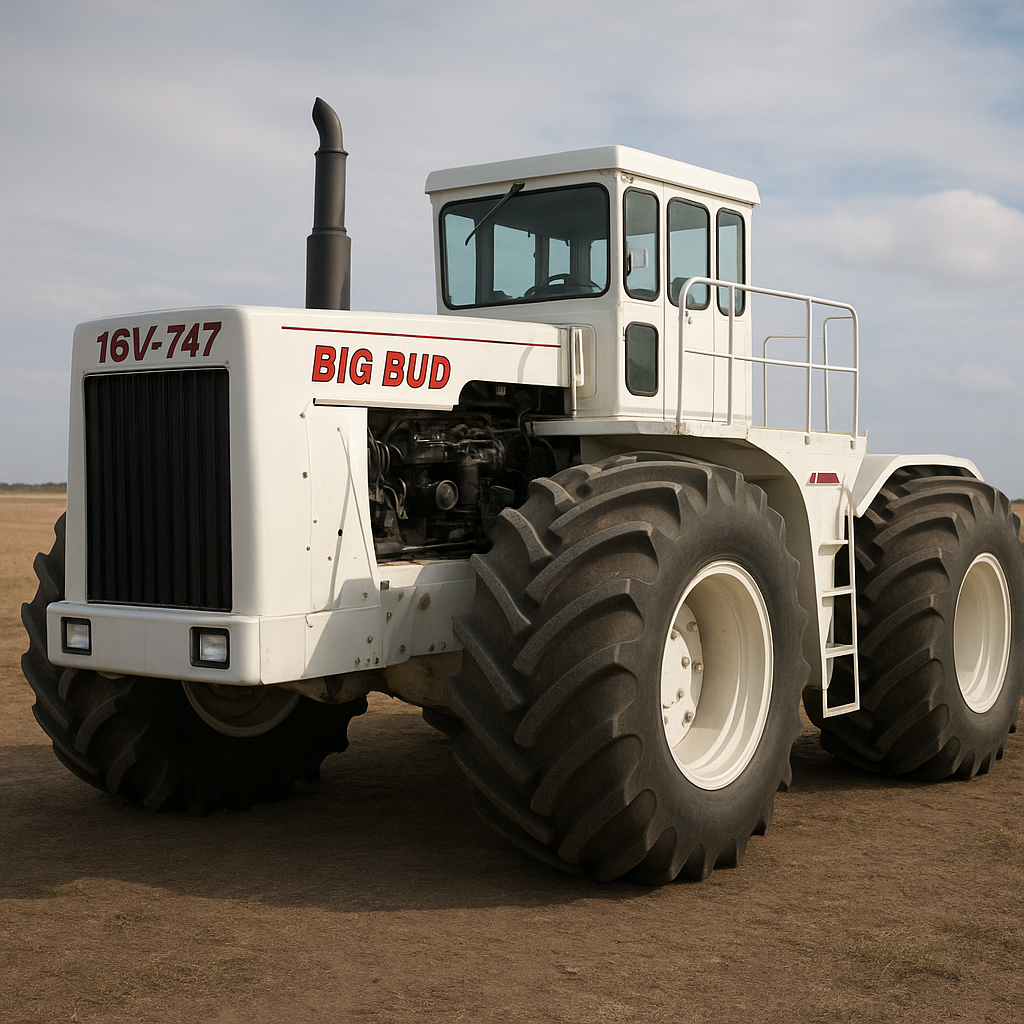
The Big Bud 16V-747 is one of the most famous and imposing names in agricultural machinery. Often described in popular media as the world’s largest farm tractor, it represents a specific era of mechanized agriculture when raw power and scale were the primary answers to the increasing demand for efficiency on very large farms and ranches. This article examines the tractor’s origins, technical characteristics, practical uses in the field, and its cultural and economic legacy. Where exact figures vary between sources, measured qualifiers such as “reported” and “approximate” are used to reflect historical and statistical uncertainty.
History and development
The Big Bud story begins in the northern Great Plains of the United States, a region characterized by expansive fields and large-scale dryland farming. The original company behind the Big Bud tractors was based in Havre, Montana. The Big Bud 16V-747 was developed in response to the need for an agricultural machine capable of pulling extremely large tillage and seeding implements across tens of thousands of acres more quickly than multiple smaller tractors could.
Development of the 16V-747 took place in the 1970s, a period when farmers and equipment designers experimented with maximalist approaches to mechanization. The goal was not only to increase productivity but also to reduce the logistical complexity of moving many smaller tractors and drivers. The finished machine embodied a philosophy of consolidation: one powerful tractor replacing several medium-sized units for certain heavy-duty tasks.
Design philosophy and goals
- Maximize single-unit implement-pulling capability
- Reduce the number of passes and tractors needed for deep tillage
- Provide heavy-duty durability and long service life on large operations
To achieve these goals, designers emphasized a substantial frame, heavy-duty driveline components, and a large-capacity diesel engine. The Big Bud 16V-747 became synonymous with the pursuit of the highest possible field horsepower in a single agricultural machine.
Design and technical characteristics
Exact specifications for the Big Bud 16V-747 vary with different rebuilds and reporting sources, but several recurring technical features illustrate what made this tractor distinctive. It is built around a very large V16 diesel engine, a robust transmission and driveline, and oversized tires or tracks to transmit torque to the ground.
Engine and powertrain
The hallmark of the 16V-747 is its multi-cylinder V16 diesel powerplant. While published numbers differ between historical reports, the model is commonly reported to deliver power in the upper hundreds to low thousands of horsepower, making it suitable for the heaviest field tasks. Reports frequently cite figures near 1000–1100 horsepower as typical ballpark values for the model in strong tune, though different rebuilds and ratings exist.
The engine was paired with a substantial transmission designed to handle continuous high torque. The driveline and axles were over-engineered to resist fatigue and wear under sustained heavy loads. Cooling and fuel delivery systems were sized accordingly to keep the machine operating consistently during long field days.
Dimensions, weight and mobility
Because the Big Bud 16V-747 was intended for very large implements, the machine’s mass and ground contact area are important. The tractor is widely described as weighing many tens of thousands of pounds (commonly reported in the range of multiple tens of thousands — often quoted around 50,000–60,000 lb, depending on configuration and attachments). Its footprint, determined by large dual or quadruple wheel arrangements (or occasionally specialized tracks), was designed to balance traction and ground pressure concerns.
One of the engineering challenges was to provide sufficient traction without excessive soil compaction. The Big Bud often operated with very large tires, wide duals, or track conversions to distribute weight and maintain pull while reducing localized soil damage.
Fuel, cooling and auxiliary systems
Large diesel engines require proportionally large fuel capacity and cooling systems. The Big Bud 16V-747 was equipped with tanks and radiators sized to support prolonged heavy-duty operation. Fuel consumption under heavy load is substantial; field reports and operator recollections suggest consumption measured in many gallons per hour under sustained maximum drawbar loads (typical accounts vary widely and are highly dependent on implement and soil conditions). Because of the scale of the machine, maintenance intervals for filters, fluids, and cooling components were critical to ensure reliability.
Field applications and practical use
The Big Bud 16V-747 found its niche on very large farms and ranches, especially in areas where wide swaths of ground need to be tilled, deep-ripped, or seeded quickly and efficiently. Its ability to pull very large implements made it particularly valuable for operations where time windows (weather, planting deadlines) are short relative to the acreage that must be serviced.
Tillage and deep ripping
One of the most common uses for the Big Bud 16V-747 was heavy tillage: pulling large plows, cultivators, or deep rippers that could penetrate tough soil layers. Deep ripping to shatter hardpans and improve subsoil drainage is a high-torque, high-drawbar task for which the tractor’s capacity was well suited. Instead of deploying a team of smaller tractors in tandem, a single Big Bud could handle very large implements, improving logistical simplicity and potentially saving crew hours.
Seeding and air drills
Another use case was pulling expansive air-seeders or grain drills. Large planters benefit from stable, continuous pull and consistent engine output; the Big Bud could manage wide folding drills in a single pass, enabling faster planting across large-acreage farms.
Other heavy-duty tasks
- Land reclamation and leveling with heavy scrapers
- Pulling large harrows and primary tillage rigs
- Occasional use in industrial and emergency towing roles where extreme drawbar pull was needed
While superb at heavy-drawbar tasks, the Big Bud was not optimized for tasks requiring nimble maneuverability in small fields, fruit orchards, or for general-purpose chores around smaller farms. Its value is greatest where continuous, long-stroke pulling of big implements over long rows is dominant.
Operational considerations: economics, safety and maintenance
Operating a machine of this magnitude carries particular economic and logistical consequences. For very large farms, the trade-offs can be favorable; for smaller operations, the cost structure and practicalities often make such a machine impractical.
Fuel and operating costs
Fuel consumption, tire or track wear, drivetrain service, and the need for specialized lifting and transport infrastructure add to the cost of ownership. Operators of Big Bud-class tractors typically account for higher per-hour operating costs, but on a per-acre basis for very large implements the efficiency gains can justify the expense. Exact fuel consumption depends on load, but sustained heavy work will consume dozens of gallons per hour according to contemporary operator reports and field tests.
Maintenance and parts
Maintenance of a large V16 diesel and its heavy mechanical systems requires skilled technicians and access to large-capacity service facilities. Oil changes, filter replacements, and periodic overhauls are more complex and costly than for conventional tractors. The relative rarity of the machine also complicates sourcing specialized parts; however, many major engine and drivetrain components were based on industrial or locomotive series parts that are more commonly available through aftermarket or salvage networks.
Transport, storage and safety
Moving a Big Bud between fields, farms or exhibitions often requires disassembly of wide implements or special transport permits on public roads. Storage must accommodate high height and width, and the weight requires heavy-duty pavement or reinforced surfaces in service areas. Operator training is critical because of the machine’s mass, inertia, and powerful controls — safety protocols for rollovers, hitching, and implement handling are paramount.
Cultural significance and legacy
Beyond pure utility, the Big Bud 16V-747 occupies a unique place in agricultural culture. It is emblematic of an era when sheer size captured the public imagination and when agricultural innovation was often displayed in ever-larger prototypes. For many enthusiasts it remains a symbol of human engineering pushing the boundaries of farm machinery.
Exhibition, preservation and ownership
Several Big Bud tractors have been preserved by collectors, museums and private owners. They appear frequently at agricultural shows and exhibitions, where crowds gather to see the scale of the machine in person. Preservation efforts often focus on maintaining original engines and paint schemes, as well as documenting the machine’s history on the farms where it worked.
Comparison to modern trends
Modern agricultural practice has moved toward smarter, more efficient systems rather than increasing single-unit horsepower indefinitely. Precision agriculture, variable-rate seeding, and GPS-guided multi-tractor fleets are often a more flexible solution for many operations. Nonetheless, for certain large-scale tillage and land-preparation tasks, very high-drawbar machines continue to have a role. The Big Bud 16V-747 stands as both a historical milestone and a reminder that the right tool depends on the scale and demands of the operation.
Interesting facts and notable statistics (reported values)
- World’s largest label: The Big Bud 16V-747 is frequently described in media and enthusiast literature as one of the world’s largest farm tractors.
- Engine type: Built around a large V16 diesel; many accounts point to heavy-duty industrial/locomotive-derived engine architecture.
- Power: Commonly reported ballpark ratings near 1000–1100 horsepower in strong configurations, with variations depending on tuning and rebuilds.
- Weight: Often cited in the multiple tens of thousands of pounds (commonly reported around 50,000–60,000 lb), depending on configuration.
- Implement capacity: Designed to pull extremely large primary tillage implements and seeders, operating with tools often far wider than standard farm equipment.
- Fuel consumption: Substantial under heavy load; anecdotal field reports indicate consumption in the range of tens of gallons per hour during sustained high-drawbar tasks.
Because the Big Bud 16V-747 is rare and has seen multiple rebuilds and customizations, precise statistics can vary by unit. The figures above are representative of commonly cited values in historical and enthusiast literature rather than definitive factory specifications from a single production run.
Conclusion
The Big Bud 16V-747 remains an iconic piece of agricultural engineering: a machine that answers the practical challenge of moving large volumes of soil and pulling massive implements with sheer mechanical force. While modern agriculture increasingly emphasizes precision, connectivity and fuel efficiency, there are still specialized scenarios where massive raw horsepower and drawbar capability are the correct solution. For historians, collectors and farmers operating extensive acreages, the Big Bud 16V-747 is both a functional tool and a fascinating chapter in the story of mechanized farming.