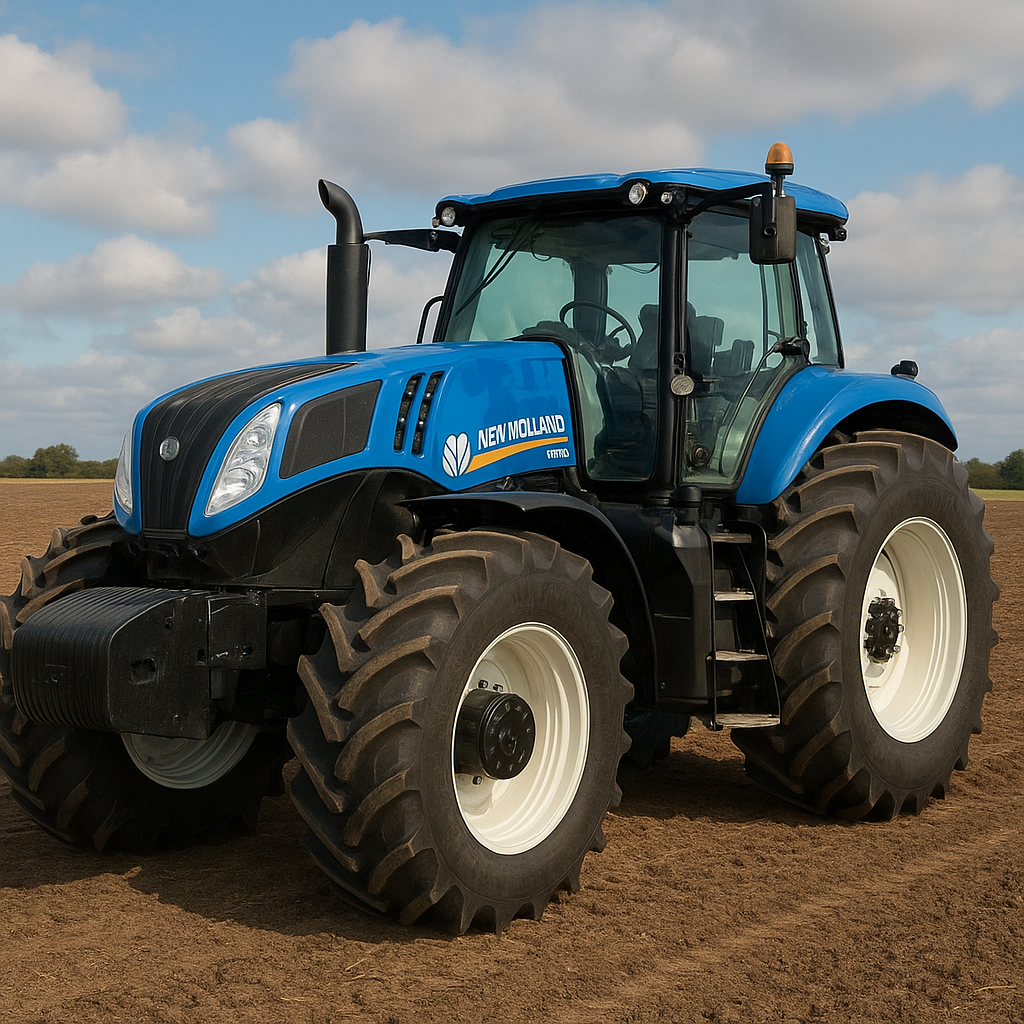
The New Holland T8.300 is a heavy-duty row-crop and high-horsepower tractor designed to bridge the gap between field efficiency and on-road transport capability. Combining modern engine technology, advanced transmission systems and operator-focused features, the T8.300 is aimed at contractors and large-scale farmers who need a machine that delivers sustained power, precise control and broad implement compatibility. Below you will find a detailed overview of its design, typical technical data, applications and operational advantages, along with practical information useful for buyers, operators and fleet managers.
Design philosophy and engineering highlights
New Holland built the T8 series to deliver a balance of power and versatility, with particular attention to fuel efficiency, operator comfort and modularity. The T8.300 sits near the middle-top of the T8 range as a high-capacity model suitable for heavy tillage, large seeding operations and high-speed transport. Key engineering goals included durable drivetrain components, user-friendly controls and electronic systems that allow integration with precision farming tools.
Powertrain and engine layout
The T8.300 is commonly equipped with an FPT (Fiat Powertrain Technologies) six-cylinder engine in the mid-to-high displacement class. While exact figures can vary by production year and regional specification, typical characteristics include:
- Approximate rated power: around 300 hp (ISO), with higher peak outputs under certain conditions.
- Engine displacement: typically in the range of 8–9 liters depending on generation and emissions package.
- Modern aftertreatment for emissions control (SCR, DPF) to meet Stage IV / Tier 4 final standards in many regions.
These engine features are designed to provide high low-end torque for draft applications while maintaining fuel economy during transport and light work. Electronic engine management optimizes response during heavy loads and when coupled with hydraulically driven implements.
Transmission and driveline options
One of the standout aspects of the T8 series is the availability of advanced transmission systems. The T8.300 is frequently offered with New Holland’s Auto Command continuously variable transmission (CVT) as an option, or with other multi-range powershift/IVT-style solutions depending on the year. These transmissions deliver smooth power transfer, improved fuel economy and precise ground-speed control for tasks like seeding or slurry application.
- Common transmission features: Auto Command CVT or equivalent high-efficiency powershift, enabling seamless speed changes and cruise control for field and road work.
- High-capacity axles and four-wheel drive, providing traction and load-bearing capability for heavy implements.
- Optional front suspension systems to improve ride quality and reduce implement shock loads.
Performance specifications and typical numbers
Below are representative performance figures and capacities for the New Holland T8.300. These values are indicative and can vary by configuration, model year and market. Always consult the manufacturer’s specification sheet for the exact machine you are considering.
- Engine power: Typically around 280–320 hp (ISO) depending on rating method and boost strategies.
- Maximum torque: Often in the range of 1200–1500 Nm (approximate), designed to provide steady draft pull and consistent PTO power.
- Displacement: Approximately 8.0–9.0 liters for the six-cylinder engine family commonly used in the series.
- PTO options: Rear PTO speeds usually 540/1000 rpm; some configurations may offer ground-speed PTO or economy PTO settings.
- Hydraulic system flow: Standard open-centre or closed-centre hydraulics providing around 120–190 L/min, with optional higher-flow packages up to ~220 L/min for implement-demanding operations.
- Rear hitch lift capacity: Typical range 8,000–12,000 kg depending on specification and hitch design.
- Fuel capacity: Fuel tanks commonly range from 500–800 L in factory configurations aimed at long field days and transport sectors.
- Weight: Operational mass often falls between 9,000 and 11,500 kg, influenced by tyre/wheel configuration and ballast.
- Top transport speed: Road speeds up to 40–50 km/h depending on gearbox and regional homologation.
These specifications demonstrate the T8.300’s focus on sustained high-power applications. The substantial hydraulic flow and hitch capacity allow the tractor to operate large seed drills, cultivators, planters and heavy tillage equipment while maintaining operational stability and control.
Applications and operational use cases
The New Holland T8.300 is designed to serve a broad range of tasks on modern commercial farms and contracting fleets. Because of its combination of high power and roadability, this model excels where both field throughput and on-road transit speed matter.
Primary farming uses
- Heavy tillage: large ploughs, discs and cultivators benefit from the T8.300’s torque and hitch capacity.
- Seeding and planting: wide drills and planters can be run efficiently thanks to steady ground speed control through Auto Command transmission and high hydraulic flow for implement demands.
- Harvest support and transport: effective for hauling grain trailers or pulling large header trailers between fields and storage.
- Baling and forage: power and hydraulic support are suitable for large balers, forage harvesters (as a tractor-mounted platform or transporter) and heavy loading work.
Contracting and mixed-use scenarios
Contractors value the T8.300 because it reduces cycle times — heavy implements can be pulled at working speeds while the tractor still manages road transits efficiently. Large farms that seasonally switch between tillage, planting and haulage similarly benefit from the model’s broad capability set.
- Seeder and sprayer platforms: stable cruising and precise speed control enable high-quality chemical and seed placement.
- Loader work and material handling: front loader configurations can be specified for farmyard, feedlot and construction-like chores.
- Specialist attachments: from subsoilers to heavy rollers and coulter systems, the T8.300 supports a wide implement ecosystem.
Operator environment and technology
New Holland focused on reducing operator fatigue and maximizing productivity through ergonomic cabin design, advanced suspension and integrated technology suites. The T8.300’s cab features options to integrate telemetry, auto-steering and precision guidance systems that are now common expectations for high-output tractors.
Cab comfort and controls
- Spacious cab with climate control, low noise levels and excellent visibility for front and rear implement operation.
- Advanced seat options include active suspension seats designed to minimize vertical and lateral vibration, improving operator endurance over long shifts.
- Intuitive armrest consoles and joystick controls for hydraulics, hitch and transmission functions reduce the learning curve and improve task execution.
Precision farming and connectivity
T8.300 tractors are commonly equipped or retrofittable with New Holland PLM (Precision Land Management) systems, offering:
- Autosteer capability for improved overlap reduction and higher seeding/spraying accuracy.
- Telematics and remote monitoring for fleet management, maintenance scheduling and performance logging.
- Variable-rate control and implement guidance integration to maximize input efficiency and crop performance.
Maintenance, operating costs and resale considerations
For high-horsepower tractors like the T8.300, maintenance strategy and lifecycle costs are critical. New Holland’s design aims to minimize downtime with accessible service points and modular components.
- Routine service: long service intervals for engine oil and filters are common for modern machines, but high-load operations will accelerate wear on drivelines and hydraulics.
- Fuel economy: while absolute fuel consumption is significant for ~300 hp machines, optimized engine maps and transmission coordination can deliver favorable fuel per hectare numbers versus older technologies performing the same task.
- Resale: T8 series tractors hold value well in markets with demand for large, versatile tractors; documented maintenance history and telematics records tend to preserve resale price.
Tip for fleet managers: track fuel consumption and implement compatibility closely; the highest efficiency comes from matching the tractor to the correct implement and using precision farming tools to reduce unnecessary passes.
Safety, regulations and environmental aspects
Compliance with emissions regulations is a key part of the T8.300 design. Aftertreatment systems such as selective catalytic reduction (SCR) and particulate filters are usually integrated to meet the latest standards where sold. Noise reduction and operator safety features (Rollover Protection, excellent lighting packages for night work, and robust braking systems) are also part of the specification.
- Emissions: Engine aftertreatment systems reduce NOx and particulates to comply with regional standards (Stage IV/Tier 4 Final or equivalent).
- Active safety: braking systems and stability control for on-road use, along with lighting and camera options for blind-spot reduction.
Comparative strengths and buyer guidance
When evaluating the T8.300 against competitors, consider these strengths:
- Versatility: strong mix of field power and transport speed.
- Transmission: advanced CVT/Auto Command options deliver superior ground-speed control and smoother operation compared with traditional powershifts.
- Hydraulics: high-flow hydraulic options make it suitable for modern, hydraulically demanding implements.
- Reliability: robust axle and chassis components designed for heavy use minimize unplanned downtime when properly maintained.
Buyer guidance:
- Choose a configuration that matches the predominant work: higher hydraulic flow and heavier axles for large planters and air seeders; simpler configurations for mainly transport-focused use.
- Consider telematics and guidance packages as standard when precision farming is part of your operation — these features often pay back by reducing input overlap and optimizing field time.
- Verify local dealer support for parts and scheduled maintenance, especially for emissions-related components which may require specialized service.
Real-world usage examples and case studies
In commercial practice, the T8.300 is often cited for:
- Large cereal farms using 6–12 m drills at high forward speeds, where stable ground speed and consistent PTO and hydraulic performance improve seeding quality.
- Contracting businesses performing multi-day tillage blocks: the tractor’s fuel capacity and comfort package reduce operator changeovers and refueling stops.
- Mixed arable and livestock operations requiring a tractor that transfers easily from fieldwork to loader work and transport duties without incurring double-tractor costs.
Operators report that the improved ride dynamics and precise speed management available with Auto Command reduce implement wear and improve overall throughput per hour compared with preceding generation models.
Final notes on ownership and long-term value
Owning a New Holland T8.300 means investing in a high-capacity platform that prioritizes continuous productivity and operator efficiency. To maximize return on investment, it is recommended to:
- Maintain a strict preventive maintenance schedule and keep electronic records (telemetry can help automate this).
- Match implements to the tractor’s capabilities rather than overspecifying or underspecifying — correct matching reduces fuel use and mechanical stress.
- Take advantage of precision agriculture options to reduce input costs and increase yield per hectare.
The T8.300 serves best where both field performance and road capability are required from a single machine. Its combination of power, advanced transmission options and integrated technology platforms make it a compelling choice for large farms and contractors seeking a durable, efficient and flexible tractor solution.