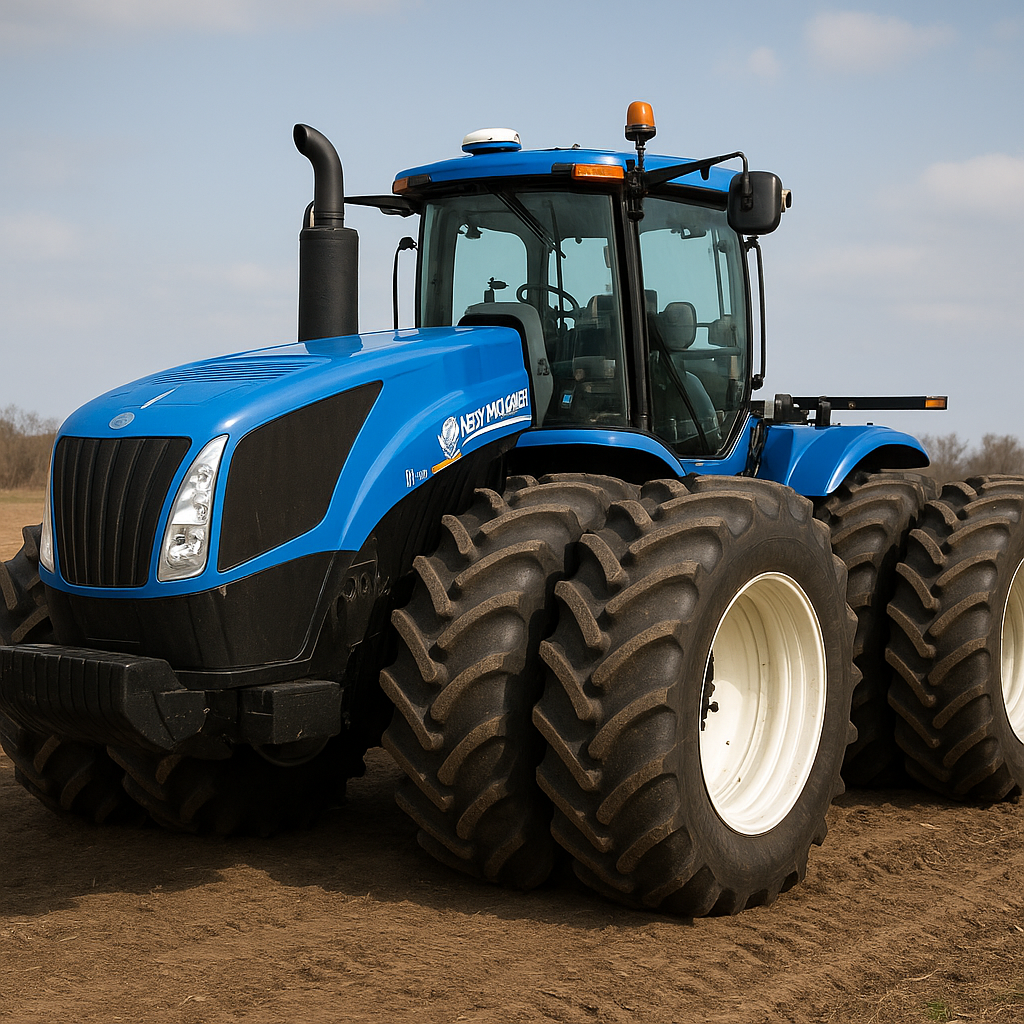
The New Holland T9.505 is a flagship articulated 4WD tractor designed to meet the demands of large-scale and intensive farming operations. Combining robust mechanical design, modern emissions systems and a range of precision-agriculture options, the T9.505 is positioned for heavy draft work, large implement towing and high-hour applications. Below you will find a detailed overview of its design, typical applications, technical characteristics, operator-focused features and considerations for purchase and operation. The text includes practical statistics and contextual performance notes where available.
Design and engineering overview
The T9 Series represents New Holland’s response to the market for high-horsepower, articulated tractors aimed at growers and contractors who require sustained traction and pulling power. The T9.505 designation corresponds to a machine with a nominal output usefully placed in the 500-horsepower class, engineered to combine raw pulling capability with modern efficiency and emissions controls.
Chassis and drivetrain
- The T9.505 uses an articulated chassis with a full-time four-wheel drive layout designed to maximize ground contact and straight-line stability when towing heavy implements. This layout helps distribute weight across a large contact patch, improving traction and reducing soil compaction under many conditions.
- Transmission options for T9 tractors typically include step/shift or continuously variable style solutions optimized for heavy draft work and load control. These drivetrains are designed to deliver smooth forward progress and maintain implement speed under load for improved field performance.
- Heavy-duty axles, differential locks and selectable traction control systems are integrated to give operators control in variable field conditions and on slopes, increasing operational uptime in wet or challenging soils.
Engine and emissions
New Holland equips its large tractors with high-displacement diesel engines that meet contemporary emissions regulations. Engines in this class are designed to deliver strong low-end torque for working implements such as deep rippers or large cultivators while using after-treatment systems (such as SCR and particulate filtration) to comply with Tier/Stage emissions requirements.
- The T9.505 has a manufacturer rating that corresponds to approximately 505 hp at the flywheel (ISO) in standard configuration; depending on model year and boost management, peak or transport outputs may be higher.
- High-capacity cooling and robust fuel systems allow sustained high-load operation during long days of heavy field work.
Primary applications and typical use cases
The T9.505 is engineered for operations that require continuous high-power performance, traction and the ability to handle very large implements. Its principal applications include:
- Tillage: Primary tillage with large ploughs, cultivators and multi-share units. The T9.505 is used where deep, wide-depth tillage is needed across large acreages.
- Seeding and planting: Pulling wide air seeders, multi-row planters or high-capacity seed drills at field speeds that maximize daily output.
- Precision nutrient and chemical application: When mounted with heavy booms and tanks, the tractor’s stability supports accurate application of fertilizers and crop protection products over large areas.
- Heavy transport and hauling: Moving trailers loaded with grain, fertilizer or equipment on-farm and between fields, where high torque and braking capacity are required.
- Specialist tasks: Land reclamation, drainage installation and machinery pulling in contracting or large estate settings.
Large-scale farmers and contractors typically choose tractors like the T9.505 where piece-rate productivity, fuel efficiency per hectare and the ability to finish jobs in tight weather windows are critical.
Performance figures and technical statistics
Below are the most relevant performance metrics and technical figures commonly associated with a 500-class articulated tractor such as the T9.505. Figures can vary by model year, market, and optional equipment; use manufacturer documentation for exact numbers for a specific unit.
- Nominal engine power: approximately 505 horsepower (ISO) — this is the baseline rating used in the model name and marketing materials.
- Peak/boost power: many tractors in this class can develop additional peak power during transport or PTO/impeller demand; depending on configuration this can add several percent above the nominal rating.
- Torque: typical maximum torque figures for engines in this class generally fall in the range of 2,200–2,800 Nm (approx.), delivering strong drawbar performance at low engine speeds.
- Operating weight: curb-to-operational weights for a T9-class machine typically range between 16,000–22,000 kg depending on ballast, wheels/tracks and attachments.
- Fuel tank capacity: large-capacity tanks (often 1,000+ liters on heavy tractors or with optional extended tanks) to support multi-hour field days between refuels.
- Hydraulic flow: multiple high-flow hydraulic circuits providing several hundred liters per minute for large planters, air carts and lifted implements.
- Maximum drawbar pull and PTO capabilities: designed to handle large implements; PTO power ratings typically align with engine output and are delivered via heavy-duty PTO shafts and driveline components.
These technical parameters help explain why this tractor is chosen where high daily outputs and consistent, heavy-duty operation are economically justified.
Cab, controls and operator-focused technology
Operator comfort, ergonomics and machine intelligence are important elements in the design of a high-hour tractor. In the T9-series class you will commonly find a suite of features intended to maximize productivity and reduce operator fatigue.
- Spacious, climate-controlled cabs with low-noise levels and premium seating reduce fatigue on long days. Seats are typically air-suspended with multiple adjustments.
- Integrated touchscreen displays and multifunction joysticks provide easy access to transmission, hydraulics and precision-agriculture systems. Systems are configurable to tailor responses for different implements.
- Precision farming packages (often branded under New Holland’s PLM — Precision Land Management) provide optional AutoGuidance, section control, variable-rate applications and automated headland management routines, boosting field efficiency and reducing overlaps.
- Telematics and remote monitoring capabilities (e.g., MyPLM Connect or similar) are commonly available to allow fleet managers to monitor fuel use, location, maintenance reminders and performance remotely, helping improve fleet utilization and reduce downtime.
These technologies combine to improve both on-field accuracy (reducing input waste and overlap) and operator productivity during long shifts.
Efficiency, economy and environmental considerations
When evaluating a high-horsepower tractor like the T9.505, farm managers and contractors look beyond peak power to metrics such as fuel use per hectare, implement matching efficiency and lifecycle cost. The T9.505 is engineered with a focus on:
- Fuel efficiency: modern engine management and torque curves are tuned to provide efficient power delivery under load, which can reduce liters-per-hectare compared to older, less efficient machines.
- Emissions compliance: contemporary after-treatment systems (SCR, catalytic converters and particulate filters) allow the tractor to meet strict emissions standards while maintaining performance.
- Implement matching: correct matching of implement size and tractor ballast can maximize field efficiency and minimize unnecessary fuel consumption and soil compaction.
Operational efficiency is also influenced by non-engine factors such as transmission control algorithms, auto-guidance accuracy and hydraulic system responsiveness — all of which are important in the T9 product philosophy.
Maintenance, serviceability and lifecycle support
Reliability and easy maintenance are crucial for a machine that may operate long days during peak season. New Holland’s heavy tractors are built with service access and dealer support networks in mind:
- Routine service points such as filters, fluid drains and inspection ports are located for accessibility, reducing service time during maintenance windows.
- Diagnostic systems and onboard fault logging help technicians quickly identify and remedy issues, minimizing downtime.
- Availability of OEM parts, extended warranty packages and service contracts through dealer networks can be decisive for contractors who cannot tolerate lengthy breakdowns during busy periods.
Variants, options and customization
The T9.505 is typically offered with a range of factory and dealer-fitted options allowing operators to tailor the tractor to specific needs:
- Wheel or dual-wheel configurations to distribute weight and reduce soil compaction.
- Track systems for improved traction and flotation in soft soils or where compaction is particularly critical.
- Different cab packages and technology bundles (guidance, telematics, additional displays).
- Hydraulic packages and hitch options to match specialized implements.
These choices allow the same base tractor to be optimized for varied roles, from straight draught work to heavy planters or specialist contractor duties.
Real-world performance and operator feedback
Farmers and contractors running tractors in the 500-horsepower class report that the primary benefits are in reduced field hours per hectare and the ability to complete larger jobs within smaller weather windows. Common themes in feedback include:
- High sustained pulling power and low-end torque give reliable performance while minimizing the need to downshift under stubborn loads.
- Comfortable cabs and intuitive controls reduce operator fatigue during long operations.
- Integrated precision systems save inputs and improve repeatability of operations.
- Fuel consumption per hectare is often lower in modern machines versus older high-horsepower tractors when implementing matched combinations and optimized field practices.
Market positioning, competitors and resale considerations
In the market for large articulated tractors, the New Holland T9.505 competes with similar models from other major manufacturers. Buyers often consider the following when choosing between brands:
- Initial acquisition cost vs. expected lifetime productivity gains.
- Dealer support, parts availability and service contracts in the buyer’s region.
- Brand familiarity and operator preference for cab layout or control philosophy.
- Resale values and secondary market demand for specific size and capability classes.
Resale values for well-maintained, high-capacity tractors remain relatively strong because they serve specialist niches where demand outstrips supply in many regions.
Safety, regulations and operator training
Operating a high-horsepower articulated tractor requires adherence to safety and regulatory norms, including:
- Appropriate training for the operator on hitching, ballast management and load limits.
- Understanding transport safety practices — these machines are heavy and wide; safe transport requires proper lights, signage and weight distribution.
- Compliance with emissions and noise regulations in different markets; after-treatment systems must be maintained to remain compliant.
Manufacturer and dealer-supplied training and documentation are important parts of safe and productive operation.
Case scenarios: how the T9.505 adds value
Large arable farm — spring planting window
On a large arable farm with thousands of hectares to plant, one or two T9-class tractors can dramatically shorten the planting window. By coupling a high-capacity air drill to the T9.505 and using AutoGuidance and section control, a contractor can plant more hectares per day with reduced overlap and lower operator strain. The economics come from reduced labor hours, lower overlap waste and the ability to complete planting while soil moisture conditions are optimal.
Contracting business — heavy tillage and transport
A contractor specializing in heavy tillage benefits from the tractor’s ability to pull wide ploughs or deep rippers without needing multiple passes. Matched to a heavy-duty implement, the T9.505 reduces fuel consumption per hectare compared with running multiple smaller tractors and saves time. The tractor also serves in transport roles, hauling large trailers between fields and depots.
Buying considerations and total cost of ownership
When considering the purchase of a T9.505, weigh the following factors:
- Match implement size to tractor capability — oversizing leads to wasted fuel and unnecessary soil wear; undersizing wastes potential productivity.
- Calculate fuel consumption relative to productivity gains. Modern tractors can be more fuel-efficient per hectare than older units despite higher peak horsepowers.
- Consider financing and residual values — large tractors are capital intensive, but for high-output operations they can pay back through increased capacity.
- Factor in telematics and precision packages in the purchase — these can reduce input costs and improve field efficiency, often repaying their cost over seasons.
Concluding remarks
The New Holland T9.505 is a purpose-built high-horsepower tractor suited for operators who require sustained pulling power, robust implement compatibility and modern precision-agriculture integration. With approximately 505 hp as its baseline rating, a focus on efficiency, traction, operator comfort and advanced technology packages make it a compelling choice for large farms and contractors. Buyers should evaluate specific model-year specifications, dealer support in their region and the best implement match to ensure they maximize the tractor’s productivity and manage total cost of ownership. Properly matched and maintained, a machine in this class can significantly increase seasonal throughput, reduce labor pressure and deliver measurable gains in field operations.