Transporting massive agricultural machines such as the latest high-horsepower tractors across continents involves intricate planning and robust equipment. Over the past decades, manufacturers and freight forwarders have developed refined processes to handle these behemoths. This article explores the technical challenges, strategies, and equipment employed to ensure safe, timely deliveries of the world’s largest tractors.
Understanding the Dimensions and Weights
The largest modern tractors can exceed 12 meters in length, 4 meters in width, and weigh more than 20 metric tons. Prior to shipping, each unit undergoes a thorough dimensional survey. Freight engineers record height, width, overall length, and weight distribution across axles. This data is vital for selecting the correct carrier and shipping method. For example:
- John Deere 9RX series: length 12.2 m, width 4.1 m, weight 22 t
- Case IH Magnum 380: length 9.7 m, width 3.9 m, weight 18.5 t
- New Holland T9.645: length 11.8 m, width 4.2 m, weight 21.7 t
Precise measurements are essential for containers clearance, crane capacity planning, and legal approval for road transport. Many nations impose strict size and weight limits on highways, requiring permits for oversized loads. Freight managers must coordinate with local authorities to secure these clearances.
Packaging and Preparation Procedures
Pre-shipment preparation includes a series of steps to protect sensitive components and ensure handling safety:
- Component Securing: Tires are chocked and axles immobilized to prevent rolling during transit.
- Protective Wrapping: High-risk areas such as radiators, lights, and electronic consoles receive custom shrink-wrap or foam padding.
- Fluid Stabilization: Hydraulic oils and fuels must comply with international safety standards. Tanks are either drained to quasi-empty or fitted with sealed caps.
- Disassembly: In some cases, large implements or dual wheels are detached to meet cargo dimension limitations. This requires reassembly instructions and part labeling.
Throughout these steps, regulations governing hazardous materials and environmental protection are strictly observed. Documentation includes Material Safety Data Sheets (MSDS) for any chemicals on board.
Choosing the Most Effective Transportation Method
Deciding on sea, rail, or road freight depends on the origin, destination, schedule, and cost constraints. Each method has unique advantages and challenges in transportation:
- Roll-on/Roll-off (Ro-Ro): Ideal for fully assembled tractors. They drive onto the vessel via ramps. Ro-Ro ships simplify loading but require compatible port infrastructure.
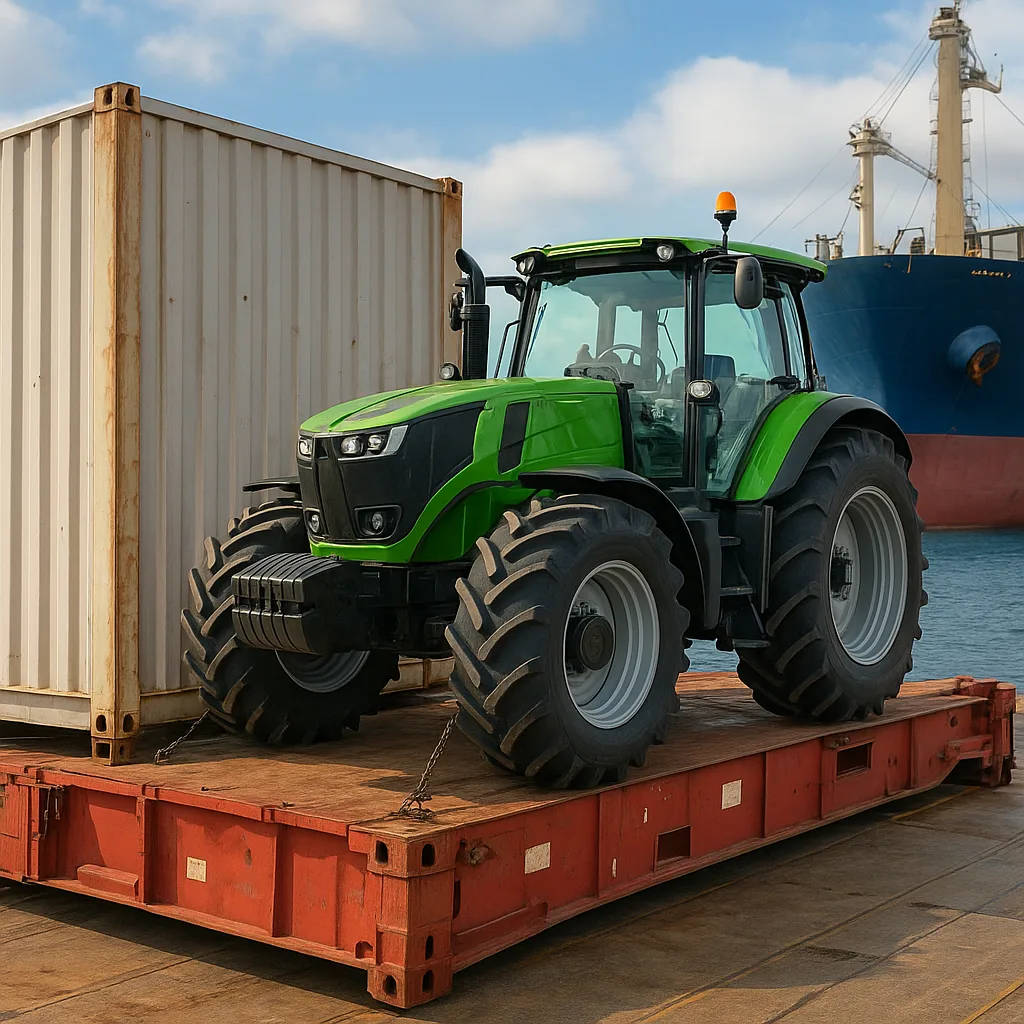
- Breakbulk Vessels: Used when port constraints prevent Ro-Ro access. Cranes lift the tractor onto the deck using custom spreader bars and lifting points on the chassis.
- Flat-Rack Containers: For mid-sized tractors that fit within flat-rack dimensions. Offers protection from sea spray and easier stowage planning.
- Multi-Axle Hydraulic Trailers: Employed for overland transport of giants. These trailers distribute weight evenly and can adjust height dynamically.
- Rail Freight: Viable for landlocked routes where gauge and bridge capacities align with tractor dimensions. Specialized wagons with reinforced decks carry the heavy loads.
Shipping lines often provide specialized services combining sea and rail to optimize routes. For instance, a tractor from Germany to Australia may travel by rail to a North Sea port, by Ro-Ro vessel to Singapore, and by flat-rack container feeder ship to Australia.
Securing Loads and Onboard Safety
Once at the port, tractors are carefully positioned on the vessel deck or inside the cargo hold. Crew members apply the following techniques:
- Lashing points on the tractor frame are reinforced to attach heavy-duty straps or chains.
- Blocking and Bracing: Wooden beams and steel supports are anchored to prevent any movement under rough sea conditions.
- Monitoring Devices: Vibration and tilt sensors may be installed to track load stability in real time.
Vessels with dynamic positioning systems further reduce load shift by maintaining heading and minimizing rolling motion. Insurance underwriters often require proof of these security measures before coverage is activated.
Customs, Documentation, and Regulatory Hurdles
Clearing large agricultural machinery through customs involves detailed paperwork and compliance checks. Key documents include:
- Commercial Invoice specifying unit value, serial numbers, and supplier details.
- Packing List with dimensional data and disassembly parts inventory.
- Certificate of Origin establishing the manufacturing country for duty calculation.
- Pre-Shipment Inspection Reports (PSI) if required by the importing nation.
- Import Licenses or permits for heavy-duty equipment.
Import duties can range from 0% for equipment under development aid programs to over 30% for commercial imports. Harmonized System (HS) codes for agricultural machinery must be correctly applied to avoid delays and penalties. Customs brokers coordinate with port authorities to schedule inspections and release the cargo swiftly.
Handling at Destination and Final Delivery
Upon arrival at the destination port, the reverse of loading procedures takes place. Key steps include:
- Disembarking using roll-off ramps or shipboard cranes.
- Customs and quarantine inspection if the destination enforces biosecurity measures for soil contamination.
- Reassembly of any detached implements and reinstallation of protective coverings.
- Quality control checks, including test-drive to verify hydraulic and engine performance.
Finally, tractors are transferred to local transport providers. In many regions, efficiency demands coordination with farm contractors who schedule deliveries directly to planting or harvesting sites. GPS tracking remains active until final handover, ensuring full visibility of the shipment.
Innovations and Future Trends
The industry continually evolves with technology improvements aimed at reducing costs and carbon footprints. Emerging trends include:
- Modular machinery designs that break down into smaller, container-friendly components.
- Use of autonomous loading robots and self-docking vessels for safer port operations.
- Blockchain-based logistics platforms offering immutable shipment records and streamlined customs clearance.
- Advanced composite materials to construct lighter transportation frames without compromising strength.
These advancements promise to reshape how the world moves its largest tractors, making the supply chain faster, greener, and more reliable than ever before.