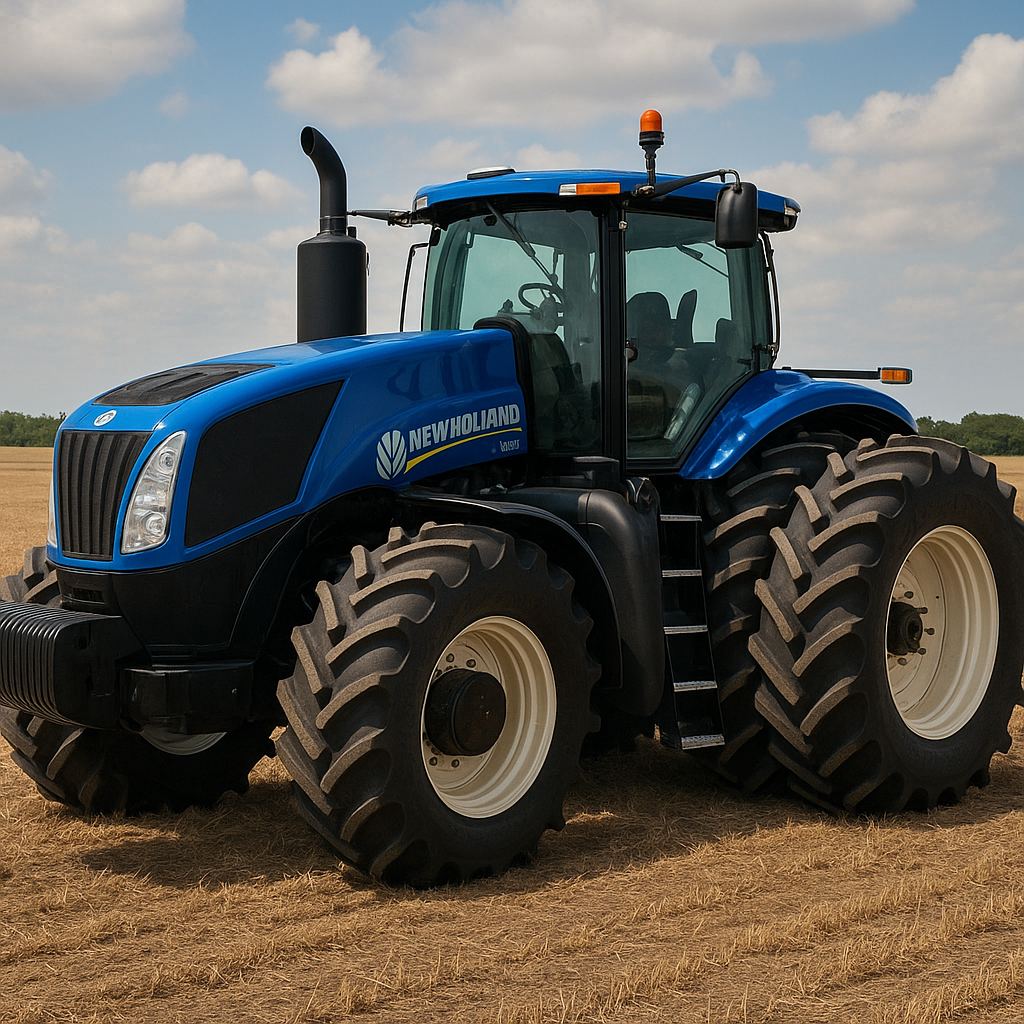
The New Holland T9.480 is a heavy-duty, high-horsepower agricultural tractor designed for large-scale farming operations and demanding field work. Combining modern engine technology, advanced transmission systems and a spacious operator environment, the T9.480 targets contractors and farmers who need sustained power, traction and productivity for tasks such as deep tillage, seeding large implements and heavy transport. This article explores the machine’s key characteristics, practical applications, technological features and operational considerations. Specifications and performance notes are given as general guidance because exact figures may vary by model year and regional configuration.
Overview of the New Holland T9.480
The T9.480 sits in New Holland’s range of articulated 4WD tractors intended for the highest power bands. Manufactured by a brand with a long history in agricultural machinery, the tractor is often chosen where continuous, reliable power delivery is essential. The model name indicates its position in the lineup: the number corresponds to the approximate engine output in metric horsepower. The T9.480 is therefore typically specified with around 480 mechanical horsepower (about 358 kW) at rated engine speed, providing the muscle needed to move large implements and maintain high field efficiency.
The T9 family emphasizes robustness and traction, with designs aimed at maximizing ground contact and minimizing slippage. That makes the T9.480 especially suitable for producers operating on many hectares where time, fuel and machine uptime are critical factors. The tractor’s build reflects a balance of raw power and modern emissions control systems to meet current regulatory standards.
Design and Technical Features
Engine and Emissions
The T9.480 is powered by a high-displacement diesel engine tuned for sustained torque at low-to-mid rpm ranges, which is essential for heavy draft work. To comply with modern emissions regulations, New Holland employs aftertreatment systems such as Selective Catalytic Reduction (SCR) together with particulate filtration and exhaust gas recirculation strategies depending on the market and model year. The result is a machine that delivers high output while meeting Tier 4 / Stage IV (or equivalent) standards in most regions.
Transmission and Drivetrain
One of the T9.480’s defining features is its advanced transmission. Many T9 tractors are offered with a continuously variable-type drive or stepless transmission under New Holland’s trade names, enabling seamless speed changes and optimal engine loading under varying ground conditions. This approach enhances fuel utilization and operator comfort by eliminating abrupt gear shifts during heavy operations.
- Transmission type: stepless/infinitely variable (market-dependent)
- Drive layout: articulated 4WD for excellent traction and turning radius
- Power take-off and axle ratings designed for heavy implements
Hydraulics and Hitching
To handle the large implements expected for the T9.480’s class, the hydraulic system provides substantial flow and multiple service couplers. Category-specific three-point hitches and drawbar options are rated for high loads, while electronic control systems manage draft, depth and implement functions for consistent results across varying soils.
Cab, Control and Operator Environment
The cab of the T9.480 is built for long working days. It offers broad visibility, ergonomic controls and integrated displays to monitor machine status. Sound insulation and suspension options reduce fatigue during extended operations. Telemetry and precision-agriculture interfaces are typically supported, allowing integration with GPS guidance, ISOBUS implements and remote diagnostics.
Practical Applications and Use Cases
The New Holland T9.480 is engineered for tasks where large power reserves and traction translate directly into productivity gains. Typical applications include:
- Primary tillage with large moldboard plows, subsoilers and heavy cultivators — where high draft force and consistent pulling power matter.
- High-capacity seeding and planting operations — pulling wide seed bars and high-capacity planters to cover many hectares quickly at target speeds.
- Large baling and forage operations — driving big balers, mowers and forage harvest attachments, often in combination with transport duties.
- Field transport and hauling — moving trailers or tankers loaded with grain, lime or other materials between fields and farm infrastructure.
- Specialty operations — in some regions, T9-class tractors are adapted for sugarcane, irrigation pumping, land reclamation and other heavy tasks.
In short, the T9.480 is aimed at operations where scale and continuity of work—not just short bursts of power—are the priority. Contractors and large-scale arable farms often prefer this class because the machine allows fewer passes, faster completion of large jobs and compatibility with very wide or heavy implements.
Performance, Efficiency and Economics
When evaluating a tractor like the T9.480, three commercial metrics dominate decision-making: work rate (hectares per hour), fuel economy, and lifecycle cost including maintenance and resale. The T9.480’s power and efficiency features are designed to optimize all three areas.
Fuel Use and Efficiency Strategies
Large tractors inherently consume significant fuel when undertaking heavy draft work. Manufacturers therefore emphasize efficient engine maps, transmission tuning for best torque utilization, and systems that allow the operator to set optimum ground speed rather than hold unnecessarily high engine rpm. In practice, fuel consumption will vary widely with soil type, implement size and field conditions; typical operational consumption for machines in this power class often ranges notably but is optimized by using appropriate gearing and guidance to reduce overlap and redundant passes.
Maintenance and Lifecycle
Modern large tractors are engineered for extended service intervals and simplified access to routine maintenance points. The T9.480 benefits from organized service schedules, sealed components where possible, and telematics-enabled alerts that help prevent unscheduled downtime. For contractors, machine availability is a direct revenue factor; therefore the availability of factory support, dealer networks and parts logistics plays a large role in the total cost of ownership.
- Expected advantages: high uptime, ease of service access, modular components for quick swaps
- Economic considerations: fuel and tire costs, annual maintenance, and depreciation/resale value
Technology, Precision Farming and Connectivity
Modern T9 tractors are more than brute-force machines; they are mobile computing platforms for precision agriculture. New Holland equips them with systems that allow operators to manage inputs and outputs with surgical accuracy.
GPS Guidance and Auto-Steer
Integrated guidance systems reduce overlap, increase planting accuracy and save inputs such as seed, fertilizer and fuel. Auto-steer systems also reduce operator fatigue and maintain consistent implement positioning across long hours.
Telematics and Data Management
Connectivity options allow fleet managers to monitor location, fuel usage, engine hours and fault codes remotely. Telemetry systems can send maintenance reminders, log performance data and facilitate faster troubleshooting with dealer support.
ISOBUS and Implement Control
ISOBUS compatibility ensures that implements and tractors from different manufacturers can communicate. That interoperability enables precision seeding, variable-rate application, and advanced control of planter and sprayer functions directly from the tractor’s onboard terminal.
Operator Experience and Safety
Long hours in the field demand attention to ergonomics and safety. The T9.480 places operator comfort at the forefront with features such as climate control, adjustable seating, low noise levels and logical control layouts. Visibility is aided by large glazing areas and optional camera systems, improving safety during rear implement maneuvers and road travel.
- Comfort features: air suspension seats, joystick controls, integrated touchscreen displays
- Safety features: rolling protection, lighting packages for night work, optional camera systems
- Road transport: heavy-duty braking and stability systems for highway and field transport of wide implements
Comparisons, Market Position and Alternatives
The T9.480 competes in the market for very large tractors against offerings from other major manufacturers. Buyers typically compare machine specifications (rated horsepower, torque curve, transmission type), operating economics (fuel consumption and service costs), dealer support and technological feature sets (precision farming tools, telematics). Preference often depends on existing fleet compatibility, dealer network strength and specific regional requirements such as soil types and typical implement widths.
Some alternative considerations for buyers include:
- Matching the tractor’s power curve to implement needs rather than choosing the highest horsepower available.
- Considering track vs wheel configurations; T9-series offers both in various forms, and tracks can provide lower ground pressure and improved traction in soft soils.
- Assessing total ownership costs including fuel, tyres/tracks, and maintenance rather than focusing solely on purchase price.
Maintenance Tips and Best Practices
To maximize the service life and availability of a large tractor such as the T9.480, routine practices are crucial. These include regular oil and filter changes at manufacturer-recommended intervals, monitoring and maintaining the aftertreatment system (including DEF/AdBlue where applicable), checking hydraulic and transmission fluids, and keeping cooling systems clean to avoid overheating during sustained heavy loads.
- Follow recommended service intervals and use OEM or approved parts for critical components.
- Use telematics and engine-management alerts to pre-empt issues.
- Keep software and precision-agriculture firmware up to date for best compatibility and performance.
Environmental and Regulatory Considerations
As with all modern large agricultural equipment, the T9.480’s design reflects the need to meet emissions standards while balancing productivity. Exhaust aftertreatment, fuel-efficient engine tuning and improved implement match-ups (fewer passes, optimized field operations) all contribute to a lower environmental footprint per hectare when compared with less efficient fleets. Buyers should consider local emissions rules and fuel type availability when specifying machine options.
Concluding Observations
The New Holland T9.480 is a purpose-built machine for large-scale farming and contracting operations that require continuous high power, robust traction and modern electronics for precision work. Its combination of a powerful diesel engine, advanced transmission technologies and integrated precision-agriculture systems positions it as a competitive option in the high-horsepower tractor segment. While exact specifications (fuel tank volume, weight, torque figures and auxiliary ratings) can vary by year and regional configuration, the T9.480’s core strengths are in delivering sustained field performance, operator comfort and the connectivity needed for contemporary farm management.
Potential buyers should evaluate machine size and features against implement compatibility, local service network quality and total lifecycle costs to ensure the tractor aligns with operational goals. For operations where covering many hectares quickly, reducing passes and maintaining high uptime are priorities, the T9.480 represents a capable and modern solution.